Bridge Loan vs. Sale Contingency in Boulder: A Move-Up Buyer's Real Menu
Found your next Boulder home before yours sold? The real move-up choice isn't bridge-vs-contingency; it's a menu gated by whether you qualify to carry two payments and when you can reach your equity. Here's the honest read, with the numbers.
You found the next house before yours sold. Now you're staring at a decision the internet boils down to bridge loan vs. sale contingency: an expensive loan or a weak offer. Neither feels right. A move-up agent who does this for a living doesn't start there. They start with two quieter questions. Can you even qualify to carry both homes at once? And where does your down payment physically come from, and on what day can you actually touch it? Answer those two, and the right move is usually cheaper than a bridge loan and safer than a contingency.
The 40-second answer
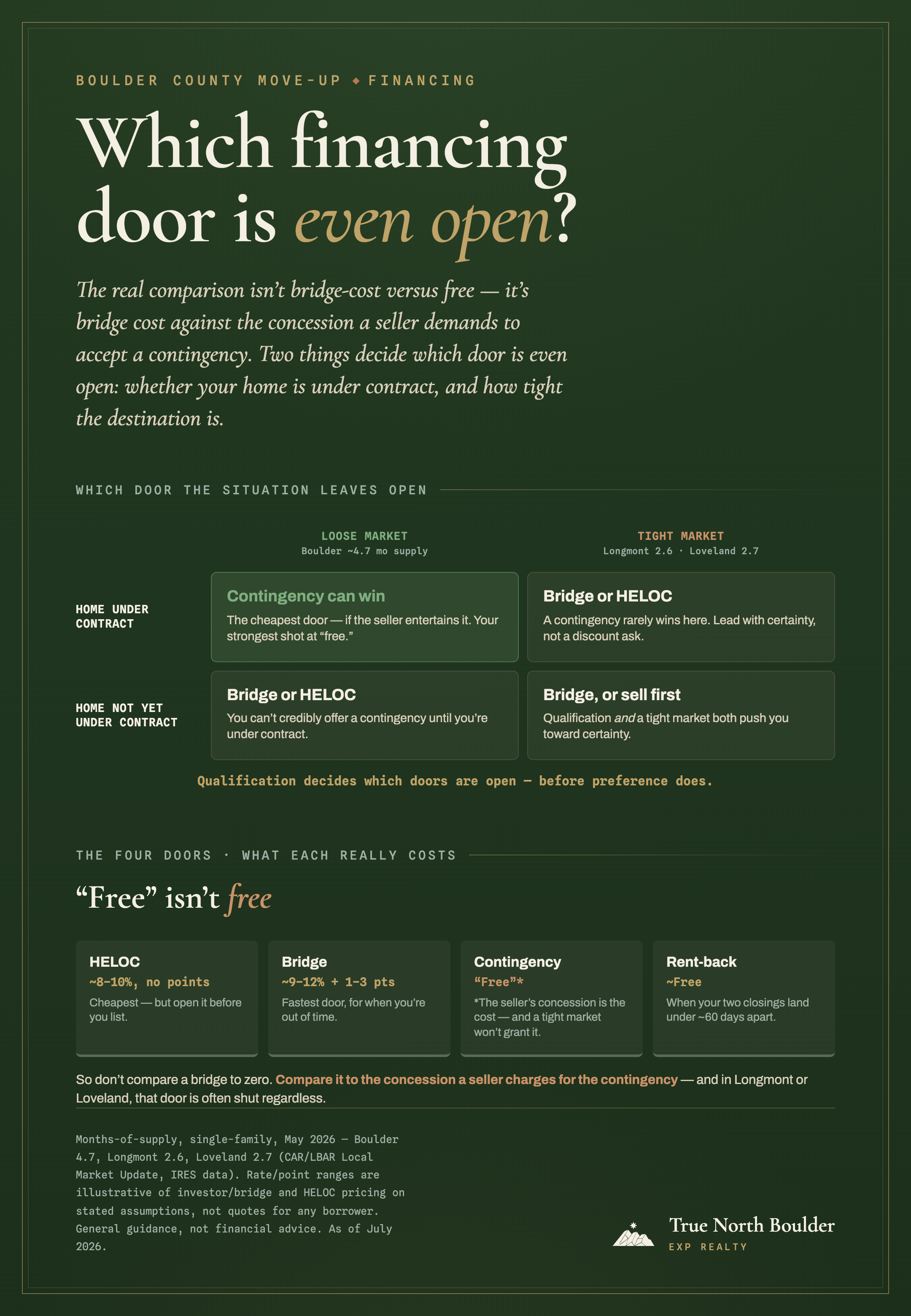
In Boulder in 2026, if you can qualify to carry both payments, the cheapest path is usually a HELOC you open before you list (roughly 8–10%, often no points), or a short rent-back between closings. A bridge loan (about 9–12% plus 1–3 points) is the fallback for when you're out of time. A sale contingency only works where the market is soft enough to accept one, and Boulder is the market where it most often can be: single-family homes take about 60 days to go under contract there, against 55 in Longmont. Which door fits you comes down to qualification, your equity timing, and exactly which neighborhood you're buying in.
First gate: can you even carry both?
Quick answer: Before any of this, your lender has to confirm you can carry your current mortgage and the new one at the same time, both payments counted against your income. At a standard 43% debt-to-income ceiling (lenders cap your monthly debt payments near 43% of your gross income), two payments of roughly $4,000 imply about $18,600 a month in gross income to clear. Plenty of equity-rich Boulder owners can't clear that on paper, which quietly takes the bridge off the table.
This is the gate generic articles skip, and it's where the equity-rich, income-tighter buyer that's common in our $800K–$1.5M band gets a surprise. There is relief. Under Fannie Mae's guidelines, a lender can stop counting your departing home's payment, but only once you have an executed sale contract with the financing contingencies cleared (Fannie Mae Selling Guide). An accepted offer isn't enough, and some loan officers get that wrong too. So the honest first step isn't choosing a product. It's a 20-minute call with a lender to find out which doors are even open to you.
The cheaper door most people miss: a HELOC you open before you list
Quick answer: A home equity line of credit on your current house runs around 8–10%, usually with no points or closing costs. That's materially cheaper than a bridge, and you draw only what you need for the down payment. The catch is all timing: most lenders won't approve a HELOC on a home that's already listed (some want it off-market for months first), so you have to open it before you go to market (The Mortgage Reports).
That single sequencing rule is the one most move-up owners learn too late. Once your home hits the MLS, your liquid options narrow fast (a cash-out refinance disappears for the same reason). A bridge loan can still advance against your equity, but it caps around 80% combined loan-to-value (all loans against the house versus its value) and stacks 1–3 points on top (Rocket Mortgage). That cap matters more than it sounds: at 80% of a $950K home, total borrowing tops out near $760K, so after your existing mortgage you may reach only part of your down-payment gap, with cash covering the rest. A stronger credit profile (roughly 740+) can lift the cap toward 90% (The Mortgage Reports). If you're even thinking about buying before you sell, opening the HELOC early costs you almost nothing and keeps the cheapest path open. One caveat: draw what you need at or before closing rather than counting on the line staying open indefinitely (a lender can freeze an undrawn line), and ask about an early-closure fee, since you'll likely pay the line off fast once your home sells.
The bridge loan: what it really costs, and what happens if your house doesn't sell
Quick answer: A bridge loan is short-term, usually 6–12 months, interest-only with a balloon at the end, priced around 9–12% plus 1–3 points. And here is the number most people get wrong: a bridge does not retire when your house goes under contract. It retires when the sale closes. Boulder's 60 days on market is list-to-contract; add another 30 to 35 days to close, and you are carrying the bridge for three to three and a half months, not two. On a $400K bridge that is roughly $11,700 in interest, plus 1–3 points, so call it $16,000–$24,000 all-in. Real money, and about double what a two-month estimate suggests.
Run it on a representative move-up rather than a brochure average, using market-accurate numbers, not a real client's file:
Say you're selling around $950K with about $500K in equity, and buying near $1.3M. That leaves a gap of about $400K. Two things fall out of that, and the second is the one nobody tells you.
The carry is longer than you think. At ~10% over the three to three and a half months a Boulder sale actually takes to close (60 days to contract, 30–35 more to closing), that is about $11,700 in interest, plus 1–3 points (~$4,000–$12,000). Call it $16,000–$24,000 all-in — roughly double what a two-month estimate suggests.
And the bridge may not even reach your gap. Most bridge lenders cap you near 80% of the departing home's value across all liens. On a $950K house that is $760K — and if $450K of first mortgage is still outstanding, only $310K is available against a $400K need. You are $90,000 short, and you find out at underwriting. Run that subtraction before you write the offer, not after.
Rates, points and the LTV cap are illustrative 2026 ranges; your lender's are the real ones.
Size in one more cash item in a tight micro-market (Longmont and Loveland, not Boulder): a bridge advances against the appraised value, not the contract price, so if the appraisal lands low, you cover that gap yourself.
The part the brochures bury is the failure path. If your old home doesn't sell before the bridge term ends, you're looking at an extension (more fees and interest), a refinance, a price cut to force a sale, or worst case, default, where the lender can foreclose on the home you were trying to sell (Rocket Mortgage). For a stretch of months you could be carrying three obligations at once: your old mortgage, the bridge, and the new mortgage. In our example that's a combined burn of roughly $8,000 a month, which is the real meter, not the points. That's the fear under the math, and it's the reason a lender wants to see your home priced to actually move before they'll write the bridge.
The sale contingency: free, but not
Quick answer: A sale contingency makes your purchase conditional on your home selling first. No double mortgage, no bridge cost. But your offer carries a kick-out clause: the seller keeps marketing, and can give you 24–72 hours to drop the contingency if a cleaner offer shows up. So it reads as a backup. And it isn't really free. A seller who accepts it usually extracts something in return, whether that's a higher price, a shorter kick-out, or a bigger earnest deposit.
Set the contingency's own ledger down before you weigh it against a loan:
Works for you
- No double mortgage, no bridge cost, so you never carry two payments.
- No qualifying to carry both homes, so a lender's 43% debt-to-income ceiling doesn't decide it for you.
- Genuinely viable out in parts of the corridor, where homes sit longer and sellers will wait.
Works against you
- The kick-out clause: the seller keeps marketing and can give you 24–72 hours to drop the contingency if a cleaner offer shows up.
- It reads as a backup, so it's slow; the seller is waiting on your sale.
- It isn't really free: a seller who accepts it usually extracts a higher price, a shorter kick-out, or a bigger earnest deposit.
- In tight markets it loses to a clean offer. Longmont, at 2.6 months of supply, is that market. The city of Boulder, at 4.7 months, is not.
So the true comparison isn't "bridge cost vs. free." It's the bridge cost against the concession a seller demands to live with your contingency, and whether they'll accept it at all. That last part is a market question, not a personality question, which brings us to Boulder specifically.
Bridge loan vs. sale contingency in Boulder: which wins where (2026)
Quick answer: A contingency only flies where homes sit long enough that a seller will wait, and in this corridor, that market is Boulder, not the towns north of it. Boulder single-family runs 4.7 months of supply and 60 days on market (CAR/IRES, May 2026), looser than Longmont (2.6) or Loveland (2.7). A Boulder seller looking at your contingent offer does not have three clean backups waiting. Longmont is the tight side, 2.6 months, the lowest supply in the corridor, and that is where a contingency usually loses. So the answer inverts depending on which way you are moving, and it is the opposite of the story most people tell about this market.
The honest take
You may have seen a headline that Boulder home values "fell 17%." They didn't. That's a blended median dragged down by a shift in what sold (more condos), not a drop in any given house's worth. Don't let a scary headline stampede you into a rushed bridge loan on a market that isn't actually falling.
The micro-market matters far more than the headline, and it runs opposite to the usual story. Longmont's single-family supply is 2.6 months, the tightest in the corridor, while Boulder's is 4.7, looser than Longmont or Loveland (only Berthoud, at 5.4, runs looser) (CAR Local Market Update, IRES data, May 2026). So the contingency that gets refused in Longmont is the same contingency a Boulder seller may well take. Buy north and you probably need the money settled before you write; buy in Boulder and you have room to breathe.
Here's the split (CAR Local Market Update, IRES data, May 2026):
| Path | Rough cost | Speed | Needs you to qualify for two? | Best when |
|---|---|---|---|---|
| HELOC (pre-listing) | ~8–10%, no points | Fast if opened early | Often yes | You plan ahead and have equity |
| Bridge loan | ~9–12% + 1–3 pts | Funds ~2–4 weeks | Yes (or executed sale) | You're out of time, buying in a tight market |
| Sale contingency | "Free" + a seller concession | Slow (seller waits) | No | The market is soft enough to accept it |
| Rent-back / timing | ~Free | N/A | No | Your two closings are ≤~60 days apart |
One clarification on that word "clean." A HELOC or bridge lets you drop the sale contingency without dropping your other protections. You can still keep the loan and appraisal deadlines on the Colorado Contract to Buy and Sell, and that middle rung (non-sale-contingent, but loan- and appraisal-protected) is the offer that actually wins a competitive bidding war without leaving you exposed. Waive those outs just to look stronger, and your earnest money, often 1–3% of the price, is what's at risk if your sale or financing slips.
The free fix for a short gap: a rent-back
Quick answer: If your two closings are only a few weeks apart, you often don't need any of this. A rent-back lets you stay in your old home a short while after it closes (or you get the same arrangement on the home you're buying), bridging a short gap for close to nothing. Fannie and Freddie generally cap owner-occupant rent-backs around 60 days.
It's the move a working agent reaches for before quoting bridge points, and it almost never occurs to a buyer reading a national pros-and-cons list. If the whole problem is that your two closings are ten days apart, the answer probably isn't a 10% loan.
The decision: five questions (and the one that settles it)
Quick answer: The decision comes down to five questions, in order: can you carry both payments, where and when you can reach your down payment, how far apart your two closings are, which Boulder micro-market you're buying in, and the dollar-vs-dollar tiebreak when you and your co-buyer disagree. The first one (qualification) usually settles which doors are even open.
Walk these in order:
- Can you qualify to carry both? (Lender call first. An executed, contingency-cleared sale can free your old payment.)
- Where's your down payment, and when can you reach it? Cash on hand means you may need neither product: buy clean, sell after. Equity means a HELOC if you opened it before listing, otherwise a bridge.
- How far apart are your two closings? Under ~60 days, ask about a rent-back before anything else.
- How stale is the specific listing, and is your house already under contract? A contingency is a listing call, not a market call. In tight destinations like Longmont at 2.6 months and Loveland at 2.7, a clean offer (HELOC or bridge) usually wins. A higher-days-on-market corridor pocket: a contingency can work.
- The number that ends the argument. If you and your co-buyer are split between "stretch" and "safe," put both costs on the same line: the dollar cost if you bridge and you're right versus the cost of losing the home if you play it safe and the contingency falls through (the re-search, the price drift while you start over). Same scoreboard, one decision.
Those five answers land you in one of four places:
If two payments don't clear a lender's 43% debt-to-income ceiling
The bridge is quietly off the table. A sale contingency or selling first is your track, until you have an executed sale contract with the financing contingencies cleared, which lets the lender stop counting the old payment.
If your down payment is equity and you haven't listed yet
Open the HELOC now, before you go to market (~8–10%, usually no points). Most lenders won't approve one on a home that's already listed, and that door closes the day you hit the MLS.
If your two closings are under ~60 days apart
Ask about a rent-back before you price any loan. Fannie and Freddie generally cap owner-occupant rent-backs around 60 days, and it costs close to nothing.
If you're out of time and buying into a tight market like Longmont or Loveland
That's the bridge's actual job (~9–12% plus 1–3 points): it buys the non-contingent offer a tight market demands, and in this corridor that is Longmont, not Boulder. Price it against the concession a seller would want for a contingency, then decide.
How this gets structured: the brokerage part
In Colorado, a single firm can't represent both sides as agents, so we'd work as a transaction broker, with that role disclosed in writing. And under current buyer-agency rules, you'll sign a written buyer agreement spelling out compensation before we tour homes. Commissions aren't set by law and are fully negotiable. None of that changes the math above. It just means the financing decision and the representation are handled cleanly, in writing, from the start.
See also: the full buy-before-you-sell playbook this sequencing sits inside · what $1M–$1.5M buys across the corridor if you're weighing where to trade up · and the move-up seller's side in how to sell a move-up home in Boulder · how much equity you actually need to move up · HELOC vs cash-out vs bridge, the three equity-access instruments · and executing the overlap once you own two homes.
About this data, and what it can't tell you
The supply and days-on-market figures here are town-level single-family numbers from the CAR Local Market Update (IRES data, May 2026). They are not broken out for the $800K–$1.5M band, and that matters, because the band sits on opposite sides of the two towns' medians. In Boulder you'd be shopping below the median, in its most liquid tier, while the town's 4.7 months is pulled up by luxury stock that sits for a year. In Longmont you'd be shopping well above the median, in a thinner upper tier than the town's 2.6 months suggests. The in-band figures likely converge, and may not invert at all.
Two more honest caveats. Boulder is tightening fast, 6.4 months to 4.7 in a year, so "looser" is a snapshot, not a condition, and Berthoud, at 5.4, is looser still. And the inversion holds on months-of-supply only: Boulder sells in 60 days at 98.6% of list, Longmont in 55 at 99.4%. Five days and eight-tenths of a point is not a desperate market. Treat the town figure as a probability, never as an instruction. A broker-side MLS pull is what settles the band, and we'll publish it when we have one.
The distinction that changes the whole answer
There are two contingencies, and almost every article about this collapses them into one.
A home-sale contingency says: I'll buy your house once I sell mine, and your house isn't even listed yet. That's the one sellers refuse, and it's the one a bridge loan exists to avoid.
A home-settlement contingency says: my house is already under contract, inspection and loan objection deadlines are behind me, I just need it to close. That is a completely different animal, and sellers accept it routinely, in Boulder and in Longmont, with no bridge loan at all.
So the real sequence for the hard direction is not "borrow at 10%." It's this: list your Boulder house, get it under contract, and only then write on the Longmont one, with a settlement contingency, a 45-day close, and a rent-back on the Boulder side if you need the days. That solves the timing problem for the price of some patience instead of $16,000 to $24,000.
Frequently asked
Do I even need a bridge loan, or can I use a HELOC?+
Often a HELOC. It's cheaper (around 8–10%, usually no points) and you only draw what you need. The one rule: open it before you list, because most lenders won't approve a HELOC on a home that's already on the market. A bridge loan is the fallback when you didn't open the line in time or need to close fast.
Can I qualify carrying two mortgages in Boulder?+
Only if your income supports both payments at once (roughly a 43% debt-to-income ceiling). Many equity-rich, income-tighter move-up buyers can't on paper until they have an executed sale contract with contingencies cleared, which lets the lender stop counting the old payment. Confirm with a lender before you fall in love with a house.
Will a Boulder seller accept a contingent offer in 2026?+
It depends on which town you are buying in, and the answer is the opposite of what most people assume. The city of Boulder runs 4.7 months of supply and 60 days on market (CAR/IRES, May 2026), looser than Longmont (2.6) or Loveland (2.7), so a Boulder seller has fewer alternatives and a contingent offer is genuinely viable there. Longmont is the tight side at 2.6 months, and a contingency rarely wins against a clean one. In slower-moving corridor pockets, sellers are more open to it, typically with a kick-out clause that lets them keep marketing.
What happens if my house doesn't sell before the bridge loan ends?+
You'd extend (added fees and interest), refinance, cut your price to force a sale, or worst case default, at which point the lender can foreclose on the home you were selling. It's why a bridge only makes sense when your old home is priced to actually move.
Am I stuck with the bigger payment after I buy?+
Usually not. Once your old home sells, many lenders let you recast the new mortgage: you apply the sale proceeds to the balance and re-amortize for a one-time fee, with no refinance, which drops the monthly payment. So the stretch of carrying the larger payment is temporary by design.
Do I need a buyer-agency agreement to tour homes first?+
Yes. Under current rules you'll sign a written buyer agreement, with compensation spelled out, before touring. Commissions aren't set by law and are negotiable.
The bottom line
Bridge-versus-contingency is the wrong opening question. Qualification and equity timing decide it for you: if you can carry both payments, a HELOC opened before you list (~8–10%, often no points) is usually the cheapest door, and a rent-back handles a short gap for close to nothing. A bridge (~9–12% plus 1–3 points) is the fastest door and the expensive one, for when you're out of time. A contingency only flies where homes sit long enough that a seller will wait, which, at 4.7 months of supply, describes Boulder better than it describes Longmont. Start with the lender call, not the product.
Map your move-up sequence.
We'll run your buy-and-sell sequence, and whether you even need a bridge, before you commit to anything. A 20-minute conversation, not a leap.
Daniel Hsieh is a licensed Colorado real estate broker with True North Boulder, brokered by eXp Realty. This is general information, not financial or legal advice. Confirm rates, loan terms, and current Colorado real-estate rules with a lender and your broker for your situation.