How Much Equity Do You Need to Move Up in Boulder? Run Your Real Number
If you feel stuck in a house you've outgrown, the number that decides whether you can move up isn't your home's value or your Zestimate. It's your net equity after costs, measured against the next home's real cash-to-close. Here's how to run it tonight.
You're standing in a house you've outgrown. The kids share a room, or the office is a corner of the bedroom, or you just want the yard and the light and the third bedroom you didn't need in 2012 and need now. And two thoughts are fighting in your head: we have to move and moving up right now would be reckless. One number settles that fight, and it's almost never the number you're looking at. It isn't your home's value, and it isn't your Zestimate. It's your net equity after costs, measured against what the next house actually costs you to buy. Get that number right and the rest is arithmetic, and half the time it says you're less stuck than you think.
The equity you need isn't a percentage of your current home; it's enough to cover the next home's cash-to-close. Your usable equity is your realistic sale price, minus your mortgage payoff, minus roughly 7–9% in selling costs. On a $1.3 million Boulder home, cash-to-close runs about $299,000 (20% down, a jumbo) to $459,000 (about 32% down to stay conforming). If your usable equity clears that, you can move without a bridge; if it falls short, that gap is what a bridge loan or a sale contingency covers.
Fast facts · running your move-up position
Sources: FHFA 2026 conforming loan limits (Boulder County) · IRS §121 · CAR/LBAR Local Market Update (IRES) · as of July 2026
How much equity do you need to move up? The one number that decides it
The mistake is a single one that wears two faces. You measure the wrong number. You look at what your home is worth (gross value, the Zestimate, the number your neighbor's house sold for) when the number that actually governs your move is what lands in your account after you sell and before you buy, set against what the next house demands in cash.
Call it your net equity-out: your realistic sale price, minus your mortgage payoff, minus the roughly 7-9% that evaporates in selling costs. That's the money that can actually become your next down payment. It is almost always meaningfully less than the value you're picturing, and the size of the gap is exactly what trips people up.
Measure the wrong number and you land in one of two ditches. The first is paralysis: you assume moving up needs far more than you have, so you stay in the house you've outgrown when your real position would clear the move with room to spare. The second is over-reach: you look at a Zestimate, feel like a millionaire, write the offer, and discover at the lender that your net position is six figures short of the down payment you assumed. Same error, the wrong number, pointing in opposite directions. The fix is the same for both: run the real one.
The reason the gross number misleads so reliably is that two big subtractions sit between it and your usable equity, and neither shows up on a home-value estimate. One is what you still owe: your payoff, which comes straight off the top. The other is the 7-9% that selling costs and closing quietly take before a dollar reaches your next down payment. On a home in this band, those two together routinely remove several hundred thousand dollars from the number you're picturing. That's not a reason not to move; it's the reason to start from the net figure, so the move you make is the one your position actually supports.
The four numbers to pull tonight
You can get most of the way to your real position in an evening, before you ever call an agent or a lender. You need four figures, and only four.
Your mortgage payoff, not your original loan
Call your servicer or check your latest statement for the exact payoff (it includes a little interest and any escrow shortfall). What you borrowed years ago is irrelevant; what you still owe comes straight off the top.
A realistic sale price, not the Zestimate
Ask an agent for a real comparable-sales read on your specific home in its actual condition. An automated estimate can be tens of thousands high or low, and this is the input every other number rides on.
Your target step-up price
Pick the real number you'd shop at, not the aspirational one. The whole calculation changes at the conforming limit, so the target matters.
Cash on hand you'd actually deploy
Savings you could move to a down payment, kept separate from the reserves you'll need to show. This is what covers any gap between your equity-out and the cash-to-close.
With those four numbers you can compute your net equity-out and compare it to the next home's cash-to-close. But before you do, there's a Boulder-specific twist that changes the target more than anything else on the list.
The gotcha nobody mentions: in Boulder, the loan limit sets your down payment
Everyone walks in with the "20% down" instinct. In our price band, that instinct quietly picks the wrong number, because a threshold you don't control decides how much you actually have to put down.
That threshold is the conforming loan limit: the biggest mortgage that qualifies for the standard, lightest-underwriting terms. Go a dollar over it and you're in jumbo territory, a stricter file that wants six to twelve months of mortgage payments in reserves and fuller documentation. For 2026, the conforming limit in Boulder County is $879,750 for a single-family home (Boulder is a designated high-cost county, so that's well above the $832,750 national figure; don't use the national number here).
Now watch what that does to a $1.3 million move-up.
| Path on a $1.3M step-up | Down payment | Loan(s) | Loan type | The trade-off |
|---|---|---|---|---|
| The 20% instinct | $260,000 (20%) | $1,040,000 | Jumbo | Stricter file (reserves, full docs); for a strong borrower the rate is often comparable to or below conforming. Keeps ~$160K liquid |
| Stay conforming | $420,250 (~32%) | $879,750 | Conforming | Lighter underwriting, but ties up ~$160K more cash in the down payment |
| Piggyback (80-10-10 style) | $130,000 (10%) | $879,750 + ~$290,000 | Conforming first + second | Keeps the first loan conforming and the down payment low; the second loan carries its own rate |
What that $879,750 limit really does isn't dictate a single answer; it forces a choice you didn't know you were making. Put 20% down and you've quietly picked jumbo. Put about 32% down and you've picked to tie up an extra ~$160,000 in cash to stay conforming. Or split it with a piggyback second loan and keep both the first loan conforming and the down payment low. And jumbo isn't the penalty box people assume: for a strong borrower with good credit and real assets, jumbo rates today often run comparable to or even below conforming, because banks keep those loans on their own books and compete for the relationship. So "put more down to stay conforming" is frequently the wrong move; it drains cash you'd rather keep liquid for reserves and the new house. The takeaway isn't a percentage; it's that the limit turns your down payment into a real decision, one worth a conversation with a lender rather than a 20% reflex. Run your position first, then talk paths.
Two owners, two verdicts: the same house, a different position
Say you own a Table Mesa ranch you bought in 2012. It'll sell for around $1,150,000 today, and you're eyeing a $1.3 million step-up. Selling costs run just over 8% all-in: agent compensation (negotiable), plus title and closing, prep, and prorated taxes. Call it about $95,000 on this sale. Two owners, same house, very different positions.
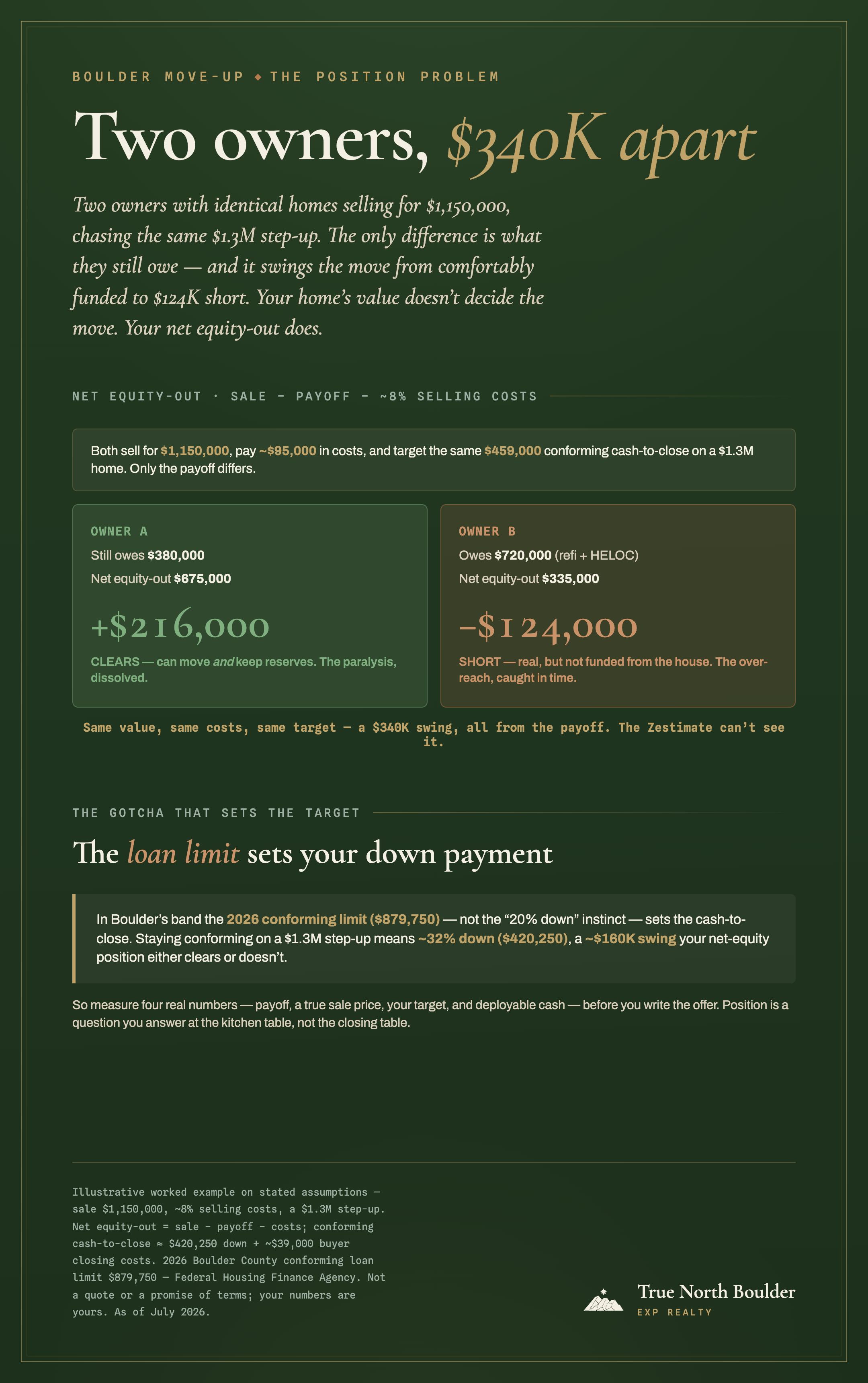
Owner A still owes $380,000. Net equity-out is $1,150,000 − $380,000 − $95,000 ≈ $675,000. The conforming cash-to-close on the $1.3M home is about $459,000 ($420,250 down plus roughly $39,000 in buyer closing costs). Owner A clears it by about $216,000, more than enough to fund the move at the conforming down payment and keep reserves in the bank. If Owner A had been anchored to "moving up needs way more than I've got," they'd have talked themselves out of a move they can comfortably make. That's the paralysis, dissolved by the real number.
Owner B owes $720,000 after a refinance and a HELOC. Same sale price, same costs, but net equity-out is $1,150,000 − $720,000 − $95,000 ≈ $335,000. Against a $459,000 conforming cash-to-close, Owner B is short by about $124,000. Drop to the 20%-down jumbo path and the cash-to-close falls to roughly $299,000, but that leaves only about $36,000, which is well under the six-to-twelve-month reserve bar on a $1.04 million jumbo loan. The Zestimate told Owner B they were a millionaire. Their position says the move is real but not funded from the house alone, and now they know it before writing the offer, not at the closing table. That's the over-reach, caught in time. Once your position is clear, the sell side of the trade is your Colorado seller net proceeds, and the buy side is whether the bigger home is actually worth the upgrade.
None of which means Owner B is stuck. The move usually survives on a lower target, on selling first so the equity is liquid before they buy, on a piggyback that shrinks the cash-to-close, on gift funds, or, most often for an owner who's asset-rich but cash-thin, on counting retirement savings toward reserves, since many jumbo lenders let roughly 60-70% of a vested 401(k) or IRA balance count. The point of running the number isn't to hear "no." It's to walk into the lender knowing which lever you're pulling.
There's one more distinction hiding in Owner B's problem, and it catches people whose equity is large but whose cash is thin. The money you hand over at closing (down payment plus closing costs) is your cash-to-close. Separate from it are reserves: liquid savings the lender wants you to document but not spend, often six to twelve months of the new mortgage payment on a jumbo loan. They're two different piles. You can have plenty of equity coming out of the sale and still stumble on reserves, because the equity is tied up in a house you haven't sold yet and the lender wants to see assets they can document today. (Those assets don't have to be cash; retirement and brokerage balances usually count, with a haircut.) When you run your position, count them separately: clearing the cash-to-close is not the same as qualifying.
And qualifying hides a second trap a cash calculation can't see. If you buy your next home before the current one is under contract with its contingencies cleared, the lender counts both mortgage payments against your debt-to-income ratio, as if you'll carry two homes indefinitely. Plenty of move-up owners clear the cash-to-close and still hear "no" for this reason alone. It's a debt-to-income problem, not a cash problem, and it's invisible on an equity ledger. It's also one more reason the sequence (buy first or sell first) is its own decision, separate from whether you have the money.
Neither owner is stuck or reckless. Each just needed the number that tells them which one they are.
What quietly eats your net equity-out
Two things shrink the gross number into the real one, and both surprise people.
The first is selling costs, that 7-9% all-in. It's agent compensation (which is negotiable and, since the 2024 settlement, negotiated separately and off the MLS), plus title and closing, transfer costs, prep, and any concessions. We won't print a single commission rate, because there isn't one; it's yours to negotiate. But you should plug an honest all-in range into your math so the number you're counting on isn't the number before costs. The detailed sell-side picture (pricing, prep, what actually maximizes your net) lives in our guide on how to sell a move-up home in Boulder; here it's just one input.
The second is capital gains, and on a long-held Boulder home it's a real line item, not a footnote. The federal Section 121 exclusion shields up to $250,000 of gain for a single filer and $500,000 for a married couple, if you've owned and lived there two of the last five years. A home bought in South Boulder or Newlands before 2010 can have appreciated past that shield, so a slice of what looks like equity is actually a tax bill. This isn't tax advice, and every situation differs; the point is only that it can reduce your net, so run it by a CPA before you count the whole gain as spendable.
Once you know your number, the next decision isn't this one
Get your position right and you've answered the question this piece exists for: can I move up, and by how much am I clear or short? The decisions that follow are real, but they're separate, and each has its own guide.
If your equity-out clears the cash-to-close, the next question is timing: do you buy first or sell first? That's the sequencing call, and it's the whole subject of our pillar on buying before you sell in Boulder. If you're short, like Owner B, the question becomes how to bridge the gap without borrowing against a house you're about to sell, which is where a bridge loan or a sale contingency comes in; we compare them in bridge loan vs. sale contingency. And if what's really holding you back is giving up a 3% rate, that's a different math entirely; the mortgage lock-in piece runs it. What your equity actually buys across the corridor is its own question too, answered in what $1M to $1.5M buys.
Frequently asked
How much equity do you actually need to move up to a $1.3 million home in Boulder?+
Enough net equity to cover the next home's cash-to-close, not a percentage of your current home's value. Usable equity = your realistic sale price minus your mortgage payoff minus roughly 7-9% selling costs. On a $1.3 million purchase, cash-to-close runs about $299,000 (20% down, a jumbo) to $459,000 (about 32% down to stay under the conforming limit). If your usable equity clears that, you can move without a bridge; if it doesn't, that gap is what a bridge loan or a sale contingency covers.
Does a $1.3 million home in Boulder require a jumbo loan?+
It depends on your down payment. The 2026 Boulder County conforming loan limit is $879,750, so putting 20% down on a $1.3 million home ($1,040,000 borrowed) lands you in jumbo territory; staying conforming takes about $420,250 down, roughly 32%. Jumbo means a stricter file and reserves, but for a strong borrower the rate is often comparable to conforming -- so 'put more down to stay conforming' isn't automatically right. It's a lender conversation, and a piggyback second loan is a third path that dodges both jumbo and the big down payment.
Why shouldn't I use my Zestimate to figure out if I can move up?+
Because a Zestimate is a gross value estimate, and the number that governs your move is net and specific. Two things separate them: roughly 7-9% of your sale price evaporates in selling costs and payoff before a dollar reaches your next down payment, and your actual sale price may be above or below the automated guess. Anchoring to the Zestimate mis-sizes your position in one of two directions -- it can make a move you can afford look impossible, or make a move you can't quite afford look easy until you're at the closing table. Start from a real net number, not the automated one.
What's the difference between cash-to-close and reserves on a move-up purchase?+
Cash-to-close is the money you actually hand over at closing -- your down payment plus buyer closing costs. Reserves are liquid savings the lender requires you to document but not spend -- typically six to twelve months of the new mortgage payment on a jumbo loan. They're different piles: you can have enough for cash-to-close and still be short on reserves, which is a real qualification hurdle that surprises move-up buyers whose equity is large but whose cash savings are thin. Keep them separate when you run your position.
Do you pay capital gains tax when you sell a Boulder home to move up?+
Sometimes, and on a long-held Boulder home it's worth checking before you count your equity. The federal Section 121 exclusion shields up to $250,000 of gain for a single filer and $500,000 for a married couple filing jointly, if you've owned and lived in the home two of the last five years. A South Boulder or Newlands home bought before 2010 can have appreciated past that shield, so part of what looks like equity is actually a tax bill that reduces your net proceeds. Colorado taxes the gain above the exclusion at its flat rate. This isn't tax advice -- talk to a CPA before you assume the whole gain is yours to spend.
Why we can't hand you an exact number
Everything here is a method and an illustration, not your number. Your real position turns on two figures only you and your lender have (your exact mortgage payoff and your realistic sale price), so anyone who quotes you a precise "you can move up to $X" without them is guessing. Bring the four inputs above.
Selling costs are shown as an all-in range because commission is negotiable and not set by law. Capital-gains treatment depends on your ownership, filing status, and basis, so confirm it with a CPA. The conforming limit cited is the 2026 Boulder County one-unit figure ($879,750); verify the current limit at the FHFA loan-limit lookup before you rely on it.
The bottom line
Whether you can move up in Boulder isn't your home's value or your gross equity. It's your net equity-out set against the next home's real cash-to-close, and in this band the conforming limit, not your 20% instinct, sets the down payment. Run those four numbers and you'll know which owner you are.
When you want the two figures you can't self-serve, a real human read on your sale price and your net proceeds, that's the one thing we do that a calculator can't. Request a home-value and equity review: we'll pull your realistic sale price, walk your payoff and costs to a true net equity-out, and set it against your target so you know exactly where you stand before you shop. It's an honest number and a conversation, not a listing pitch. True North Boulder is a real-estate team under eXp Realty.
Sources & data notes
- Conforming loan limit: FHFA 2026 conforming loan limits, Boulder County one-unit $879,750 (a designated high-cost county; national baseline $832,750), via the FHFA loan-limit lookup. As of July 2026.
- Jumbo reserves / underwriting: general lender guidance: 6–12 months of reserves, lender-dependent.
- Capital-gains exclusion: IRS Topic 701 / IRC §121: $250,000 single, $500,000 married filing jointly, two of the last five years owned and lived in; Colorado Department of Revenue (state conformity). Not tax advice.
- Selling-cost range: illustrative all-in 7–9%; commission is negotiable and not set by law, and since the 2024 NAR settlement is negotiated separately and off the MLS.
- Home-price anchor: CAR/LBAR Local Market Update (IRES data), single-family, sold, through May 2026. The $1,150,000 sale and $1.3M target are illustrative, not a valuation of any specific home.
- Not tax or lending advice. Confirm with a CPA and a licensed lender before you rely on any figure here.