What $1M–$1.5M Buys Across the Boulder Corridor
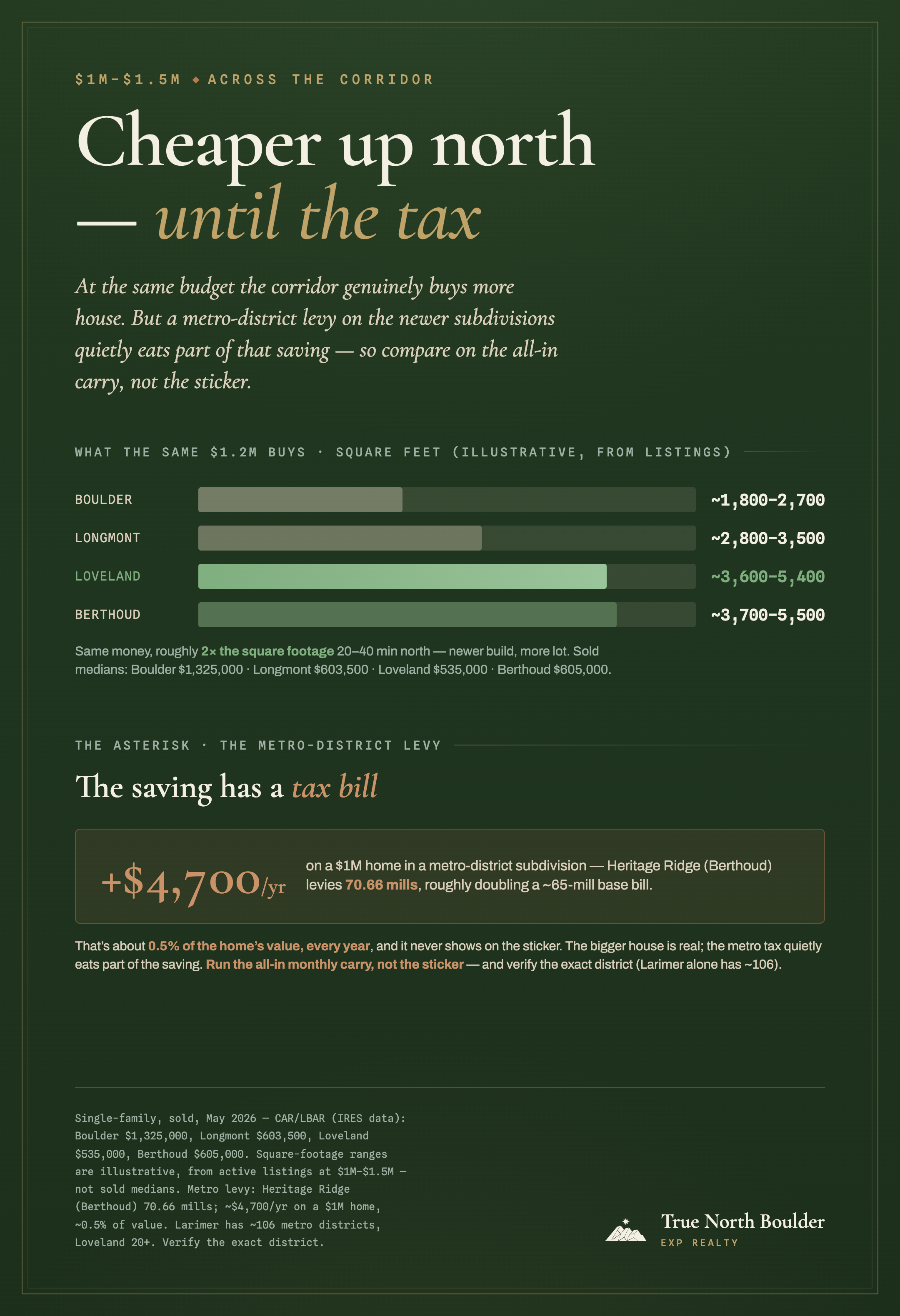
Across the corridor, $1M–$1.5M buys the location in Boulder and a lot more house north of it. But the newer Loveland, Berthoud, and SW-Longmont subdivisions move-up buyers target sit in metro tax districts that can roughly double the base mill levy. Check the tax line before you bank the savings.
For a move-up buyer, the Boulder corridor comes down to one trade: pay Boulder-city prices to stay in the walkable core, or move north to Longmont, Niwot, Loveland, or Berthoud, where $1M–$1.5M buys noticeably more house and lot. The honest question is how much of that saving you actually keep. The newer subdivisions a move-up buyer gravitates to in Loveland, Berthoud, and southwest Longmont often sit inside a metro tax district that quietly adds to the bill every year, and that changes the math. This guide runs the five towns side by side on the house, the commute, and the schools, then covers the tax catch most corridor comparisons skip.
Plenty of guides pit Boulder against one other town. Almost none run the whole corridor at a single price band through the lens that matters when you're trading up, which for most move-up buyers means buying before you sell: what does each town do to your money, your drive, and your all-in monthly cost?
Read this if
- You're weighing $1M–$1.5M across more than two corridor towns (Boulder, Longmont, Niwot, Loveland, Berthoud), not just Boulder against one of them.
- You're trading up, so the budget you're shopping with is the equity in the home you still have to sell.
- One of your finalists is a newer subdivision in Loveland, Berthoud, or southwest Longmont, where a metro-district levy can change what the home actually costs to hold.
- Your shortlist crosses school districts: BVSD, St. Vrain, and Thompson R2-J are three different districts, and the assignment is set by address, not by town.
Which corridor town gives a move-up buyer the most for $1M–$1.5M?
It depends on what you're optimizing. Boulder gives you the location and walkability at a price where $1M–$1.5M buys around or just above the city's single-family average. North of it, the same money buys progressively more house: Longmont for a middle ground, Niwot for large-lot, low-density in-band inventory, Loveland and Berthoud for the most square footage and newest construction per dollar. The trade-offs are a longer drive and, in the newer subdivisions, a metro-district tax. Here's the shape of it, town by town.
| Move-up factor | Boulder | Longmont | Niwot | Loveland | Berthoud |
|---|---|---|---|---|---|
| Single-family median (CAR/IRES, May 2026) | $1,325,000 | $603,500 | ~$1.05M (portal) | $535,000 | $605,000 |
| What $1M–$1.5M actually buys | ~1,800–2,700 sq ft, often older or smaller on a modest lot; you're buying location | ~2,800–3,500 sq ft, updated, standard lot; some acreage near the top of the band | Limited $1M+ inventory; ~3,000–4,500 sq ft on ~0.3–0.5-acre lots | ~3,600–5,400 sq ft, or 3–5 bed on acreage; newest build, most space per dollar | ~3,700–5,500 sq ft, heavily new-build (TPC/Vantage), 4–5 bed |
| Commute to Boulder core | In it | ~20–25 min off-peak; 35–45 peak | ~15–20 min | ~40–50 min | ~35–50 min |
| School district | BVSD | SVVSD | SVVSD | Thompson R2-J | Thompson R2-J |
| Property-tax catch | Base levy; metro districts rare | Older core none; newer SW subdivisions add metro levies | Established; generally no metro | 20+ metro districts (8 in Centerra) | New-build heavy; metro levies common |
| Setting | Walkable urban core, foothills | Suburban, more space | Larger lots, low volume | Lake/foothills; best value per dollar | Newest build; highest new-construction share |
Town single-family medians: CAR Local Market Update (IRES data), single-family, sold, May 2026. The $1M–$1.5M product ranges are from public listing data (Redfin/Zillow, accessed 2026-07-02) and are illustrative, not sold medians. Verify any figure and any school or tax-district assignment against current sources for the specific address.
One caveat holds across every cell: match condition and product before you call a gap. A renovated Loveland build stacked against a dated Boulder bungalow will overstate the spread. Compare like for like, and treat the product ranges above as illustrative. The town medians beside them are MLS sold figures.
The metro-district tax that narrows the corridor's savings
The catch most corridor comparisons skip is on the tax side: the newer Loveland, Berthoud, and southwest-Longmont subdivisions a move-up buyer targets often sit inside a metropolitan (metro) tax district, which stacks its own mill levy on top of your county, city, and school taxes. That extra levy can narrow, sometimes erase, the "I'll save by moving north" math before you unpack a box.
The mechanism is public. A typical Boulder County residential property carries district levies totaling around 65 mills in tax year 2025, per the Boulder County Assessor. A metro district is a separate taxing entity layered on top, and its levy can rival the entire base bill. The Heritage Ridge Metropolitan District in Berthoud levies 70.66 mills on its own, which roughly doubles that ~65-mill base. In dollars, a metro district can add about 0.5% of a home's value each year, several thousand on an $800K–$1.5M home, every year for the 20-to-30-plus years the district's bonds run. Larimer County alone has roughly 106 metro districts and the City of Loveland has more than 20 (eight in Centerra), so this is the norm for new-build inventory in the corridor, not a rare edge case.
Two moves before you count any savings. First, get the actual tax bill and the district's disclosure for the specific address, not the base county levy and not the seller's first-year bill on a brand-new home. New construction is assessed on the bare lot the first year and re-assessed with the finished house the next, so a first-year bill can understate the steady-state tax badly. Second, ask directly whether the home sits in a metro district, what its levy is, and how many years remain on its bonds. On a move-up home, the gap between an established no-metro address and a new metro-district one can run several thousand dollars a year, enough to change which town actually wins.
What about schools?
The corridor spans three separate districts, so "good schools" is an address question, not a town question. Boulder and Gunbarrel are Boulder Valley (BVSD); Longmont, Lyons, and Niwot are St. Vrain Valley (SVVSD); Loveland and Berthoud are Thompson R2-J. Each district has stronger and weaker assigned schools depending on the boundary, and those boundaries cross town and county lines, so compare the specific assigned schools for the addresses you're weighing using the district's boundary finder, never the district in the abstract. Boundaries drive resale too: a well-regarded assigned school can carry a premium worth weighing against a lower purchase price one town over.
The honest take
The move-up buyer who assumes "$1.2M goes way further in Loveland or Berthoud" is usually right on the house and sometimes wrong on the all-in cost. The bigger, newer home is real. But if it sits in a metro district, the tax line on the closing sheet can run several thousand dollars a year above an equivalent no-metro home, every year, for decades. That doesn't make the corridor a worse buy. For plenty of move-up buyers the extra house and the lower price still win clearly. It just means you run the comparison on the all-in monthly carry, mortgage plus the real steady-state tax bill, not the sticker price.
When you and your partner disagree
The corridor version of the classic standoff, one partner set on staying near Boulder and the other wanting the house and the yard up north, settles the same way the two-town version does, and the Boulder vs. Longmont move-up guide walks that exact head-to-head. Reduce it to numbers you can both see. Two questions. How many days a week do you genuinely need to be in Boulder's core? Two or fewer, and the commute rarely justifies the Boulder premium. And what's the all-in monthly carry on each finalist address, mortgage plus the actual tax bill, metro district included? Put both on paper and the argument usually resolves itself, because you stop debating feelings and start comparing the same two numbers.
A real side-by-side on your actual addresses
We're a newer brand in Boulder, so instead of a wall of closings we'll show you the actual thinking on the addresses you're weighing. From the first conversation you get a real side-by-side across the corridor: the price, the assigned schools, the commute driven at 8 a.m. on a workday, and the whole tax picture including any metro-district levy, so the choice rests on your numbers instead of a slogan about what a million dollars buys. And if a commute is what's pinning your search to the corridor, where to live for the Boulder–Denver commute picks the node, not the midpoint.
Frequently asked
How much more house does $1M–$1.5M buy in Longmont or Loveland than in Boulder?+
Meaningfully more, because the same dollar starts from a much lower base. As of 2026 the figures run roughly $1,325,000 median for a single-family home in the city of Boulder, about $603,500 in Longmont, and about $535,000 in Loveland. At $1M–$1.5M you're buying around Boulder's single-family average but well into the upper tier north of it. The per-town square-footage and lot ranges here are from public listings and sharpen to precise IRES figures on a later refresh, so check the metro-district tax on newer corridor homes before you count the savings.
Do newer Loveland and Berthoud homes have higher property taxes?+
Often, yes. Many newer subdivisions in Loveland and Berthoud sit inside a metropolitan (metro) tax district that adds its own mill levy on top of county, city, and school taxes. Larimer County alone has roughly 106 metro districts, and Loveland has more than 20. A metro levy can add about 0.5% of a home's value per year: Heritage Ridge in Berthoud levies 70.66 mills on its own, which roughly doubles a typical ~65-mill base bill and runs on the order of $4,700 a year on a $1M home. Always pull the actual tax bill and the district's disclosure for the specific address, not the base county mill levy.
What's the commute to Boulder from the corridor towns?+
From Longmont, about 20–25 minutes to Boulder's core off-peak and 35–45 at rush hour via CO-119 (the Diagonal), which is under active construction through 2027. Niwot and Gunbarrel are Boulder-adjacent (roughly 15–20 minutes). Loveland and Berthoud are farther, roughly 35–50 minutes depending on route and traffic. Drive your actual route at 8 a.m. before you commit.
Are Boulder, Longmont, Loveland, and Berthoud in the same school district?+
No. Boulder (and Gunbarrel) are Boulder Valley (BVSD); Longmont, Lyons, and Niwot are St. Vrain Valley (SVVSD); Loveland and Berthoud are Thompson R2-J. Boundaries cross town and county lines, so compare the specific assigned schools for an address using the district's finder, never the district in the abstract.
The bottom line
At $1M–$1.5M, Boulder buys you the location: roughly 1,800–2,700 sq ft, often older or smaller, on a modest lot. The same money buys about 2,800–3,500 sq ft in Longmont, 3,600–5,400 in Loveland, 3,700–5,500 in Berthoud. The extra house is real. What settles which town wins isn't the square footage. It's two numbers you can only get address by address: how many days a week you genuinely need Boulder's core, and the all-in monthly carry once the actual tax bill, metro district included, is in the column.
Run your $1M–$1.5M numbers across the corridor.
We'll price the specific addresses you're weighing: the actual tax bill (metro district included), the assigned schools, and the commute at rush hour.
See also: the Gunbarrel value option for a Boulder address at a corridor-ish price. External references: Boulder County mill levies & taxing districts · Larimer County property-tax calculation · CDOT CO-119 mobility & construction.
Daniel Hsieh is a licensed Colorado real estate broker with True North Boulder, brokered by eXp Realty. Prices, tax districts, and school assignments change — verify specifics for any address before you act.