How to Sell a Move-Up Home in Boulder: 2026 Seller Guide
To sell a move-up home in Boulder, plan the sale and the next purchase as one move, not two. With Boulder homes taking about 60 days to go under contract, your listing timing and pricing bend to the sequence you pick: sell first or buy first.
To sell a move-up home in Boulder, treat the sale and your next purchase as one move, not two. That's the honest starting point, and it's what almost every "how to sell your house" article misses. You're not just a seller. You're a seller who has to turn around and buy up in the same market, often the same month, which means your listing date, your price, and your willingness to negotiate are all hostage to the home you're trying to buy next. Boulder single-family homes take about 60 days to go under contract and close near 98.6% of list (CAR Local Market Update, IRES data, May 2026), so the market rewards a prepared, correctly-priced home. But the strategy that actually protects your money is set one level up, in the sequence. Here's how to run it.
How to sell a move-up home in Boulder: start with the sequence, not the sign in the yard
Before you pick a paint color or a list price, decide whether you're selling first or buying first, because that single choice reshapes everything downstream. A move-up seller has two live transactions at once: the home you're leaving and the home you're chasing. Sell before you're ready to buy and you may land in temporary housing. Buy before you sell and you may carry two mortgages. Your listing plan serves whichever sequence you choose, not the other way around.
The sequence isn't abstract. On a typical Boulder trade-up it looks like this:
Picture a Table Mesa ranch worth about $1.1M, and a larger home in Niwot you want to trade up to. If your down payment for Niwot is locked inside the Table Mesa house, you almost have to sell first, which means your listing strategy has to buy you time to land. If you have separate cash and a lender's blessing to carry both, you can list on a schedule that serves the purchase instead.
Same house, same market, two completely different plans. Get the sequence right and the rest of this guide is execution.
What is your Boulder move-up home actually worth in 2026?
No honest agent will name your exact number before walking the home, but you can bracket it with real data. Boulder's single-family median is $1,325,000, and the average is $1,592,974 (CAR Local Market Update, IRES data, May 2026). Use the median. The average runs roughly 20% higher because a handful of $3M-plus Mapleton and Newlands sales pull it up, and none of them are your comp. Be equally wary of any "Boulder median" quoted below a million: that is an all-property-types figure with condos and townhomes blended in, and it describes a market you are not selling into. Homes here close near 98.6% of list. Your home's worth lives inside that range, set by three things: recent closed sales of genuinely comparable homes near you, your home's condition and finishes, and current demand at your price point.
Notice what does not set your value: a Zestimate, the price a neighbor once listed at (list prices are asks, not results), or what you paid plus what you spent. An automated valuation is a starting guess built on public records it can't see inside. A real comparative market analysis pulls the actual closed sales of homes near yours over the last few months, adjusts for square footage, lot, updates, and condition, and lands on a defensible range. For move-up sellers the number matters twice over, because your equity here becomes your buying power there. If you want to see what that equity actually buys in the next tier, our guide on what $1M to $1.5M buys across the corridor maps it town by town.
Should you sell first or buy first when you're trading up?
The rule
If your next down payment is locked up in the home you’re standing in, sell first; only reverse that order when a lender has signed off on you carrying two mortgages at once.
For a seller, that single yes-or-no from your lender shapes the listing calendar more than any headline about where prices are heading. With Boulder single-family supply at 4.7 months (CAR/IRES, May 2026) and 30-year rates near 6.43% in early July 2026 (Freddie Mac PMMS), carrying two homes is both expensive and slow: at that supply level your Boulder house is not guaranteed to clear in a month, so "we'll just sell it right after" is a plan with an open end on it. Many equity-rich but income-tighter owners simply can't qualify to carry both.
This is the decision your whole listing strategy hangs on, so it deserves its own careful read. Our buy-before-you-sell Boulder guide walks the three routes: sell first (safest on money, but plan for a gap between homes), buy first (one move, and you can win a home that will not wait, if you qualify), or thread both with a rent-back or tightly-timed close. And if you're weighing the financing tools that let you buy first, the companion piece on bridge loans versus sale contingencies in Boulder County runs the product-level math. Read one of those before you set a list date. The sequence tells you when to list; this guide tells you how.
How should you price a $1 million-plus home in a 4.7-month market?
Price at the market, not above it, because an overpriced $1M-plus Boulder listing sits, goes stale, and usually sells for less than a home priced right on day one. Boulder runs about 4.7 months of supply and homes close near 98.6% of list (CAR/IRES, May 2026). That is looser than Longmont (2.6) or Loveland (2.7). Only Berthoud, at 5.4, runs looser still. There is no scarcity here to rescue an ambitious price. A buyer who thinks your house is over-asked simply looks at the next one, and at 4.7 months there is a next one. Your sharpest demand arrives in the first two weeks a home is live, when it hits every saved search at once. Price it correctly and you capture that surge. Anchor high "to leave room to negotiate" and you spend that surge on a listing buyers scroll past, then chase the market down with price cuts that signal weakness.
The move-up seller feels a specific pull here: you want a high sale price because it funds your next purchase. But a high list price doesn't create a high sale price. It usually costs you one. The homes that clear at or above ask are the ones priced at recent comparable closings and prepared well enough that buyers compete.
The honest take
"List high, you can always come down" is the most expensive advice a move-up seller follows, and it is worse advice in a loose market than a tight one. At 4.7 months of supply a stale Boulder listing doesn't just wait, it decays: days-on-market piles up, buyers assume something is wrong, and the eventual sale often lands below what a correctly-priced home would have fetched in its first two weeks. In a scarce market an over-ask can get bailed out by a buyer with no alternative. Boulder is not that market right now. Coming down from a high anchor almost never recovers the momentum you gave away. Price it right on day one and let the market, not your wishful number, do the lifting.
What listing prep actually moves the needle in this price band?
In the $1M-plus band, the highest-return prep is boring: deep cleaning, decluttering, a pre-listing inspection, and honest disclosure, not a granite splurge you'll never recoup. Buyers at this price expect a home that shows as cared-for, and the cheapest way to signal that is to remove clutter and clean to a level that reads in photos and in person. Industry staging data puts a typical staging spend around 1–3% of list price, concentrated in the kitchen, primary bedroom, and main living space (2026 staging data); an occupied home that's been decluttered and lightly staged usually shows better than a vacant one.
Two Colorado-specific moves matter more than any cosmetic upgrade. First, a pre-listing inspection lets you find and fix problems on your own timeline and budget rather than under a buyer's deadline, which protects your leverage when the buyer's inspector shows up. Second, Colorado law requires you to complete the Seller's Property Disclosure to your current actual knowledge and to disclose any known adverse material defect, even one the form doesn't list (Colorado Division of Real Estate). That isn't a marketing choice, it's a legal duty, and getting ahead of it with a pre-inspection is how you avoid a renegotiation ambush two weeks before closing. Fix the roof and the furnace before you fuss over the backsplash.
What does a good listing strategy look like for a $1M home?
A strong $1M-plus listing wins on accurate pricing, professional photography and floor plans, broad IDX and portal syndication, and a clear-eyed decision on whether to offer a buyer concession, all under a written representation agreement. Presentation is table stakes at this price: real photography, a floor plan, and complete, factual property details (bedrooms, baths, square footage, lot, school boundary assignment, and drive times to the trailheads and job centers your buyers care about). Factual and specific also keeps your marketing fair-housing-compliant, because you're describing the property, not who might live there.
The 2026 rule change you need to plan for is compensation. Offers of buyer-broker compensation can no longer be posted on the MLS, but you as the seller may still offer to cover a buyer's agent or a general buyer concession off-MLS, and every commission is negotiable and not set by law (National Association of Realtors). Whether offering a concession helps your specific home is a pricing-strategy call, weighed against your buyer pool and your net. And because Colorado prohibits a single firm from representing both sides as agents, the way one brokerage handles both parties in a deal is through a written, disclosed transaction-broker arrangement, not dual agency. Ask any agent to explain, in writing, exactly how they'd handle representation if a buyer comes to them directly.
Not sure whether to list first or buy first?
We'll run your equity, your net proceeds, and your sequence before you ever put a sign in the yard.
What will it cost you to sell, and what will you actually net?
Budget roughly 2.48% of the sale price in seller closing costs plus a negotiable commission that averages about 5.71% in Colorado, and remember Colorado has no statewide transfer tax, only a token documentary fee. Those figures come from 2026 Colorado seller cost data (ListWithClever); commission is negotiable, so treat the average as a starting point, not a rule. Owner's title insurance is commonly seller-paid in Colorado, and it's folded into that closing-cost range.
One more line item sellers forget: if you've owned and lived in the home at least two of the last five years, the federal capital-gains exclusion shields up to $250,000 of gain for a single filer or $500,000 for a married couple filing jointly, but a long-held, appreciated Boulder home can run past that, so have a CPA check the number before you count your net (IRS Publication 523).
Here's the math on a home selling around Boulder's single-family median. Every figure is an estimate you'll replace with a real net sheet from your agent and title company.
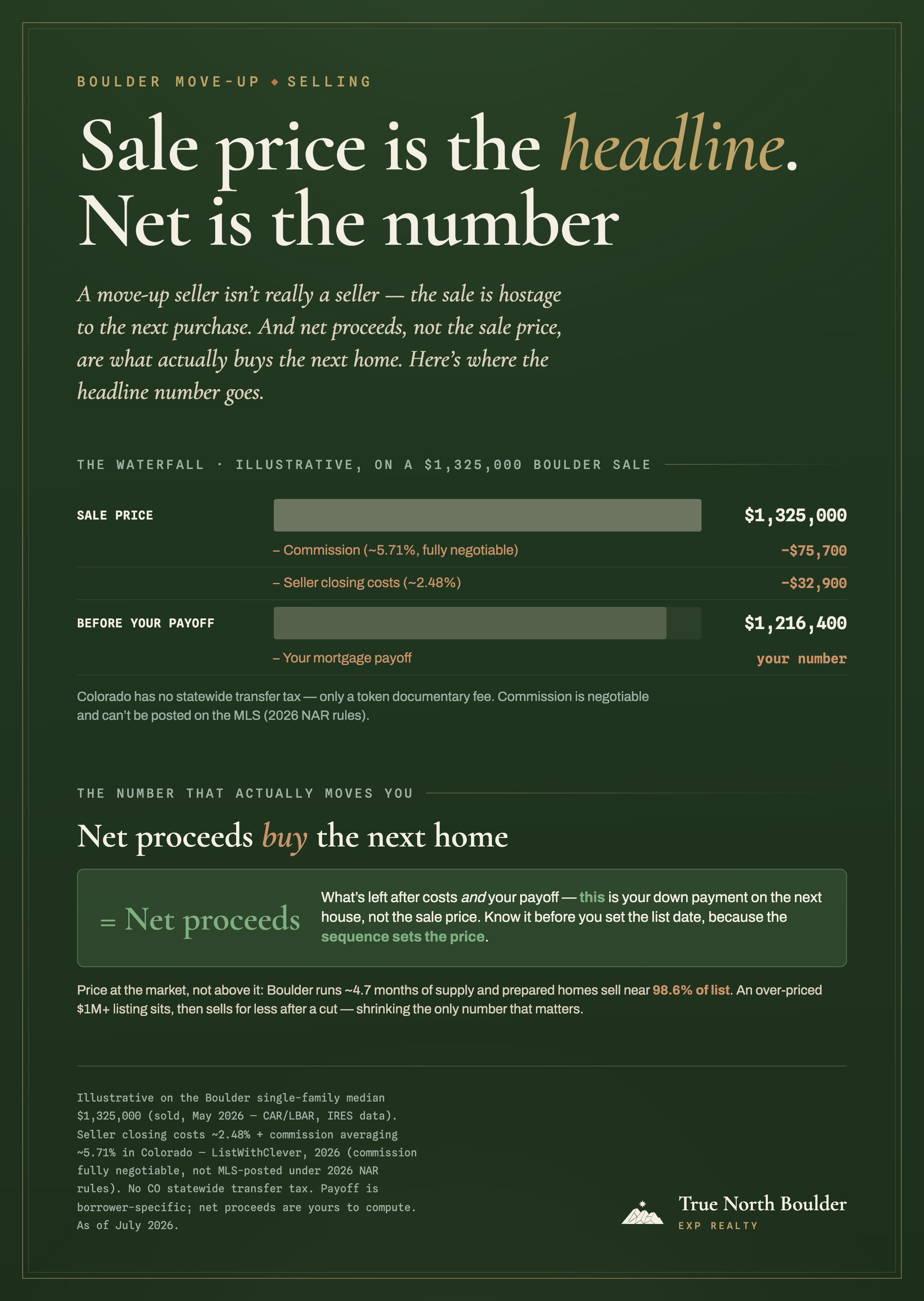
For a move-up seller, the number that matters isn't the sale price on the sign, it's what lands in your account after payoff and costs, because that figure is the down payment on your next home. Run the net before you fall for a list price. If your equity nets, say, $600,000 after costs and payoff, that's what's really buying your next home, whether you're trading up within Boulder or stretching that equity further in Longmont's upper tier. Sale price is the headline; net proceeds are the plan.
Show the math behind the $1,325,000 net sheet
Commission at Colorado's ~5.71% average, on a $1,325,000 sale: 0.0571 × $1,325,000 ≈ $75,700. Other seller closing costs at ~2.48%: 0.0248 × $1,325,000 ≈ $32,900. Add the documentary fee (Colorado charges $0.01 per $100 of price, about $133 here) and estimated selling costs land near $108,700, before your mortgage payoff.
Commission is negotiable and not set by law, so move that rate and every number under it moves with it. The percentages are 2026 Colorado averages (ListWithClever); the net sheet your agent and title company run for your address is the real one.
The move-up seller's order of operations
Run these in order. The first two decide the rest:
Start here
Get your value bracket and your net
A real comparative market analysis plus a net sheet tells you what your home is worth and what it actually puts in your pocket.
Before you set a list date
Decide the sequence
Sell first or buy first, gated by whether a lender says you can carry both. This sets your list date.
Price at the market
Anchor to recent comparable closings, not a wishful number, to capture the first-two-weeks demand surge.
Prep for leverage
Declutter, clean, and run a pre-listing inspection so the buyer’s inspection holds no surprises, and complete your disclosure honestly.
List with a real strategy
Professional media, factual details, broad syndication, and a deliberate call on buyer concessions, all under a written representation agreement.
Do it in that order and you're not just selling a house. You're financing the next one, on your terms and your timeline.
See also: what a Boulder move-up neighborhood looks like on the ground in Gunbarrel, one of the areas local sellers most often trade up into · how much equity you actually need to move up and your Colorado seller net proceeds, the two numbers that decide whether the trade works.
About this data, and what it can't tell you
The supply and days-on-market figures here are town-level single-family numbers from the CAR Local Market Update (IRES data, May 2026). They are not broken out for the $800K–$1.5M band, and that matters, because the band sits on opposite sides of the two towns' medians. In Boulder you'd be shopping below the median, in its most liquid tier, while the town's 4.7 months is pulled up by luxury stock that sits for a year. In Longmont you'd be shopping well above the median, in a thinner upper tier than the town's 2.6 months suggests. The in-band figures likely converge, and may not invert at all.
Two more honest caveats. Boulder is tightening fast, from 6.4 months to 4.7 in a year, so "looser" is a snapshot, not a condition. And Berthoud, at 5.4, is looser still. And the inversion holds on months-of-supply only: Boulder sells in 60 days at 98.6% of list, Longmont in 55 at 99.4%. Five days and eight-tenths of a point is not a desperate market. Treat the town figure as a probability, never as an instruction. A broker-side MLS pull is what settles the band, and we'll publish it when we have one.
Frequently asked
How do I sell a move-up home in Boulder?+
Start with the sequence, not the sign in the yard. Because you're selling and buying up at once, decide first whether you'll sell before you buy or buy before you sell, then set your list date and price around that. In Boulder's 2026 market, single-family homes take about 60 days to go under contract and close near 98.6% of list (CAR/IRES, May 2026), so a well-prepped, correctly-priced home still sells briskly. The mechanics of prep, pricing, and disclosure come after the sequence is set.
What is my Boulder move-up home worth in 2026?+
No honest agent can name your number without seeing the home, but you can bracket it. Boulder's single-family median is $1,325,000 and the average is $1,592,974 (CAR Local Market Update, IRES data, May 2026). The average sits far above the median because a handful of $3M-plus sales pull it up, so use the median for what a house costs. Homes close near 98.6% of list. Your home's worth is set by recent closed sales of comparable homes on your block, adjusted for condition and finishes, not by an online estimate or the price a neighbor once listed at.
Should I sell first or buy first when trading up in Boulder?+
If the cash for your next down payment is tied up in the home you're selling, plan to sell first; only buy first when a lender has confirmed in writing that you can carry both loans at once. Boulder single-family runs 60 days on market and 4.7 months of supply (CAR/IRES, May 2026), looser than Longmont (2.6) or Loveland (2.7), so buying first does not win you a scarce home here, and it does leave you carrying two mortgages into a market that may take months to clear. Our buy-before-you-sell guide walks the full decision, because your listing plan depends on the answer.
How should I price a $1 million-plus Boulder home in 2026?+
Price at the market, not above it. Boulder runs about 4.7 months of supply and homes sell near 98.6% of list (CAR/IRES, May 2026), so an overpriced $1M-plus listing tends to sit, then sell for less after a price cut. The strongest first two weeks come from pricing at recent comparable closings and letting demand compress. Chasing the market down from a high anchor is the most expensive mistake move-up sellers make.
Do I have to disclose problems when selling my Colorado home?+
Yes. Colorado requires sellers to complete the Seller's Property Disclosure to their current actual knowledge and to disclose any known adverse material defect, even one not listed on the form (Colorado Division of Real Estate). This is a legal duty, not a marketing choice. A pre-listing inspection helps you disclose accurately and fix issues on your own timeline rather than under a buyer's inspection deadline.
Can I still offer to pay the buyer's agent after the 2026 rule changes?+
Yes, but not on the MLS. Under the 2026 NAR settlement rules, offers of buyer-broker compensation can't be posted in the MLS, though sellers may still offer buyer-agent compensation or general concessions off-MLS, and all commissions are fully negotiable and not set by law (National Association of Realtors). Whether to offer a concession is a pricing-strategy decision for your specific home and buyer pool.
What will it cost me to sell, and what will I net?+
Plan on roughly 2.48% of the sale price in seller closing costs plus a negotiable commission that averages about 5.71% in Colorado (ListWithClever, 2026); Colorado has no statewide transfer tax, only a token documentary fee. Your net proceeds become the down payment on the home you're buying up to, which is exactly why move-up sellers should run the net, not the sale price.
True North Boulder is a real-estate team brokered by eXp Realty, serving Boulder and the northern Front Range of Colorado. This guide is educational and reflects market conditions as of July 2026; it is not legal, tax, or financial advice. Figures cited are sourced and, where noted, pending a live IRES data pull. Confirm disclosure duties and any partnership or representation arrangement against current Colorado Division of Real Estate rules and, where appropriate, a Colorado real-estate attorney. If we represent parties on both sides of a transaction, it is only through a written, disclosed transaction-broker arrangement; Colorado prohibits dual agency.
True North Boulder, brokered by eXp Realty.