Boulder vs. Longmont: What Your Equity Actually Buys
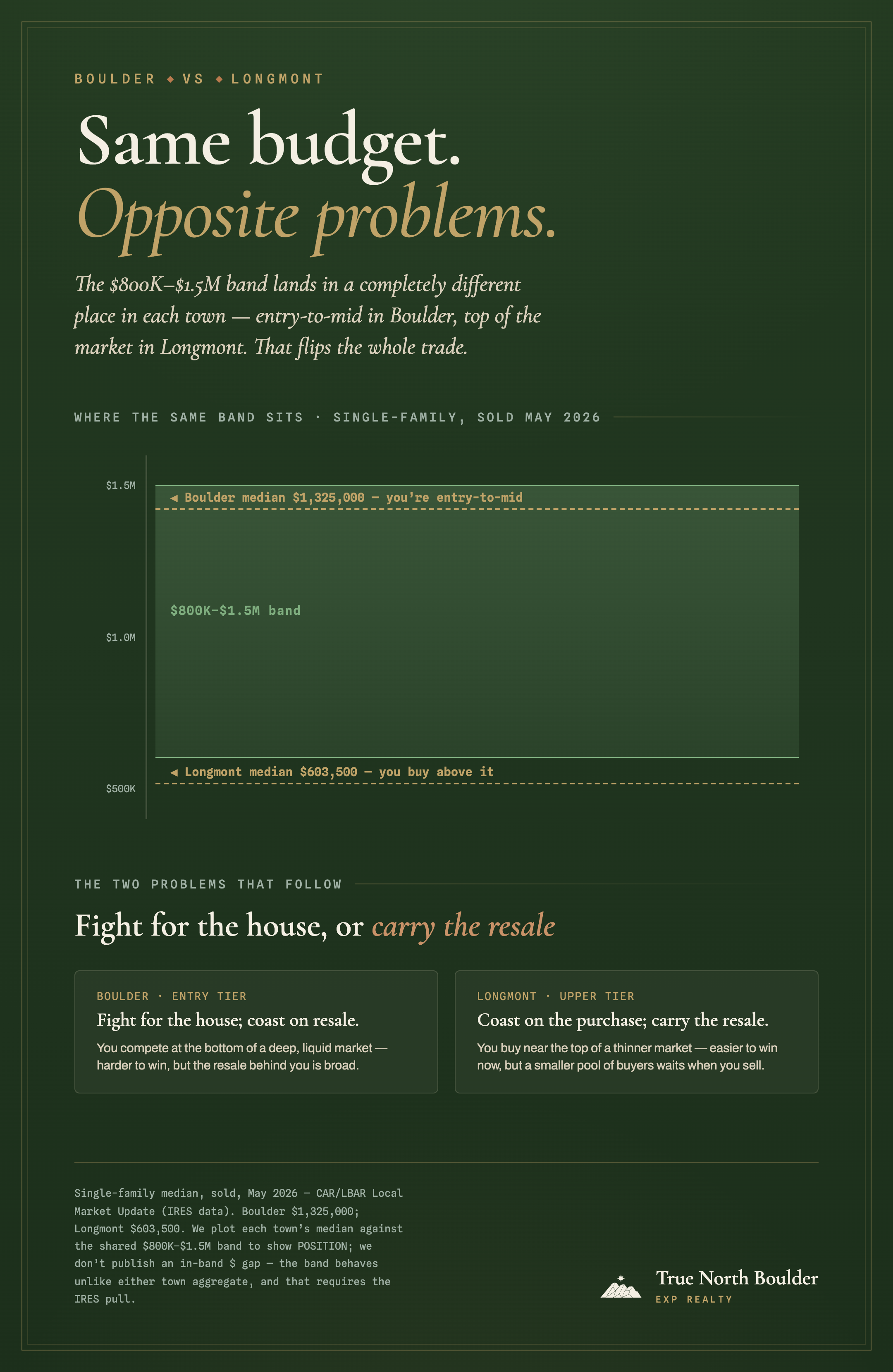
Boulder's single-family median is $1,325,000; Longmont's is $603,500. The gap is real. But you're not buying a town median. You're buying a position in it, and the same $800K–$1.5M is entry-tier in Boulder and upper-tier in Longmont. Two edges, opposite problems.
Figures below carry their source and date. Rates, prices, and district boundaries move.
Key takeaways
- The same $800K–$1.5M is entry-to-mid in Boulder and upper-tier in Longmont. In Boulder you compete for the house and coast on the resale; in Longmont it's the reverse.
- A cheaper house can cost more per month. Net ~$520K, buy at $1.05M, finance $530K at about 6.5% and you're at about $3,350 in principal and interest, against about $2,108 on the $500K note at 3% you're leaving. Roughly the same debt, payment up about 59%.
- On a $1.1M Boulder sale with a $500K balance, a 6–8% cost of sale nets you $512,000 to $534,000. That, not either median, is what you have to spend.
- Longmont is the tighter market: 2.6 months of supply against Boulder's 4.7 (CAR Local Market Update, IRES data, May 2026). What we still won't give you is a figure for the $800K–$1.5M band itself — nobody publishes one, and the band sits below Boulder's median and above Longmont's, so the in-band picture is likely narrower than the town gap suggests.
Longmont isn't half of Boulder, not at the level you'd actually buy in. Boulder's single-family median is $1,325,000; Longmont's is $603,500 (CAR Local Market Update, IRES data, May 2026). Compared like to like, that gap is real — roughly 2.2 times. But you are not buying either town's median. You are buying a position in it, and the same $800K–$1.5M buys two very different positions: the entry-to-mid tier of Boulder, and the upper tier of Longmont.
That is the real Boulder vs. Longmont question, and almost nobody asks it. It changes what your equity actually nets, what your payment does, and the one that costs real money: whether you can time the move at all.
What does your Boulder home actually put in your pocket?
Start here, not with either median. Your cost of sale is the listing-side fee, plus closing costs, plus whatever you agree to contribute toward the buyer's broker, if anything. Treat it as a range: call it 6% to 8% all-in. On a $1.1M Boulder sale with a $500,000 balance, that's $66,000 to $88,000 off the top, and you net between $512,000 and $534,000.
That $22,000 spread is the only part of this you control, so know what moves it. Two things do: the listing fee you negotiate, and whether you contribute anything toward the buyer's broker. That second one used to be automatic and posted on the MLS. Since the NAR settlement it isn't. It's negotiated in the contract now, and on a thin-inventory listing it's a live decision rather than a foregone conclusion: treat it as a pricing lever, not a fee, and weigh what it buys you in showings against what it costs you at close. The top of the range here reflects Colorado statewide averages (about 5.71% commission plus 2.48% in closing costs) used to make the arithmetic concrete. They aren't our rate. Commissions aren't set by law and are fully negotiable.
And that $1.1M is an assumption, not your number. Get a real read on what your house is actually worth before you build a plan on it, that's what the home-value page is for.
Sit with that for a second, because it's where the "Longmont is cheaper" story first starts to bend. Your Boulder equity doesn't arrive in Longmont whole. It arrives after the cost of selling and after your payoff. The seller guide runs that net sheet properly, and you want yours run before you fall in love with a listing.
That's the comparison. Now here's the part we're not going to fake.
About this data, and what we won't tell you
Every article comparing these two towns states a price gap. Almost all of them are wrong, because they put Boulder's single-family figure next to Longmont's blended median, different products, different bases. We won't publish that gap. We also won't tell you which town is "moving faster": published months-of-supply figures for Longmont range from under 2 to over 5, because the portals' underlying sold-counts disagree by roughly threefold. We now have the figure that settles it: Longmont's single-family median is $603,500 and its supply is 2.6 months, against Boulder's $1,325,000 and 4.7 (CAR Local Market Update, IRES data, May 2026). Both are sold medians, from the same report, on the same basis. What we can say is the part that matters: the move-up product trades in the town's upper tier, well above any of these medians. The count that actually decides your move is this: how many $800K-plus single-family homes truly sold in Longmont in the last six months. The count that decides your move is how many $800K-plus single-family homes actually sold in each town in the last six months. That figure lives in IRES, the MLS covering this county. Ask any broker you interview to pull it, and to show you the search, not just the number. Ask for it, and ask to see the search, not just the number. publish it here. Showing live MLS figures on a public page needs a licensed data feed; telling you on the phone doesn't.
Will your monthly payment actually go down?
This is the question the "cheaper town" story never asks, and it can reverse the whole decision. If you're holding a 2–3% pandemic mortgage and you'd finance the Longmont purchase at today's rate, lately in the mid-6% range (Freddie Mac PMMS, check current), a less expensive house can still carry a bigger payment.
Here's the arithmetic nobody runs. Say you net about $520,000 on the Boulder sale and buy at $1.05M in Longmont, a cheaper house by any measure. You finance $530,000 at today's rate, and your principal and interest come to roughly $3,350 a month. The note you're leaving behind, $500,000 at 3%, costs about $2,108. Roughly the same debt. A cheaper house. And the payment goes up about 59%.
That is the trade almost nobody prices, and it is why "Longmont is cheaper" can be true about the sticker and false about your life. Price and payment aren't the same thing, and in 2026 the rate is usually the louder of the two.
One more item lands in the payment rather than the price. If a Longmont house sits inside a metro district (a special taxing district that adds its own mill levy on top of city, county, and school taxes), your lender counts that levy in your monthly obligation, so the district doesn't just raise your tax bill. It lowers what you qualify to borrow. Longmont approves very few of them, which is a genuine advantage here, see the FAQ. The corridor guide explains how the levy itself works. A Boulder owner who "moves down" to a cheaper town and finances it at more than double their old rate can land in a smaller house with a larger monthly bill, which is not the trade anyone thinks they're making. We wrote a whole guide to what your 3% mortgage is actually worth, and the short version is: run the payment, not the price. If the answer is that you'd pay more per month for less house, that isn't automatically a no, but you should know you're making that choice, not stumble into it.
Why you're buying at the top of Longmont's market, not its middle
Same money, two very different places in the stack. At $1.1M in Boulder you're at the bottom of the range: you fight for the house, but you're standing on a thick floor of comparable sales. At $1.1M in Longmont you're near the top of the town's range, and three things flip.
Selection thins out. As a count, not a ratio. Months-of-supply is an abstraction; what a buyer actually experiences is "there are four of these in the entire town, and one has a bad floor plan." That's the number to ask for.
Appraisal risk goes up. At the top of a market's range the appraiser is reaching for comparable sales in a thin set, and thin comps mean more appraisal uncertainty. If your contract price outruns the appraisal, covering that gap is a cash commitment on top of your down payment. Budget for it, and ask your lender what happens if the number comes in low.
And your exit changes. In eight years, the buyer for your Boulder house is the broad middle of a deep market. The buyer for your top-of-Longmont house is the same narrow pool you're standing in right now. That isn't a prediction about prices. Nobody can tell you where those go. It's a statement about liquidity, and liquidity is what you feel the day you need to sell on a schedule.
The trap in "just sell first"
About 60 days to get under contract in Boulder, another 35 or so to close, up to 60 more on a rent-back: four to five months of runway. That sounds like plenty, and it is, unless only a handful of $800K-plus homes come to market in Longmont in that entire window. Standard advice says sell first and buy with a clean offer. On this trade it can strand you.
Watch out
Do the real arithmetic first, because the scare version of this doesn't survive it. Call it about 60 days to get under contract in Boulder, another 35 or so to close, and up to 60 more on a rent-back (you sell, then stay on paying rent to your buyer, generally capped near 60 days): four to five months of runway from the day the sign goes up. That sounds like plenty. It isn't, if only a handful of in-band homes come to market in that entire window, and the one you actually want lands in month five with two other move-up buyers already on it. The sell-first sequence quietly assumes your destination is at least as deep as your origin. On this trade it may not be. So before you list, ask for the count of in-band homes that actually sold in Longmont over the last six months. If it's a handful, plan a longer close, interim housing, or a different sequence entirely, the buy-before-you-sell playbook covers the options.
There's one more asymmetry, and it flips mid-transaction. Much of Boulder's in-band stock is mid-century, so on the sell side you're the one facing the sewer scope, the radon test (Boulder County is an EPA Zone 1 county), the aluminum branch wiring in mid-60s-to-early-70s houses, the basement someone finished without a permit. Longmont's in-band product skews newer, so on the buy side your homework is the builder warranty and the new-build punch list. Same move, two completely different inspection problems, and the one that costs you is the one on your side of it.
The rule
Scope the sewer and test for radon before you list, not after you're under contract and negotiating from behind. If the house is pre-1978 you owe a federal lead-based-paint disclosure and the buyer gets a 10-day window to test. And that basement someone finished without a permit doesn't count as square footage to an appraiser. That's the same appraisal thread from two sections ago, pointed back at you, this time as the seller.
Boulder vs. Longmont: what actually decides it?
Not either median. Three numbers: what your Boulder sale nets ($512K–$534K on a $1.1M sale with a $500K balance), what the payment becomes at today's rate (about $3,350 against the $2,108 you pay now), and how many $800K-plus homes actually sold in Longmont in the last six months. If those three work, Longmont is a genuinely good move.
Longmont probably fits you if
- You need Boulder's core one or two days a week, not four, the drive is what you're buying with the savings.
- Your equity nets enough to land in the upper tier without stretching, and you've priced the payment at today's rate rather than yesterday's.
- You want newer construction and more square footage (a new-build lot is often smaller than a 1960s Boulder lot, so don't assume more land), and you've pulled the floodplain status for the exact address.
- You can sit with a thinner set of choices, and a thinner set of buyers when you eventually sell.
The commute is what you're buying with the savings, so price it. Longmont to central Boulder is about 16 miles down the Diagonal (CO-119): roughly 20 to 25 minutes when the road is empty, and materially longer when it isn't, with bus service on the corridor and a widening project mid-construction. A Sunday-afternoon test drive will tell you nothing. Judge it on the version of that road you'd actually be sitting in, in the direction you'd actually be going, on a workday. And if you need to be in Boulder four days a week, Longmont is the wrong answer, and no amount of square footage fixes that. We'll say so before you list, not after the truck is unloaded, because the time to hear it is now, not once you've moved. And if what you actually want is to know what a given budget buys across the whole corridor (five towns, street by street, including the metro-district math), that's a different question, and our corridor comparison is the piece that answers it. This one is about the trade itself.
The honest take
"Longmont is half the price of Boulder" is the most repeated sentence about these two towns, and it survives only because nobody checks what the two numbers are counting. Strip the basis error out and a real choice is still there. It just isn't the one people think they're making. You aren't moving down-market. You're moving to the top of a shallower market, and the top of a shallow market is a much easier place to buy into than to get out of. Plenty of people should do it anyway: the house is bigger, the systems are newer, the district may be the one you want, and the drive may be one you can live with. Just go in knowing which of the two problems you bought, because in eight years it's the one you'll still be holding while you wait for an offer.
How we'd run a Boulder-to-Longmont move
Two transactions, one clock, and they really are two separate deals, which matters more than people think. Your Boulder sale and your Longmont purchase have different counterparties, so there's no conflict in us working both: you're our client on each one, and the brokerage relationship for each is set in writing before we start. Colorado banned dual agency in 2003, which means one firm can't represent both parties in the same transaction, so the only time a different structure comes up is if we happened to land on both sides of one deal (say the Longmont house you want is our own listing). If that happened, we'd disclose it and change roles in writing for that deal, before it happened rather than after. What we're offering here isn't both-sides representation. It's coordination: sequencing the two closings so the timing doesn't break on you, which is the thing that actually goes wrong on this trade.
And if you just want to go look at a few houses in both towns: you'll sign a written buyer agreement before we tour, but it doesn't have to be a six-month exclusive to see three houses, it can be limited in time and scope. Commissions aren't set by law and are fully negotiable, and buyer-broker compensation is no longer posted on the MLS. It's negotiated, and you can still ask a seller to cover some or all of it as a concession in the contract.
Frequently asked
Which is better for a move-up buyer, Boulder or Longmont?+
Neither, and any agent who answers that question without asking you two others is selling you something. The same $800K–$1.5M budget puts you at the bottom of Boulder's single-family market or near the top of Longmont's, and those are two edge positions with opposite problems. In Boulder you compete hard for the house, then enjoy an easy resale into the deepest buyer pool in the county. In Longmont the purchase is comparatively easy and the resale is thin. The real question is which of those two problems you would rather own, and whether you need to be in Boulder more than a day or two a week.
How much cheaper is Longmont than Boulder?+
Compared like to like, Boulder's single-family median is $1,325,000 and Longmont's is $603,500. Both are sold medians from the same report (CAR Local Market Update, IRES data, May 2026), so the roughly 2.2x gap is real. But the gap is not what decides your move. The same $800K–$1.5M budget is the entry-to-mid tier of Boulder and the upper tier of Longmont, which means you are choosing between two edge positions with opposite problems, not between a cheap town and an expensive one.
Is Longmont really half the price of Boulder?+
Not at the level a move-up buyer actually shops. Longmont's $603,500 single-family median (CAR/IRES, May 2026) describes the middle of that town, but a Boulder owner moving up does not buy Longmont's middle. They buy its $800K–$1.5M upper tier, which is a different product with different competition. Half the median does not mean half the house you would actually want.
Will my monthly payment go down if I move from Boulder to Longmont?+
Not necessarily, and this surprises people. If you hold a 2–3% pandemic-era mortgage and you would finance the Longmont purchase at today's rates, which have lately run in the mid-6% range (Freddie Mac PMMS, check current), a cheaper house can still carry a larger payment. The rate, not the price, often decides. Run that number before you decide the move saves you money; our guide to what a 3% mortgage is actually worth walks through it.
How long is the drive from Longmont to Boulder?+
About 16 miles down the Diagonal (CO-119) to central Boulder, which runs roughly 20 to 25 minutes when the road is clear and materially longer at peak. There's bus service on the corridor and a widening project mid-construction. Drive the version of that road you'd actually be sitting in, on a workday, in the direction you'd actually be going. If you need to be in Boulder four days a week rather than one or two, the savings stop paying for the drive.
Which schools serve Boulder and Longmont?+
Boulder is Boulder Valley (BVSD); Longmont is St. Vrain Valley (SVVSD). But the district is an address fact, not a town fact, boundaries cross town lines, and a Longmont address doesn't automatically mean the school you assumed. Confirm the assigned elementary, middle, and high school for the exact address with the district's boundary finder before you write an offer.
Should I sell my Boulder home before buying in Longmont?+
Be careful with the standard advice here. Selling first gives you a clean, non-contingent offer, and in most markets that's the safer play. But Longmont's move-up tier is thin, so you can end up having sold in about 60 days, holding a rent-back capped near 60 days, and still not have found a home you want. The sell-first sequence assumes your destination is at least as deep as your origin. On this particular trade, it may not be. Ask for the count of in-band homes that actually sold in Longmont in the last six months before you list.
What's the catch with the newer Longmont subdivisions?+
Here Longmont is unusually good, and almost nobody says so. The city limits new metropolitan tax districts, and Mountain Brook is the only residential metro district it has approved since 2019, a quiet advantage over Loveland and Berthoud, where they are common. So the levy trap that catches corridor buyers mostly doesn't apply in Longmont. Still confirm the district status for the exact address, and if it is, ask for the service plan and the debt-service mill levy cap. The thing to actually check in southwest Longmont is the floodplain: parts of that area sit near reworked FEMA floodplain along the St. Vrain, which affects insurance and disclosure. Pull the floodplain status for the exact parcel.
The bottom line
Run three numbers before you decide: what your Boulder sale nets after costs and payoff, what the new payment is at today's rate rather than your old one, and how many homes in Longmont's upper tier actually sold in the last six months. If those three work, Longmont is a genuinely good move and the extra house is real. If the payment goes up and the selection is four houses, the honest answer might be to stay put and renovate. We'll tell you that too.
Price the position, not the town name.
Give us your rough balance, your current rate, and the two towns, and we'll map what your Boulder sale nets against what the Longmont payment actually becomes, the rate you'd finance at included. If the cheaper town would quietly cost you more per month, that's exactly the thing we'll show you before you list.
Sources & data notes
- Longmont single-family median $603,500 and Boulder single-family median $1,325,000: CAR Local Market Update (IRES data), single-family, sold, May 2026. Both figures are the same basis, from the same report.
- Boulder single-family median $1,325,000 and 60 days on market: CAR Local Market Update (IRES data), single-family, sold, May 2026. Boulder's $800K–$1.5M band is the entry-to-mid tier of its single-family market, which is why this piece calls it the bottom of an expensive market.
- Months of supply: deliberately not stated. Published figures for Longmont range from under 2 to over 5 because the portals' underlying sold-counts disagree by roughly threefold. We will not publish a head-to-head leverage claim whose direction we cannot verify. The real figure is an IRES figure.
- Cost of sale, 6% to 8% all-in. The top of that range is the Colorado statewide average: a negotiable commission near 5.71% plus about 2.48% in other seller closing costs (ListWithClever, 2026), as run in our seller guide. The bottom reflects a negotiated listing fee with little or no contribution toward the buyer's broker, which since the NAR settlement is a contract negotiation rather than an MLS posting. Commissions are not set by law and are fully negotiable. These averages are used to make the arithmetic concrete; they are not our rate.
- 30-year fixed in the mid-6% range as of mid-2026: Freddie Mac PMMS (check current rates). A conforming, 20%-down survey average, not a quote for any borrower; rates move, so confirm today's figure before you run your own math.
- Owner-occupant rent-backs are generally capped near 60 days (Fannie Mae and Freddie Mac); some lenders allow less.
- Thin comparable sales raise appraisal uncertainty, and covering an appraisal gap is a cash commitment on top of the down payment. That is our read of how appraisal works at the top of a price range, not a cited statistic. Ask your lender what happens if the number comes in low. In Colorado the appraisal condition is also a contract deadline with a termination right, which is the buyer's actual lever.
- Longmont limits new metropolitan tax districts, and Mountain Brook is the only residential metro district it has approved since 2019. See our Longmont report. That is the opposite of the corridor norm; the corridor comparison covers how the levy works where it does apply. No levy figure is quoted here. Reworked FEMA floodplain in parts of southwest Longmont: pull the parcel's status for the exact address.
- School districts: Boulder Valley (BVSD) and St. Vrain Valley (SVVSD). Assignment is an address fact; confirm with the district's boundary finder.
- Payment and net-proceeds figures are our own arithmetic on the stated assumptions, not a lender quote.
See also: what $1M–$1.5M buys across the corridor if you're weighing more than two towns · what your 3% mortgage is actually worth before you assume a cheaper town means a cheaper month · the buy-before-you-sell playbook for the sequence · and the monthly Longmont market report.
Daniel Hsieh is a licensed Colorado real estate broker with True North Boulder, brokered by eXp Realty. This is market and process information, not mortgage, tax, or legal advice. Verify any figure against current IRES or county data, and confirm school assignment and district status for the exact address before you act.