Moving Up in Boulder With a 3% Mortgage: Lock-In Math
No, your 3% rate doesn't move with you: a conventional loan dies at closing. But on a typical Boulder move-up the payment climbs about $2,312 a month, and only $1,469 of that is the rate. Call that the rate-only delta. The other $843 is simply owing more, and you'd owe it at 3% too.
Rates and limits move; every figure below carries its source and date.
Key takeaways
- Your 3% rate is not portable. A conventional loan carries a due-on-sale clause and dies at closing (Garn-St. Germain, 1982); only FHA, VA, and USDA loans are assumable.
- On a typical Boulder move-up the payment climbs about $2,312 a month, but only $1,469 is the rate. Call that the rate-only delta. The other $843 is simply owing more, and you'd owe it at 3% too.
- Your 3% is worth less than you think: the subsidy is capped by your remaining balance, not your home's value, and it shrinks every year you pay the loan down.
- Staying is not free. The renovation you would do instead is real money, and if you have a large gain in a market that keeps rising, the tax side gets harder the longer you wait. The $250K/$500K exclusion has not moved since 1997.
You've run this in your head a hundred times, and it ends the same way every time: the house doesn't work any more, and the 3% says you're staying. You're not being irrational. Colorado has the widest mortgage lock-in gap in the country, about 2.6 percentage points between what people pay and what a new loan costs, and it has held that title two years running. This is arithmetic, not cowardice.
No, your 3% rate doesn't move with you: a conventional Colorado mortgage carries a due-on-sale clause, and it dies at closing. But in a representative Boulder move-up, a $500,000 loan at 3% traded for a $700,000 loan at about 6.5%, the payment climbs about $2,312 a month, and only $1,469 of that is the rate. Call that $1,469 the rate-only delta. The other $843 is simply owing more; you would owe it at 3% too. That split is the number almost nobody separates out, and it changes the decision. This guide is about what your 3% is genuinely worth, what it costs to move, and what it costs to stay.
Two of our guides already assume you've decided to move: buy-before-you-sell owns the sequence, and bridge-versus-contingency owns the financing. This one sits upstream of both, on the question they skip. Should you move at all?
How much of the payment jump is actually the rate?
Less than you think, and the split matters. Isolate the rate and hold everything else still: on the same $700,000 loan over 30 years, principal and interest run about $2,951 a month at 3% and about $4,420 at 6.49%. That is the rate-only delta: roughly $1,469 a month. Not the whole $2,312 jump. That figure quietly bundles in the cost of borrowing a bigger loan.
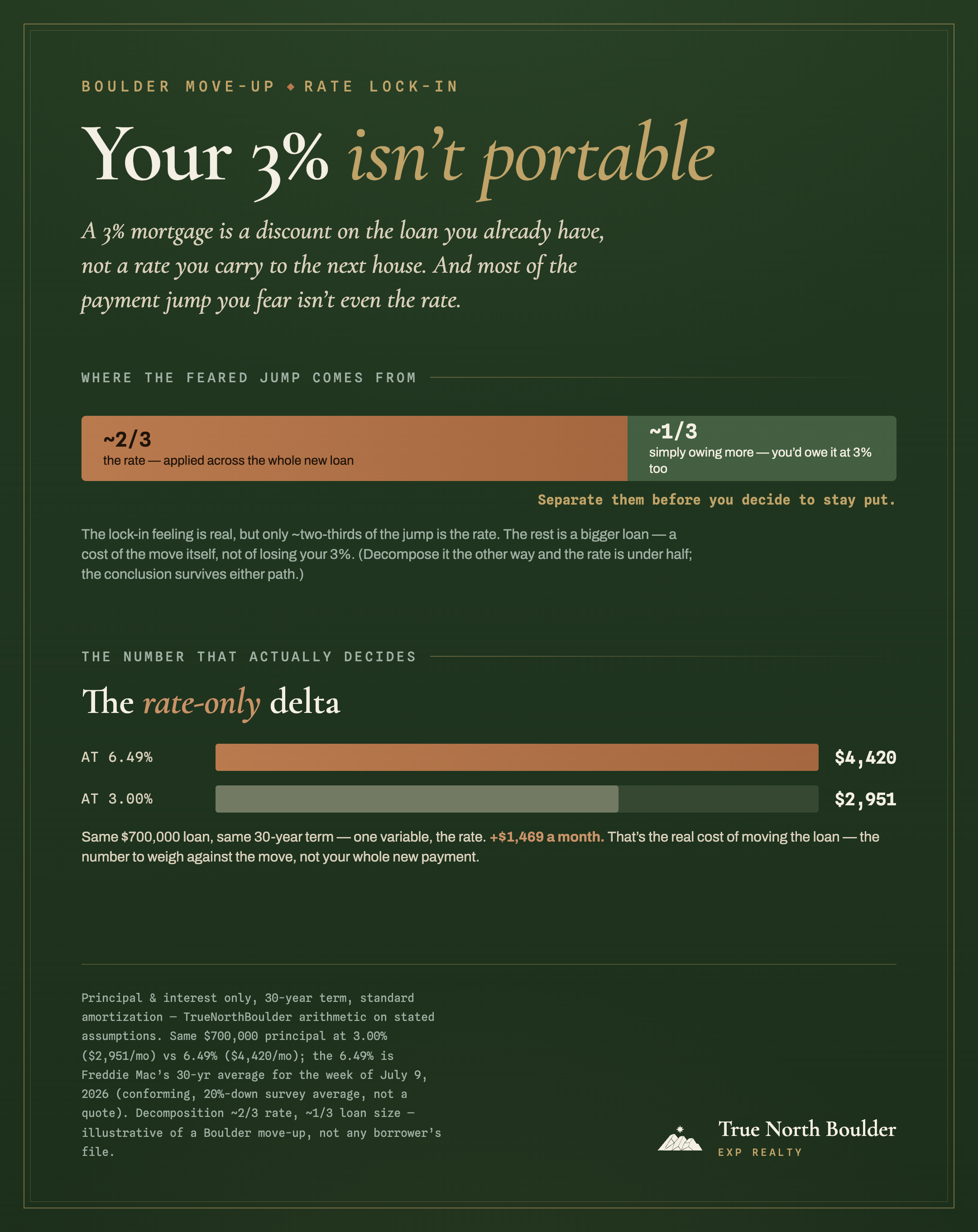
Say that plainly, because it is easy to misread. $843 of that jump is simply owing more; you would owe it at 3% too. That is what the extra $200,000 costs at your old rate. The other $1,469 is what the rate costs, applied across the whole new $700,000 loan. Split it the other way. Price the $500,000 you already owed at today's rate first, then add the new $200,000, and the rate accounts for less than half the jump rather than two-thirds. Both readings sum to the same $2,312, and the honest conclusion survives either one: the rate is not the whole story, and it is usually not even the biggest part of it. The math below shows both paths. Keep them apart and you can see what you are actually deciding; blend them, and you end up blaming the rate for a house you chose to buy.
Picture a Table Mesa owner who sells near $1.1M with a $500,000 balance at 3%. After a cost of sale around 8% (a negotiable commission plus closing costs, the math the seller guide runs properly), they net roughly $510,000. That is the number that decides what they can buy, and it is the one most people skip. It puts about $500,000 down on a $1.2M home in Niwot, before buy-side closing costs that your lender will quote, and leaves them carrying a $700,000 loan. Their principal and interest go from about $2,108 a month to about $4,420. Of that $2,312 increase, roughly $843 is the bigger loan (they'd owe that at 3% too) and roughly $1,469 is the rate. Market-accurate figures on our stated assumptions, not a real client's file.
One thing the loan math leaves out: that $2,312 is principal and interest only. Your escrow moves too. A higher assessed value means a higher tax bill, and in wildfire-exposed Boulder County the insurance quote is its own surprise. Get both numbers before you decide. The full jump is larger than the loan arithmetic alone.
What is your 3% actually worth, and for how long?
Your low rate is a discount on the loan you still owe, not on the house you own. That means the subsidy is capped by your remaining balance, and it shrinks every year you pay the loan down. A Boulder owner with a $1.35M home and a $390,000 balance often believes they are wearing handcuffs. They are wearing a bracelet.
Put a number on it. That 3% on a $390,000 balance is worth about $818 a month against today's rate, or roughly $9,800 a year. The neighbor carrying a $700,000 balance is holding $1,469 a month of the same subsidy, on the same 30-year basis. Same street, same rate, nearly double the handcuff. And the low-balance owner's number shrinks with every payment, while the house it's attached to does not.
That's why the value of a 3% mortgage is roughly the rate gap multiplied by what you still owe, not by what your house is worth. The owner who refinanced a large balance in 2021 is genuinely locked in. The one who's been paying down a modest balance since 2012 is nearly free and doesn't know it.
The lock-in effect
The reluctance to sell a home because doing so means giving up a below-market mortgage rate. It's measurable, not just psychological: the Federal Housing Finance Agency found that for every percentage point the market rate sits above your original rate, your probability of selling drops about 18.1%. It estimates that effect prevented roughly 1.33 million U.S. sales between spring 2022 and the end of 2023.
There is a Colorado wrinkle worth knowing: our lock-in gap is the widest in the country, and has been for two years running: roughly 2.6 percentage points between rates on existing mortgages and new ones. That's the arithmetic reason our inventory has been thin. It is not a prediction about where rates go next, and you should be suspicious of anyone who turns it into one.
Show the math behind the rate-only delta
Standard amortization, 30-year term, principal and interest only. On $700,000: at 3.00% the monthly payment is about $2,951; at 6.49% it is about $4,420. The difference, $1,469 a month, is the rate-only delta: roughly $17,600 a year, and about $194,000 across the 11 years the typical U.S. seller now holds a home (NAR, 2025; a national median, not a Boulder one; use your own number). That total is nominal and undiscounted, and it assumes you hold the 6.49% loan for all 11 years without ever refinancing.
A fair objection: the split depends on the order you do the arithmetic in. Decompose it the other way. Price the $500,000 you already owed at 6.49% (that is +$1,049 a month) and then add the new $200,000 at 6.49% (+$1,263), and it still sums to the same $2,312. Read that way, the rate is responsible for less than half the jump, not two-thirds. Either path lands on the same conclusion, which is the point: the rate is not the whole story, and it is usually not even the biggest part of it.
Your actual rate depends on your loan size, your credit, and whether you land in jumbo territory. Boulder County's 2026 high-balance conforming limit is $879,750, and at this price band with 20% down, plenty of buyers land above it. Ask a lender to price your real scenario.
Can you take the 3% with you?
No. Your conventional loan carries a due-on-sale clause, one federal law has made enforceable since the Garn-St. Germain Act of 1982, so the balance comes due when you sell. Only FHA, VA, and USDA loans are assumable at all, and in this band the assumable route dies on arithmetic rather than on paperwork.
Start with what is even possible. Boulder County's 2026 FHA limit is $879,750 (the same figure as the high-balance conforming limit here), and an FHA borrower putting the minimum down supports a purchase price only a little above $900,000. That reaches the bottom edge of the $800K–$1.5M band and no further. VA is the real exception, and it is worth saying plainly because a lot of writing on this topic gets it wrong: since 2020 there is no county loan limit for a full-entitlement VA borrower, so an assumable $900K–$1.2M VA note absolutely can exist in this corridor. And in a footprint with Ball, BAE, NOAA, and CU in it, some do.
Then the rock they all hit. An assumption transfers the loan, not the price. The buyer must cover the gap between what the home costs and what is still owed on it, in cash. Assume a $550,000 balance on a $1.1M home and the buyer brings $550,000 to the table. Read that number again. The buyer who wants your 3% has to bring more cash to the table than most Boulder buyers have in total. That's the whole reason "assumable" is a great headline and a rare closing. A second lien can bridge the gap, priced at today's rates, which quietly erases the reason you wanted the assumption. Servicer approval routinely runs 45 to 90 days, and in a Boulder market moving in about 60 days, most sellers will not wait. And if you are the veteran on the other side of this: a non-veteran assuming your VA loan leaves your entitlement tied to that property until it is paid off. It is restored immediately only if the buyer is VA-eligible and formally substitutes their own. That is a real cost to you, and it is the question a veteran should ask before advertising an assumable rate as a feature.
The other popular fix deserves the same discipline. A 2-1 buydown cuts your rate by two points in year one and one point in year two, then snaps back. Its up-front cost is roughly the interest it saves during that window, so it's close to a wash; the honest question is who pays it. The same dollars, taken as a price reduction instead, lower your loan permanently rather than for two years. Which one wins comes down to how long you will stay, which by now you may have noticed is the answer to almost every question in this piece.
Can you keep the house, rent it out, and keep the 3%?
It's the first thing most people ask, and the answer is sometimes, with three conditions worth knowing before you build a plan on it. Your note probably has an owner-occupancy clause (it requires you to live there), so ask your lender before you assume the loan simply travels with you. The City of Boulder requires a rental license and an inspection for a long-term rental, which is a real process, not a formality. And the tax clock is the trap: Section 121 requires you to have lived in the home two of the last five years, so moving out starts a window, roughly three years, after which the exclusion begins slipping away from you. Keeping the 3% by keeping the house can quietly cost you the $250,000 or $500,000 exclusion, which is a far bigger number than the rate. Ask your CPA what that trade looks like before you rent it out, not after.
What does staying actually cost?
Nothing in the "stay put" column is free, and this is where most of these articles stop. Start with the cost that never shows up on a spreadsheet: the years. If the house is wrong now (the office that's really a bedroom, the kitchen you've stopped inviting people into, the commute you took for a job you no longer have), it will still be wrong in 2029, and you'll have paid for the wait in the only currency you can't get back.
Then the ones that are line items. If you stay, you don't simply keep your rate. You keep your rate and you spend money on the house you're trying to make work: the pop-top, the basement, the addition. In Boulder that's a real bid from a real contractor, and permitting is its own timeline. Get the bid before you assume staying is the cheaper answer.
And here's the twist that catches people. The owner with the least rate problem usually has the most tax problem. A small balance means a long tenure, and a long tenure in Boulder means a large gain, against an exclusion that hasn't moved since 1997.
Then there is the part that can get worse while you wait. Under Section 121, a home sale excludes $250,000 of gain for a single filer and $500,000 for a married couple filing jointly. These figures have not been indexed for inflation since 1997. A long-tenured Boulder home can run past them, and in a market that keeps appreciating, the gain grows while the exclusion does not. Improvements and selling costs adjust your basis in your favor; a rented basement or ADU can create depreciation recapture (tax on the depreciation you claimed while renting) that survives the exclusion and works against you.
We're not going to compute your tax bill, and you should be wary of any agent who offers to. What we will say plainly: for an owner with a large gain, as long as values keep rising, the tax side of this decision gets harder the longer you wait, while the rate side at least can improve. Nobody knows where rates go, and we are not going to guess. Pull your basis together and take it to a CPA before you list.
Watch out
The instinct to "solve" a rate problem by buying a cheaper new build up the corridor has a catch. Many newer subdivisions in Loveland, Berthoud, and southwest Longmont sit inside a metropolitan tax district that adds its own mill levy on top of county, city, and school taxes. Colorado's contract carries a special taxing district disclosure. Take it, then ask for the district's service plan and its debt-service mill levy cap (the ceiling the district is allowed to raise your rate to). The cap, not today's levy, is what you are actually buying. Pull the real tax bill for the specific address before you celebrate the lower price. Our corridor comparison walks that math street by street.
Does Colorado's mortgage lock-in effect ease if you wait?
Colorado's lock-in gap is the widest in the country, about 2.6 percentage points between existing and new mortgage rates, and nobody can tell you when it eases. Waiting is a legitimate choice. It just isn't a free one, and in this band it helps you less than you'd think, because lock-in freezes supply far harder than it freezes demand.
Think about who you are actually bidding against for a $1.2M Boulder home. You are not bidding only against other locked-in owners. Boulder's demand base runs on employer relocation, out-of-state equity, and cash, and none of that is waiting on rates. A job transfer is not optional; a cash buyer has no rate to give up; an out-of-state seller trading a bigger basis is not doing your arithmetic. Your handcuffs are not their handcuffs. So your low rate genuinely helps you as a seller: there are fewer competing listings, and that is worth something in a Boulder market moving in about 60 days on 4.7 months of supply, looser than Longmont (2.6) or Loveland (2.7) (CAR/IRES, May 2026), which means buyers there have alternatives and time. It does close to nothing for you as a buyer.
The national picture has been shifting anyway. Below-4% mortgages fell to 49.9% of all outstanding loans in the first quarter of 2026, the first time under half since 2020. And Coldwell Banker's spring survey of more than 700 agents found 35% of sellers listing this year were giving up a sub-5% rate to do it, while 61% of agents still called lock-in a major or moderate factor. Both things are true. People are moving anyway, and it still hurts.
The 30-year fixed-rate mortgage averaged 6.49% this week. Mortgage rates have not changed much recently, but economic growth and housing affordability continue to improve for homebuyers as they shop for homes in today's market.
Sam Khater
Chief Economist · Freddie Mac
Primary Mortgage Market Survey release, week of July 9, 2026
That's a description of the present, not a forecast. Notice how fast the sentence turns from what rates are to what buyers should conclude. Nobody credible knows where rates go, and an agent who tells you to move before the thaw is selling you urgency, not advice.
What should you ask your lender, and your CPA?
We're brokers. Not lenders, not accountants. So here's the most useful thing we can do: hand you the exact questions to carry into each of those rooms. That's not a dodge. It's the difference between a decision you can defend and one you regret.
Ask your lender: what is my real rate at my loan size, my credit, and my down payment, and does it land in jumbo or high-balance territory? What does a 7/6 ARM price at against the 30-year fixed, and what is the payment at the cap? What would a recast do for me (re-amortizing the loan after a lump-sum paydown)? (You cannot move the rate, but you can sometimes move the balance; the bridge-versus-contingency guide covers the mechanics.) If a seller offers a concession, would I rather have it as a buydown or as a lower price?
Ask your CPA: what is my adjusted basis after improvements and selling costs? How much of my gain clears the $250,000 or $500,000 exclusion, and what is the rest taxed at, including any state and net investment income tax? Did we ever rent part of the house?
And be honest about tenure. Every question above resolves against the same multiplier: how many years you will actually stay. The typical American seller has now owned for a record 11 years, but that is a national median, not a Boulder one, and it is not you. Use your number.
The honest take
Some of you should stay put. If your balance is small, your gain is large, and the house mostly works, the arithmetic may well tell you to renovate and keep the 3%, and we would rather tell you that than sell you a move you regret. The people who should move are the ones for whom the house is genuinely wrong, and for them the rate was never the real obstacle. It was just the easiest thing to blame.
If you do want to look, one practical note: a written buyer agreement is now required before an agent tours homes with you, but it does not have to be a six-month exclusive to go see three houses. It can be short-term and limited in scope. Commissions are not set by law and are fully negotiable, and buyer-broker compensation is no longer offered on the MLS. It is negotiated between you and your agent, and you can still ask a seller to cover some or all of it as a concession in the contract. It just cannot be advertised on the MLS. None of that has to be a leap.
About this data, and what it can't tell you
The supply and days-on-market figures here are town-level single-family numbers from the CAR Local Market Update (IRES data, May 2026). They are not broken out for the $800K–$1.5M band, and that matters, because the band sits on opposite sides of the two towns' medians. In Boulder you'd be shopping below the median, in its most liquid tier, while the town's 4.7 months is pulled up by luxury stock that sits for a year. In Longmont you'd be shopping well above the median, in a thinner upper tier than the town's 2.6 months suggests. The in-band figures likely converge, and may not invert at all.
Two more honest caveats. Boulder is tightening fast (6.4 months to 4.7 in a year), so "looser" is a snapshot, not a condition, and Berthoud, at 5.4, is looser still. And the inversion holds on months-of-supply only: Boulder sells in 60 days at 98.6% of list, Longmont in 55 at 99.4%. Five days and eight-tenths of a point is not a desperate market. Treat the town figure as a probability, never as an instruction. A broker-side MLS pull is what settles the band, and we'll publish it when we have one.
Frequently asked
Am I making a mistake giving up my 3% mortgage?+
Not necessarily, and the honest answer is that it depends on two numbers most people never separate. On a typical Boulder move-up the payment climbs about $2,312 a month, but only about $1,469 of that is the rate. The other $843 is simply owing more, and you would owe it at 3% too. Multiply the rate-only delta by the years you will actually stay, then set it beside what staying costs you: the renovation you would do instead, and, in a market that keeps rising, a capital-gains bill that grows while the exclusion does not. For some owners the arithmetic genuinely says stay put.
What is the mortgage lock-in effect, and why is Colorado's the widest in the country?+
It is the reluctance to sell a home because selling means giving up a below-market mortgage rate, and it is measurable rather than merely psychological. The Federal Housing Finance Agency found that for every percentage point the market rate sits above your original rate, your probability of selling drops about 18.1%. That effect, it estimates, prevented roughly 1.33 million U.S. sales between spring 2022 and the end of 2023. Colorado carries the widest gap in the nation, about 2.6 percentage points between existing and new mortgage rates, for the second year running. That gap is the arithmetic reason local inventory has stayed thin.
Is a 3% mortgage assumable when I sell my Boulder home?+
Almost certainly not, if it is a conventional loan. Conventional loans carry a due-on-sale clause, which federal law has made enforceable since the Garn-St. Germain Act of 1982, so the balance comes due when you sell. Only FHA, VA, and USDA loans are assumable. Boulder County's 2026 FHA limit is $879,750, which reaches only the bottom edge of the $800K–$1.5M move-up band; VA is the exception, with no county limit for a full-entitlement borrower. But the real obstacle is the same either way: an assumption transfers the loan, not the price, so the buyer must cover the gap between the two in cash: $550,000 on a $1.1M home with a $550,000 balance.
How much does giving up a 3% mortgage actually cost per month?+
Isolate the rate and the number gets smaller than most people expect. On a $700,000 loan over 30 years, principal and interest run about $2,951 a month at 3% and about $4,420 at 6.49% (Freddie Mac's average for the week of July 9, 2026). That is a rate-only delta of roughly $1,469 a month, about $17,600 a year. On a real move-up the whole payment jump is bigger, about $2,312, but only $1,469 of that is the rate: the other $843 is simply owing more. Our arithmetic, on those stated assumptions; your actual rate depends on your loan size, credit, and whether you land in jumbo territory.
Should I wait for rates to fall before moving up in Boulder?+
Waiting is a real choice, but it isn't a free one. Lock-in freezes supply far more than it freezes demand here. You are not bidding only against other locked-in owners: Boulder's demand base runs on employer relocation, out-of-state equity, and cash, and none of that is waiting on rates. So your low rate helps you as a seller, with fewer competing listings, and does close to nothing for you as a buyer. Meanwhile, if you have a large capital gain and values keep rising, waiting makes the tax side harder, not easier.
Does the capital gains exclusion cover my Boulder home sale?+
Maybe not, and it is worth checking before you list. Section 121 excludes $250,000 of gain for a single filer and $500,000 for a married couple filing jointly. Those figures have not been indexed for inflation since 1997, and a long-tenured Boulder home can run past them. Improvements and selling costs adjust your basis, and a rented unit can create depreciation recapture that survives the exclusion. Pull your basis together and take it to a CPA before you list, not after.
Can I keep my Boulder house, rent it out, and keep the 3% mortgage?+
Sometimes, with three conditions worth knowing first. Your note probably carries an owner-occupancy clause, so ask your lender before assuming the loan simply stays put. The City of Boulder requires a rental license and an inspection for a long-term rental. And the tax clock is the trap: Section 121 requires you to have lived in the home two of the last five years, so moving out starts a window of roughly three years after which the $250,000 or $500,000 exclusion begins slipping away. Keeping the 3% by keeping the house can quietly cost you far more than the rate. Ask your CPA before you rent it out, not after.
Is a 2-1 buydown better than a price cut?+
It depends on how long you will stay, which is the same question that decides everything else here. A temporary buydown's up-front cost is roughly the interest it saves over the buydown period, so it's close to a wash; the real question is who pays it. The same dollars taken as a price reduction lower your loan permanently rather than for two years, so past roughly two to three years of ownership the arithmetic usually favors the price cut on our stated assumptions. Run both against your real numbers with your lender. The counterweight is honest: a price cut lands in the comparable sales and the appraisal has to support it, while a buydown puts cash relief exactly where a double carry hurts.
The bottom line
Your 3% is a discount on a shrinking balance, not a rate you can carry. Isolate what it is really costing you: the rate-only delta, multiplied by the years you will actually stay, plus what the transaction itself costs (the net sheet lives in the seller guide). Then set that beside the full cost of staying, including a renovation bid and a tax bill that can grow while you wait. Run those two columns honestly and the decision usually makes itself. Sometimes the answer is stay.
Run your two columns.
Tell us your rough balance, your rate, and the house you have in mind (round numbers are fine, and please don't send account numbers or statements), and we will map the rate-only delta against what staying costs, including the answer that says don't move. It's arithmetic on your assumptions, not a loan quote or tax advice: you take the result to your lender and your CPA. See our privacy policy. No obligation.
Sources & data notes
- 30-year fixed 6.49%, 15-year 5.82%, and the Sam Khater quotation: Freddie Mac Primary Mortgage Market Survey release, week of July 9, 2026 (current rates here). A conforming, 20%-down survey average, not a quote for any borrower.
- Lock-in effect: 18.1% lower probability of sale per percentage point of rate gap; roughly 1.33 million sales prevented, 2022Q2–2023Q4: FHFA Working Paper 24-03 (Batzer, Coste, Doerner, Seiler, 2024). Descriptive, not a forecast.
- Below-4% mortgages at 49.9% of all outstanding loans, Q1 2026 (the first time under half since 2020): FHFA National Mortgage Database.
- Colorado's lock-in gap, widest in the nation for a second year at roughly 2.6 percentage points: U.S. News analysis, 2026.
- 35% of spring sellers giving up a sub-5% rate; 61% of agents still call lock-in a major or moderate factor: Coldwell Banker 2026 Home Shopping Season Report (survey of 700+ agents, April 2026).
- Median seller tenure of 11 years: NAR 2025 Profile of Home Buyers and Sellers. A national median; not a Boulder figure.
- Section 121 requires two of the last five years of use as a principal residence: IRS Publication 523. The rental/owner-occupancy and Boulder rental license points are general requirements to confirm with your lender and the City; nothing here is tax or legal advice.
- Conventional loans are not assumable (due-on-sale): Garn-St. Germain Depository Institutions Act, 1982. FHA, VA, and USDA loans are assumable, subject to lender approval and the buyer covering the equity gap in cash.
- Boulder County 2026 FHA limit and high-balance conforming limit: both $879,750, per HUD and FHFA loan-limit tables. VA imposes no county loan limit on a full-entitlement borrower (Blue Water Navy Vietnam Veterans Act, effective 2020).
- The $250,000 / $500,000 capital-gains exclusion, not indexed since 1997: 26 U.S.C. §121 / IRS Publication 523. Nothing here is tax advice.
- Boulder and corridor market figures: Colorado Association of REALTORS Local Market Update, single-family, sold, May 2026, built on IRES MLS data and published free each month. Boulder: median $1,325,000, 60 days, 4.7 months of supply. Longmont: median $603,500, 55 days, 2.6 months.
- Payment figures ($2,951 / $4,420 / the $1,469 rate-only delta; the $818 and ~$9,800 on a $390,000 balance; the rebuilt example's ~$510,000 net proceeds at a ~8% cost of sale) are our own arithmetic on the stated assumptions (30-year term, principal and interest only, standard amortization), not a lender quote. The ~8% cost of sale reconciles with our seller guide (a negotiable ~5.71% Colorado average commission plus ~2.48% other closing costs).
See also: the buy-before-you-sell playbook if you have decided to move and need the sequence · the bridge-versus-contingency guide for what the gap financing actually costs · how to sell a move-up home in Boulder for the net-proceeds math · what $1M–$1.5M buys across the corridor, including the metro-district levy · and once you've decided to go, how much equity you actually need to move up.
Daniel Hsieh is a licensed Colorado real estate broker with True North Boulder, brokered by eXp Realty. This is market and process information, not mortgage, tax, or legal advice: rates, loan limits, and tax rules change, and your situation is your own. Verify any figure with your lender, your CPA, and current IRES or county data before you act.