Capital Gains on a Colorado Home Sale: Know Your Basis
A married couple who meets the tests can exclude up to $500,000 of gain on a home sale, and a single filer $250,000. Colorado taxes whatever is left as ordinary income, with no home-sale break of its own. On a long-held Boulder home, that ceiling is closer than most owners think.
A married couple who meets the tests can exclude up to $500,000 of gain on a principal-residence sale, and a single filer up to $250,000. Colorado then taxes whatever is left as ordinary income, with no home-sale break of its own. Those federal figures come from IRC §121 and they carry a two-of-five-year test most owners pass without thinking about it. The part that surprises people is what happens above the ceiling: the excess is a taxable gain, federally and again in Colorado. On a Boulder home bought two or three decades ago, that ceiling is a great deal closer than it looks.
Read this first
This is general information, not tax advice. We're real-estate brokers, not CPAs and not tax attorneys. We can't tell you what you'll owe, and nothing here is an opinion on your situation. The rules below are federal (IRC §121) and Colorado statute as they stood in April 2026; tax law changes, and your facts decide the outcome. Talk to a CPA or tax attorney before you act on any of it. And know our interest: we're paid when a home sells, which is exactly why we're not going to tell you whether to sell.
How much of a Colorado home sale is actually tax-free?
Up to $250,000 of gain for a single filer and $500,000 for a married couple filing jointly, if the ownership and use tests are met (IRC §121). Anything above that is taxable gain, federally and again in Colorado, which taxes it as ordinary income at its flat rate with no home-sale exclusion of its own.
The exclusion applies to gain, not to the sale price, and that distinction is where most of the confusion starts. Gain is the amount realized on the sale minus the adjusted basis, which is roughly what was paid for the home plus the capital improvements made to it over the years. A home that sold for $1.4 million after being bought for $400,000 has not produced a $1.4 million tax event. It has produced something closer to a $1 million gain, before basis adjustments. Against that, a married couple meeting both tests may exclude $500,000. The rest is taxable.
Federally, the taxable slice is a long-term capital gain, taxed at 0%, 15%, or 20% depending on taxable income, and the 3.8% net investment income tax can reach part of it for higher earners. Colorado does something different, and simpler, and less generous. That gets its own section below.
Why that ceiling covers less every year
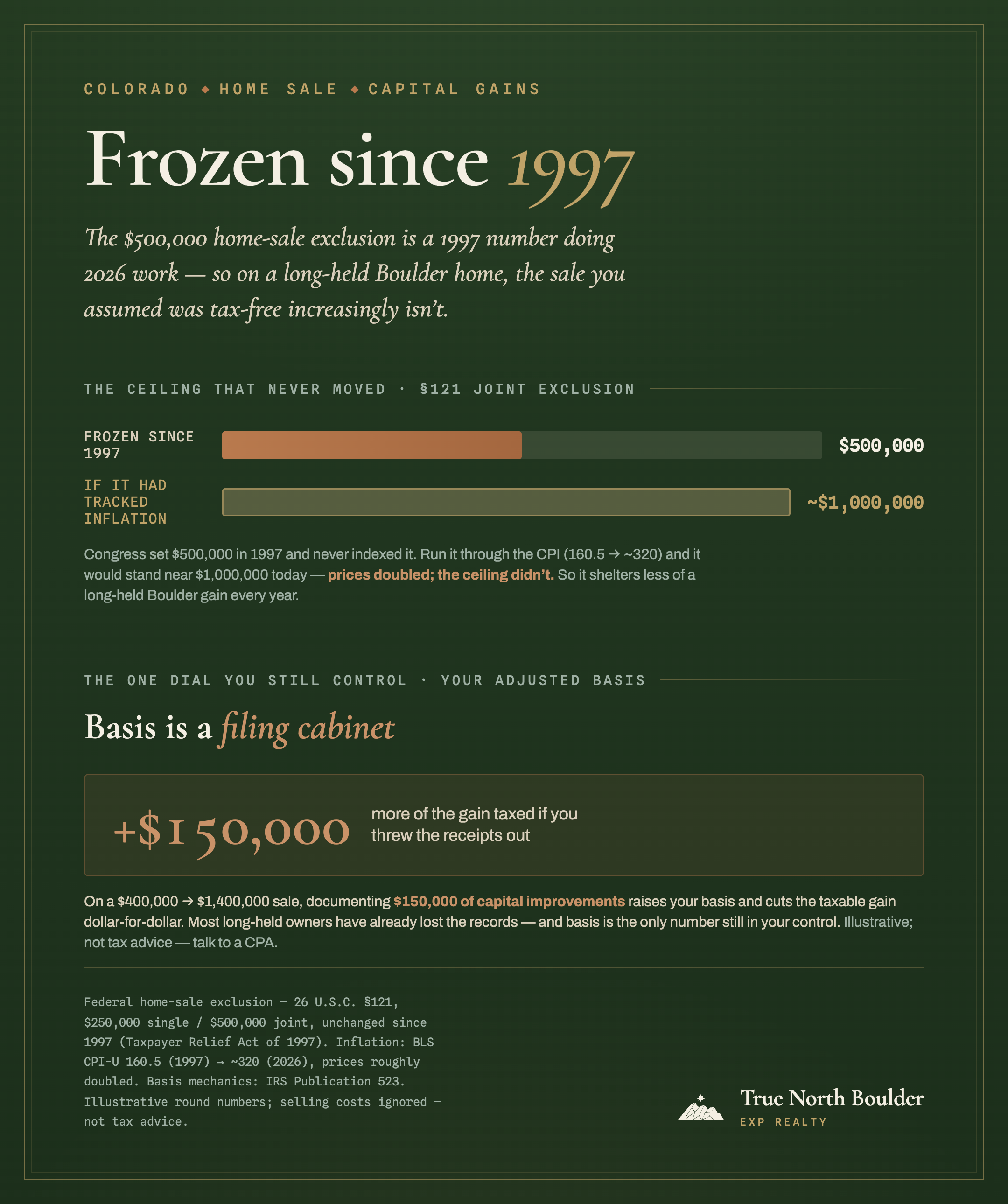
Congress set $250,000/$500,000 in 1997 and never indexed the figures. Run them through the BLS consumer price index and prices have roughly doubled since, so an indexed $500,000 ceiling would stand near $1 million today. The ceiling didn't move; prices did. The share of a long-held home's gain it shelters keeps shrinking.
The exclusion is a 1997 number doing 2026 work. The Taxpayer Relief Act of 1997 set the limits at $250,000 and $500,000 and, unlike a great deal of the tax code, they were never indexed to inflation. The consumer price index averaged 160.5 in 1997 and has since crossed 320 (BLS, CPI-U) — prices have roughly doubled. Had the limits been indexed, the single figure would stand near $500,000 and the joint figure near $1 million. They are not. Put another way: an indexed 1997 single-filer limit would be worth about what the joint limit is today. Bills to index them have been introduced repeatedly and none has passed, so it isn't prudent to plan around relief arriving.
That is the whole of the freeze, and it is worth being precise about what it does and doesn't imply. It does not mean waiting is a mistake. An owner who never sells may hand the property to heirs at a stepped-up basis and see the gain disappear entirely, which is the last section. It means the assumption that a primary residence sells tax-free was written for a different housing market, and on a long-held Front Range home it quietly stopped being true. The same arithmetic shows up from the other direction in the mortgage rate lock-in guide: the owner with the smallest rate problem usually has the largest tax one.
The one dial you still control: your adjusted basis
The ceiling is fixed and the sale price is the market's call. Adjusted basis is the only input a seller still influences: purchase price plus capital improvements. Every documented capital improvement raises basis and cuts the gain, and most long-held owners have thrown away the paperwork that proves it.
This is the part worth acting on, because it is the only part still in play. Gain is the amount realized minus adjusted basis. Nobody controls the ceiling. Congress does, and it hasn’t moved in nearly thirty years. Nobody controls the sale price; the market does. Adjusted basis is the remaining variable, and it is built from the purchase price plus the capital improvements made over the life of the ownership (IRS Publication 523).
Adjusted basis
Broadly, what was paid for the home, plus certain purchase closing costs, plus the cost of capital improvements, less certain decreases such as depreciation or casualty-loss reimbursements. Capital improvements are work that adds value, extends the home's life, or adapts it to a new use: an addition, a new roof, a kitchen remodel, a finished basement. Routine repairs and maintenance that keep the home in working order do not raise basis. A higher adjusted basis means a smaller gain.
Two owners can sell the identical house for the identical price and hand the IRS very different numbers. The only thing that separates them is whether anyone kept the paperwork.
Here is the uncomfortable part. Two decades of ownership on a Boulder home usually means a furnace, a roof, a kitchen, maybe a bathroom and a basement. Six figures of genuine capital improvement, most of it paid for and then forgotten. The IRS doesn't take a seller's word for that number, and a remodel nobody can document is, for tax purposes, a remodel that may as well not have happened. The §121 overshoot is a records failure before it is a tax failure. The owner who kept a folder has a materially different outcome than the owner who didn't, and the difference was decided years before either of them called a broker.
Nothing about that requires selling. It requires a folder: closing statements from the purchase, contractor invoices, permits, receipts. That is a job for a rainy afternoon, and it is worth more than any advice about timing.
Do you actually qualify?
The 2-of-5 test: 24 months of ownership and 24 months of principal-residence use, both inside the five years ending at the sale. For joint filers, both spouses must meet the use test but only one the ownership test. Rental history, a recent prior exclusion, or a short tenure each change the answer.
Most long-term owners clear the basic test without effort, and then get caught by one of the qualifiers. The core rule is straightforward: an owner must have owned the home 24 months and used it as a principal residence 24 months, both within the five years ending on the sale date, and the two periods need not be the same stretch (IRS Publication 523). For a married couple filing jointly, both spouses must meet the use test; only one needs to meet the ownership test. The exclusion generally isn't available if it was already claimed on another home sold in the prior two years.
Three provisions do the real damage, and each is a statute rather than a judgment call:
- Nonqualified use. Under IRC §121(b)(5), stretches after January 1, 2009 when the home was not a principal residence (a rental period, most commonly) generally create a slice of gain that can’t be excluded, prorated as nonqualified time after 2009 over the total ownership period — the 2009 cutoff limits what counts as nonqualified use, not the ownership span it's measured against (26 U.S.C. §121(b)(5)(B)–(C)). A long tenure before 2009 therefore dilutes the hit rather than concentrating it, but a house that spent four years as a rental does not get the full exclusion back simply by moving in again.
- Depreciation. Gain equal to depreciation allowed or allowable for periods after May 6, 1997, whether from a rental stretch or a home-office deduction, can’t be excluded at all.
- A shortened window. Treasury Regulation §1.121-3 provides safe harbors for a sale forced by a change in place of employment, health, or certain unforeseen circumstances, allowing a prorated exclusion instead of none.
One more provision belongs here because its deadline is easy to miss: under IRC §121(b)(4), an unmarried individual whose spouse has died may use the $500,000 figure rather than $250,000 if the sale occurs no later than two years after the date of death and the requirements were met immediately before it. It is a hard statutory window, and it runs quietly.
What Colorado adds on top
Colorado taxes the taxable slice as ordinary income at its flat rate. There's no preferential long-term rate here the way there is federally, and no home-sale exclusion of its own. The state's capital gain subtraction sounds like it should help. Since 2022 it reaches only farmers selling agricultural land.
Colorado is simpler than the federal system and, for a home seller, less forgiving. Whatever survives §121 lands in Colorado taxable income and is taxed at the state's flat rate as ordinary income (C.R.S. §39-22-104). There is no long-term capital gains preference at the state level. The distinction that saves federal filers real money simply isn’t there. And the rate itself is not a fixed constant. It is set annually and can move with the TABOR surplus mechanism, so the honest thing to do is check the current figure at tax.colorado.gov rather than trust a number printed in any article, including this one.
The trap
The Colorado capital gain subtraction is the most common misconception on this subject, and the name is doing the damage. For tax years beginning on or after January 1, 2022, it is allowed only for capital gains recognized by farmers from the sale of agricultural real property (C.R.S. §39-22-518). It does not reach a residential home sale. An owner who has budgeted around a state-level break has budgeted around something that no longer exists for them.
Put the federal and state layers together and the shape of the thing becomes clear. The exclusion does the heavy lifting, basis decides how much work it has to do, and Colorado quietly taxes whatever is left over at the same rate as a paycheck. A rough sketch of how those pieces interact, with round numbers that belong to nobody:
Say a couple bought a Boulder home for $400,000 a long time ago and sells it for $1.4 million. Start with a $1 million gain — and note we're ignoring selling costs, which reduce the amount realized and therefore the gain: another line for the CPA. Suppose they can document $150,000 of capital improvements over the years: adjusted basis rises to $550,000 and the gain falls to $850,000. Meeting both tests as joint filers, they exclude $500,000. That leaves roughly $350,000 of taxable gain: federal, plus Colorado as ordinary income. Had they documented nothing, the taxable slice would have been $150,000 larger. What rate applies to that slice depends on their income, and that is a question for their CPA, not for us.
What to do about it — and what we can't tell you
Assemble the basis file, and take real questions to a tax professional. We can't tell you what you'll owe or whether to sell, and the honest counterweight is that an owner who never sells may pass the home to heirs at a stepped-up basis, which can erase the gain entirely.
Start with the folder, not the decision. Two things are broker-scope work, and both are worth doing whether or not a sale is ever on the table: pull the closing statement from the original purchase, and inventory the capital improvements with whatever invoices, permits, and receipts still exist. That is the raw material for adjusted basis, and it is the input nobody else can reconstruct later.
Then take questions, not conclusions, to a CPA or tax attorney. Useful ones: what is the adjusted basis on this evidence, and what would strengthen it? Does any stretch of this ownership count as nonqualified use? Was depreciation ever claimed? Does a partial-exclusion safe harbor apply? What does the state rate do to the taxable slice this year?
And the counterweight, which cuts against our own interest and belongs here anyway. Under IRC §1014, property held until death takes a new basis equal to its fair market value at the date of death, so appreciation that accumulated over a lifetime can escape capital gains tax entirely for the people who inherit it, whether or not the estate owes any estate tax. If a sale isn't in the plan, this analysis may simply not apply, and stepped-up basis is a question for a tax advisor and an estate attorney. Sometimes the honest answer for a long-held home is to stay put, renovate, and keep it, a conclusion the move-up sequencing guide reaches from an entirely different direction, and one the buy-before-you-sell decision has to survive first.
What we can do is the part that is actually ours: tell you honestly what the home is worth today, what it would net at that price, and what that number actually buys if you did move. The tax question belongs to your CPA. The market question is ours, and it's worth putting both on the table before you decide anything.
Frequently asked
How long do you have to live in a home to avoid capital gains tax?+
The federal rule is the 2-of-5 test: to claim the exclusion, an owner must have owned the home for at least 24 months and used it as a principal residence for at least 24 months, both within the five years ending on the sale date (IRS Publication 523). The two 24-month periods don't have to be the same stretch of time. For a married couple filing jointly, both spouses must meet the use test, but only one needs to meet the ownership test. There's also an anti-stacking rule: the exclusion generally isn't available if it was already used on another home sold within the prior two years.
Does Colorado have its own capital gains break on a home sale?+
No. Colorado taxes capital gains as ordinary income at its flat rate, with no preferential long-term rate the way the federal system has. The Colorado capital gain subtraction is a common source of confusion: for tax years beginning on or after January 1, 2022, it is allowed only for capital gains recognized by farmers from the sale of agricultural real property, so it does not reach a residential home sale. The flat rate itself is set annually and can move with the state's TABOR surplus mechanism, so check the current rate at tax.colorado.gov rather than relying on a figure in any article.
What counts as a capital improvement for basis?+
Broadly, work that adds value, extends the home's life, or adapts it to a new use: a kitchen remodel, an addition, a new roof, a finished basement, a replaced furnace. Routine repairs and maintenance that simply keep the home in working order do not count (IRS Publication 523). The distinction matters because capital improvements increase adjusted basis, and a higher basis means a smaller gain. This is the one part of the calculation an owner can still influence, by keeping the records.
What happens to the exclusion if the home was rented out for a few years?+
Renting can shrink it. Under IRC §121(b)(5), periods after January 1, 2009 when the property was not the principal residence count as 'nonqualified use,' and a proportional slice of the gain (nonqualified time after 2009, divided by the whole time you owned the home) can't be excluded — the 2009 cutoff limits the numerator, not the denominator (26 U.S.C. §121(b)(5)(B)–(C)). Separately, gain equal to depreciation allowed or allowable for periods after May 6, 1997 can't be excluded at all. An owner with any rental history should treat the exclusion as an open question for their tax advisor, not a given.
What if a spouse has died? Is the exclusion still $500,000?+
It can be, within a window. IRC §121(b)(4) allows an unmarried individual whose spouse has died to use the $500,000 figure instead of $250,000 if the sale happens no later than two years after the date of death and the ownership and use requirements were met immediately before that date. Outside that window the single figure generally applies. This is a statutory provision with a hard deadline, which is a reason to raise it with a tax advisor early rather than late.
Can you claim any exclusion if you have to move before the two years are up?+
Sometimes, on a prorated basis. Treasury Regulation §1.121-3 provides safe harbors for a sale driven by a change in place of employment, health, or certain unforeseen circumstances, which allow a partial exclusion rather than none. The prorated amount depends on how much of the two-year requirement was satisfied. Whether a particular move fits a safe harbor is a facts-and-circumstances question for a tax professional.
Want the market half of the answer?
We'll tell you what your home is realistically worth and what it would net: the number your CPA would need before the tax question can even be asked. No pressure to list.
True North Boulder is a real-estate brand brokered by eXp Realty. We are not tax professionals.
External references: IRS Publication 523, Selling Your Home · 26 U.S.C. §121 · Colorado Department of Revenue: Income Tax Topics, Colorado Capital Gain Subtraction.
Daniel Hsieh is a licensed Colorado real estate broker with True North Boulder, brokered by eXp Realty. This article is general information about published federal and Colorado tax rules, not tax advice, and not an opinion on any reader's situation. Tax law changes and individual facts control the outcome, so consult a CPA or tax attorney before acting.