Where to Live for the Boulder–Denver Commute: Pick the Node, Not the Midpoint
The cheap house at the geographic midpoint is usually the worst commute you can buy. On the Boulder–Denver corridor you don't split the distance; you pick a transit node that matches your real in-office cadence, and you price the toll and the insurance, not just the mortgage.
You've priced the houses, and the math seems to point one direction: buy south, toward Denver, somewhere in the middle, where it's cheaper than Boulder and closer than staying put. It feels like the smart compromise. It usually isn't. You'll live this choice twice a day, in the dark half the year, long after you've forgotten what you paid for the house. The house at the geographic midpoint is often the worst commute you can buy: it's on transit to neither hub, and it hands you the toll-lane drive in both directions. The Boulder–Denver corridor isn't a line you find the middle of. It's a handful of discrete transit nodes, and the right one is the node that matches how you actually commute, not the average of a five-day week you may not work.
Fast facts · the Boulder–Denver corridor
Sources: RTD · CDOT · Boulder Reporting Lab · as of July 2026
The split-the-distance house is the worst commute you can buy
Here's the trap in one line: the middle of the corridor is equidistant from everything and convenient to nothing. A house in the geographic center sits off the transit line, so there's no car-free option, and it puts you in the toll lanes heading north to a Boulder job or south to a Denver one. You inherit the worst of both directions, and the savings that lured you there evaporate at the tollgate. "Split the distance" is the one strategy the corridor punishes hardest.
The fix is to stop thinking in miles and start thinking in nodes. Each real node on this corridor, from Boulder and Table Mesa at the north end to the McCaslin area at Louisville and Superior, Broomfield in the middle, and the north-county towns off the line, has a completely different commute profile, and you pick the one that fits your pattern.
Commute the node, not the map
There isn't one; it depends on where in Denver you work and how often. If it's a downtown job two or three days a week, a Flatiron Flyer node like Table Mesa or the McCaslin station lets you bus in car-free in about 56 minutes. If it's the Tech Center or an Interlocken office park, transit barely helps: the stop's on the highway, a last mile from your desk, so you're optimizing a drive. The wrong answer for everyone is the cheap house in the geographic middle.
A node is worth what it costs you across a real week, and that cost has parts most buyers only count one of. There's the mortgage, the number you shopped on. There's the toll on the US-36 express lanes, call it $130 to $330 a month at the two or three days you actually drive in, up to $300–$550 at a full five-day return, a housing cost wearing a highway's clothes. On part of this corridor there's an insurance delta that can run hundreds a month. And some of the newer corridor stock, parts of the Superior rebuilds especially, sits in a metro district whose special-district mill levy, escrowed into your monthly payment, the survivor home down the block or the Boulder home you're comparing may not carry, so pull the itemized levy for any address before it wins you over. Add them up and the "cheaper" node sometimes costs more than the pricier one.
And the number you're really trading against these costs is windshield time. To downtown Denver at peak, figure something like a half-hour from Broomfield at the south end to an hour or more from the north-county towns, with Boulder and the McCaslin nodes in between, but your actual Denver destination moves every one of those, which is exactly why you optimize the node, not the map.
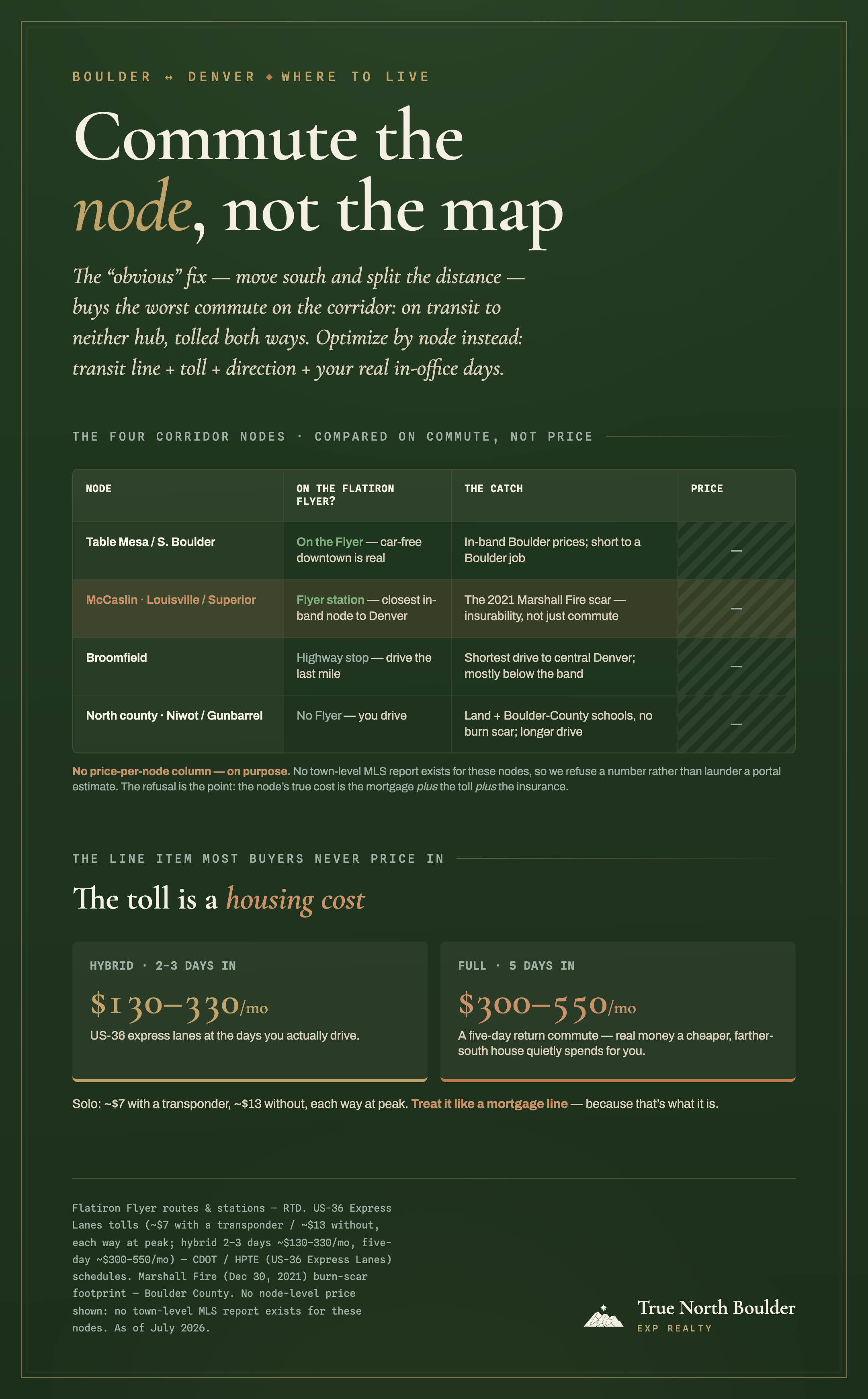
Notice what the table doesn't have: a price-per-town ladder. That's on purpose. What your dollar buys in each corridor town is its own guide, and it's the wrong lens for this decision. Here the comparison unit is your commute, not your square footage.
Where the Flatiron Flyer saves you, and where it doesn't
For a downtown job, genuinely yes: the Flatiron Flyer runs Boulder to Union Station in about 56 minutes, and living at a US-36 station (Table Mesa, McCaslin, or Broomfield) makes it car-free on your office days. For a Tech Center, west-side, or DIA job, no. And while Interlocken and Broomfield have highway stops, the office parks aren't walkable from them, so you're still driving the last mile. Match the node to where you're actually going.
The corridor's real asset is the Flatiron Flyer, RTD's bus rapid transit on US-36. It runs Boulder to Union Station in about 56 minutes with frequent service at peak, and from a station town you can genuinely leave the car home on your office days. That's a real and underused option, but only for a downtown-Denver commute. If your job is in the Tech Center, on the west side, or out by the airport, the Flyer doesn't reach it at all; and even the Interlocken and Broomfield stops sit on the highway, a last mile from office parks you can't walk to, so for most of those desks you're still optimizing a drive, not a bus. The node math there is all about direction, not transit.
Two caveats, because a bus you can't rely on is worse than no bus at all. RTD service has thinned since the pandemic and is in the middle of a system overhaul as of 2026, so off-peak and weekend frequency is limited. Treat car-free as a commute strategy for your two or three office days, not a car-free life. And the express toll lanes are the quiet line item: that $300–550 a month is real money that a cheaper, farther-south house quietly spends for you.
If you land on Louisville or Superior, buy the burn scar well
You can, and thousands have rebuilt, but buy it deliberately. The December 2021 fire destroyed more than 1,000 homes across the two towns, so on many streets you're choosing among rebuilt-to-code homes (which often insure better), survivor homes, and empty lots. Ask "rebuilt or original?" at every showing, check the flood overlay, and get a real insurance quote before you go under contract, not after.
The McCaslin node, Louisville and Superior, is the corridor's sweet spot on paper: a Flatiron Flyer station, genuinely in the move-up band, Boulder Valley schools. It's also the heart of the December 2021 Marshall Fire, which destroyed more than a thousand homes across the two towns. As of late 2025 about three-quarters had been rebuilt, with some still under construction and some lots still empty. That doesn't make it a place to avoid. It makes it a place to buy carefully.
On a given block you're choosing among a rebuilt-to-current-code home, a survivor home, and a vacant lot, and they're three different purchases. The rebuilt home often insures at a better rate than untouched older stock, because it's built to current fire code, though at a higher replacement cost. A "survivor" home isn't automatically the safe pick either: many took real smoke, soot, and HVAC contamination, so one needs an air-quality inspection, not just a lower price. Three moves settle it: ask "rebuilt or original?" at every showing, check whether the parcel carries a flood overlay, and, the one that matters most, get an insurance quote before you go under contract, backstopped by your inspection or insurance objection deadline, and confirm you can even bind a policy, not just what it would cost. Our Medtronic-Louisville relocation guide goes deeper on the rebuild-versus-survivor decision and the post-fire insurance mechanics if this node is your target, and the broader hazard checklist (radon, wildfire, flood, metro-district tax) is in our Ball Aerospace relocation guide.
The north trade, and the honest bet behind it
For a real share of move-up buyers, the better answer isn't a node south at all. It's staying in Boulder County, in a Table Mesa that's still on the Flyer or a Niwot or Gunbarrel with land and Boulder-County schools, and accepting a longer drive. But it only works if you're honest about what it is, so here it is straight.
For a single-income, one-anchor Denver commuter, staying north is a longer forward commute, not a shortcut and not a reverse-commute, that you accept in exchange for land, schools, and no burn-scar insurance premium. That trade makes sense when you're in the office two or three days a week. If your employer moves back to five days downtown, a node on the line wins, plainly, so choosing north is partly a bet that hybrid holds, and you should make it on purpose.
For a two-career household with one job in Boulder and one in Denver, the corridor stops being a line and becomes a genuine conflict, and the rule applies hardest here: do not resolve it by buying the midpoint, because that's the worst node for both of you. Weight it by cadence. Whoever is in an office more days, or on a harder-to-move schedule, gets the node that serves them; the other takes the longer drive or rides the Flyer. A north-county home is often the honest answer for this household specifically, not because it's a reverse commute (it isn't; a north-county drive into Boulder is still a forward one), but because it hands the Boulder earner a short drive and the Denver earner a longer one, and the framework, not the mileage, is what settles the argument at the kitchen table.
Turn "somewhere in the middle" into a specific node
The decision underneath all of this is which node your actual week points at, and that's a calculation, not a vibe. Tell us your commute anchor or anchors, where in Denver, where in Boulder, and how many days you're really in each office, and we'll map the nodes against it, pull a block-level comp set for the ones that fit, and, on a burn-scar block, run an insurance reality-check before you tour, not after. That's the part a corridor listicle can't do: turn "somewhere in the middle, I guess" into the specific node that costs your household the least, all-in. And if there's no office to anchor to at all, the whole node calculation changes: our remote-worker guide optimizes the parcel instead of the position.
We help buyers across the whole corridor, and we're a real-estate team under eXp Realty. If the honest read is that your Denver job and your budget point south, we'll say so and help you buy the scar well; if it points to staying north, we'll say that. The node that's right for your commute is rarely the one that's cheapest on the listing, and the whole job here is telling you which is which.
Frequently asked
How long is the Boulder-to-Denver commute?+
About 45 minutes to an hour each way by car in peak traffic on US-36, less off-peak, and roughly the same by bus: the RTD Flatiron Flyer runs Boulder to Denver's Union Station in about 56 minutes with frequent peak service. The honest answer is that the number depends less on which town you pick than on where in Denver you're going -- a downtown job is transit-reachable, while a Tech Center or DIA job is a pure drive and an Interlocken office park leaves you driving the last mile from the highway stop. Optimize for the two or three days you're actually in the office, not a five-day average.
Can you commute from Boulder to Denver car-free?+
For a downtown, weekday commute, yes -- the Flatiron Flyer connects Boulder (including the Table Mesa station) to Union Station in about 56 minutes, and a handful of US-36 stations (McCaslin near Louisville/Superior, Broomfield, Church Ranch) let you live along the line and bus in. But keep it commute-specific, not a car-free life: RTD service has thinned since the pandemic, off-peak and weekend frequency is limited, and the system is mid-overhaul as of 2026. Great for your in-office days; you'll still own a car for everything else.
How much do the US-36 express toll lanes cost?+
More than most buyers price in. A solo driver pays roughly $7 with a transponder or about $13 without, each way at peak -- call it $14 to $26 a day. At the two or three days most people actually drive in, that's about $130 to $330 a month; at a full five-day commute it's the $300 to $550 top of the range. Carpools of three-plus ride free, but few move-up commuters carpool daily. Treat the toll like a housing cost, because it is one: a cheaper house 15 minutes farther south can quietly hand back its savings at the tollgate.
Are Superior and Louisville still affected by the Marshall Fire?+
Yes, and it changes how you buy there. The December 2021 Marshall Fire destroyed more than 1,000 homes across Superior and Louisville; as of late 2025 roughly three-quarters had been rebuilt, with some still under construction and some lots still empty. On a given street you may be choosing among a rebuilt-to-current-code home (which often insures at a better rate, though at a higher replacement cost), a survivor home (which may carry smoke and soot damage, so inspect for it), and a vacant lot. Ask 'rebuilt or original?' on every showing, check the flood overlay, and get an actual insurance quote before you go under contract -- confirm you can bind a policy at all, not just what it costs, because premiums rose sharply and some carriers tightened new business.
Can you live north of Boulder and still commute to Denver?+
You can, and for some buyers it's the better trade -- but be clear-eyed about what it is. From Niwot or Gunbarrel a Denver commute is a longer forward drive, not a shortcut; what you're buying is more land, Boulder-County schools, and no burn-scar insurance premium, in exchange for more windshield time on the days you actually drive in. It works best if your in-office cadence is genuinely two or three days a week. If your employer moves back to five days in the office, a US-36 node closer to the line wins -- so it's partly a bet on hybrid holding.
About these prices, and why we won't publish node medians
The corridor's south towns (Superior, Louisville, Broomfield) sit outside our five-town Boulder-County footprint and, unlike Boulder or Longmont, have no town-level MLS market report published monthly. So we won't print a precise "Superior median" or "Louisville median" here: the figures floating around are unsourced portal estimates with no stated basis, not numbers we'd stand behind for a seven-figure decision. When a node is your target, we pull a block-level comp set from the MLS for your actual streets.
The transit, toll, return-to-office, and Marshall-recovery figures are as of July 2026. We refresh this guide when RTD service, a return-to-office shift, or a Marshall-recovery milestone changes the math.
The bottom line
Don't split the distance. Price the toll and the insurance, not just the mortgage, and buy the node that matches the two or three days you're actually in an office.
Sources & data notes
- This guide is independent and not affiliated with, or endorsed by, RTD or CDOT. Confirm current schedules and toll rates before you rely on them.
- Transit: the RTD Flatiron Flyer runs Boulder to Denver's Union Station in about 56 minutes, frequent at peak, with US-36 stations at Table Mesa, McCaslin (Louisville/Superior), Broomfield, and Church Ranch (Westminster): RTD Flatiron Flyer route and schedule, as of July 2026.
- Toll: the US-36 express lanes run roughly $7 with a transponder or about $13 without, each way at peak, for a solo driver, about $130 to $330 a month at a hybrid two-to-three days, up to $300–$550 at a five-day commute; carpools of three-plus ride free. CDOT US-36 Express Lanes toll schedule, as of July 2026.
- Transit reliability: RTD service has thinned since the pandemic and is mid–system overhaul in 2026: RTD ridership dashboard and the 2026 RTD system overhaul.
- Return-to-office: roughly 64% of downtown-Denver workers were back in the office in 2025: downtown-Denver return-to-office reporting, as of 2025.
- Marshall Fire: the December 2021 fire destroyed more than 1,000 homes across Superior and Louisville; about three-quarters were rebuilt by late 2025; roughly two-thirds of destroyed households were underinsured, with an average gap above $100,000 (Colorado Division of Insurance). County insurance premiums rose sharply afterward, and availability tightened: Boulder Reporting Lab; City of Louisville Rebuilds. As of July 2026.
- Node prices: unsourced portal estimates with no stated basis; no town-level MLS market report is published for the south US-36 towns (Superior, Louisville, Broomfield), so we refuse a node median here and pull a block-level comp set per target instead; upgrades at an IRES pull. As of July 2026.