What Moving to Loveland, Colorado Actually Costs You
In Loveland's move-up band, the west-side foothills and canyon-mouth homes your dollar reaches are the same homes wildfire and flood insurers have turned hardest to cover. Underwrite the insurance before you write the offer.
Across December 2025, the median single-family home in Loveland sold for $515,000. That number is worth pausing on, because most search engines will quote you something closer to $486,000 for a Loveland "home value," and that lower figure blends in condos and townhomes. For a move-up buyer shopping detached houses in the $800K-$1.5M range, the real number matters, and so does what it tells you: this budget reaches well past the middle of Loveland's market, which is exactly why it lands you on the west side, in the foothills, along the Big Thompson, and around Lake Loveland. That is the good news and the catch in one sentence. The west side is where the money goes furthest, and it is where insurability, not price, decides the deal.
Loveland is not a Boulder suburb, and treating it like one is the first mistake. It is its own Northern-Colorado town with its own gravity, and understanding that is what makes the rest of this make sense.
Loveland is its own town, and your dollar goes west
Loveland sits entirely in Larimer County and belongs to the Fort Collins metro area (all of Larimer County), anchored to Fort Collins about 15 minutes north. Denver is roughly 50 minutes; Boulder about 45. Schools are Thompson R2-J, its own district. It runs its own economy, not a bedroom community's, and a move-up budget buys real space here, most of it on the west side by the foothills, plus the in-town Lake Loveland pocket. That is the draw, and it comes with a catch worth knowing before you shop.
If you are moving from out of state, the single most useful correction to make early is where Loveland points. The answer engines fold it into Denver's orbit, or lump it with Boulder because both are on the Front Range. Neither is right. Loveland is in the Fort Collins metropolitan area, which the federal government defines as all of Larimer County, and its daily gravity runs north to Fort Collins, about fifteen minutes up US-287, not south. Denver is closer to fifty minutes; Boulder is roughly forty-five and across the county line. If your job or your family is in Fort Collins or Northern Colorado, Loveland is a short commute. If it is in Boulder or Denver, price that drive honestly before you fall for a foothills view.
It runs its own economy, too, which is why it does not feel like a bedroom community. Banner Health's McKee Medical Center anchors the medical side, and Loveland co-owns the Northern Colorado Regional Airport with Fort Collins, a real aerospace and advanced-manufacturing base. Schools are Thompson School District R2-J, which covers Loveland, Berthoud, a slice of south Fort Collins, and pieces of the surrounding county. It is neither Boulder Valley nor St. Vrain, so if you are comparing districts across the corridor, this is a third one with its own boundaries to check by address. If you are weighing Loveland against the rest of the corridor on price, what a move-up budget buys from Boulder down to Loveland puts the towns side by side, and the other corridor towns have their own guides, from Boulder to Longmont.
The neighborhoods a move-up buyer actually shops split along a line that turns out to be the whole story. To the west sit the foothills and the water: Mariana Butte with its golf and its ridgelines, the Seven Lakes area, and the parcels running up toward the mouth of the Big Thompson Canyon. The homes around Lake Loveland are a different case, in-town rather than foothills, where the question is the private reservoir and the older-stock carry, not the wildfire interface. To the east and around the interstate sit the newer master-planned communities, Centerra chief among them. Downtown Loveland, with its restored core and the sculpture and arts scene the town is known for, sits in the middle. One more piece of ordinary diligence before you get attached to any of them: this is Larimer County, an EPA Radon Zone 1 area where the average indoor reading runs well above the action level, so budget a radon test and likely a mitigation system on any house you seriously consider. None of that is a reason to hesitate. It is the homework the listing will not do for you. And the biggest piece of that homework is on the west side.
Why the best-priced Loveland houses are the hardest to insure
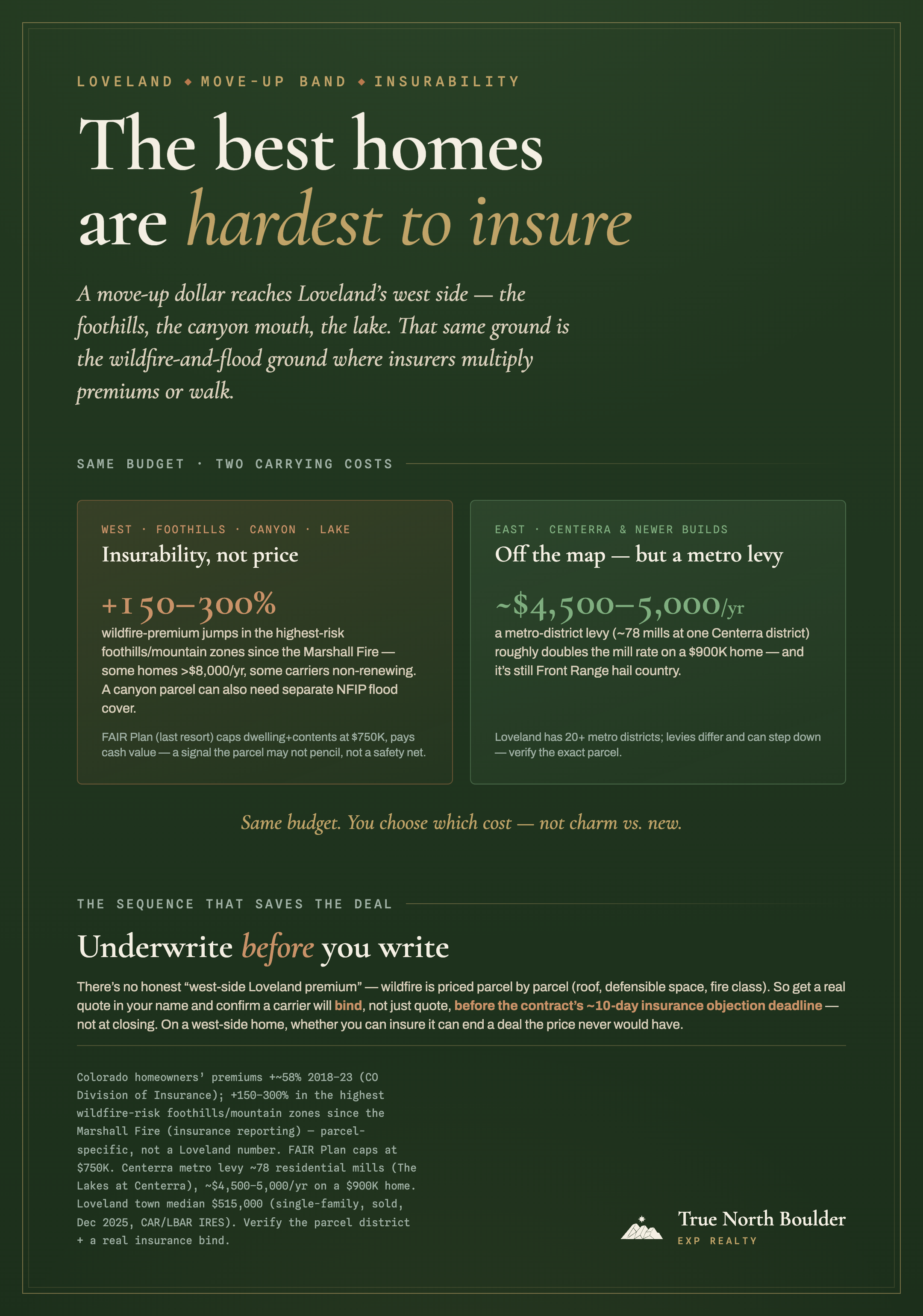
The west-side foothills, canyon-mouth, and lakeshore ground that a move-up budget reaches in Loveland is the same ground that carries wildfire (WUI) and flood exposure. Colorado homeowners' premiums rose about 58 percent from 2018 to 2023, and in the highest wildfire-risk areas the jumps run far steeper: reporting across the Front Range foothills describes increases of 150 to 300 percent, some homes paying $8,000 a year or more, and carriers non-renewing outright. On these homes, insurability decides the deal before price does.
Here is the part no relocation guide tells you. The feature that makes a west-side Loveland home worth $900,000, the foothills backdrop, the water, the canyon at the end of the road, is the same feature that now decides whether an insurer will write it. Loveland sits at the mouth of the Big Thompson Canyon, and its most desirable stock sits in the wildland-urban interface, the WUI, where wildfire risk models drive the premium.
The numbers are a statewide story that lands hardest on ground like Loveland's west side. Across Colorado, homeowners' premiums rose about 58 percent between 2018 and 2023, according to the state Division of Insurance. In the highest wildfire-risk areas the increases run far steeper: reporting across the Front Range foothills and mountains describes premiums climbing 150 to 300 percent since the Marshall Fire of December 2021, some homes now paying north of $8,000 a year, and, in the hardest-hit mountain counties, carriers non-renewing policies outright. Homeowners who lose coverage get pushed toward the Colorado FAIR Plan, the state's insurer of last resort, and for a move-up home that is a warning sign, not a safety net. The FAIR Plan caps dwelling and contents together at $750,000, pays actual cash value rather than replacement cost, and carries no liability or loss-of-use coverage, so on an $800,000-plus foothills home it usually has to be paired with a separate wrap policy just to satisfy a lender. If the only path to insuring a house runs through the FAIR Plan, treat that as a signal the parcel may not pencil, not as a fallback. That is the constraint. On a west-side house, the question is not only what it costs to buy. It is whether you can insure it, and for how much, and that answer can end a deal that the price never would have.
About this data, and the number we won't publish
The statewide premium figure above (about 58 percent, 2018 to 2023) is the Colorado Division of Insurance's; the steeper 150-to-300-percent range and the non-renewals describe the highest wildfire-risk foothills and mountain zones, from insurance reporting, not a single Loveland statistic. That is deliberate. What we will not publish is a "Loveland west-side premium" number, because there isn't an honest one. A wildfire premium is set parcel by parcel, on the specific home's construction, roof age, defensible space, fire-protection class, and the carrier's own risk model, and any figure that claims to be "the Loveland number" is a guess dressed as a statistic. The only premium that means anything is a real quote on the real address, in your name, which is exactly why the section below tells you to get one before you write.
Wildfire and flood are two different problems
West-side Loveland can carry two separate hazards that need two separate policies. Foothills homes face wildfire, priced through a standard homeowner's policy or, in the worst cases, the FAIR Plan. Homes in the Big Thompson corridor may sit in a mapped Special Flood Hazard Area, much of which was redrawn after the 2013 flood, and a federally backed mortgage legally requires flood insurance through the NFIP there. They are different products with different triggers, and one listing can need both.
A lot of buyers hear "hazard" and picture one problem. On the west side of Loveland there can be two, and they are underwritten separately. Wildfire is the one most people expect: it rides on the WUI scoring above, and it lives in your homeowner's policy or, when no standard carrier will write, the FAIR Plan. Flood is the other, and it surprises people. The 2013 Big Thompson flood was severe enough that the Colorado Water Conservation Board remapped the floodplain afterward, and the City of Loveland regulates to those newer maps. If a parcel sits in a mapped Special Flood Hazard Area, a federally backed mortgage legally requires you to carry flood insurance, through the National Flood Insurance Program or an accepted private flood policy, and that is coverage entirely separate from your wildfire coverage. One canyon-adjacent house can need both.
Which means your one scouting trip has a short, specific checklist. Stand on the parcel and look at the defensible space and the roof. Note the road: is it a single way in, how far to a hydrant, what fire-protection district serves it. If the parcel is acreage rather than a subdivision lot, add the rural layer, because a west-Loveland budget often reaches land that runs on a private well and a septic system: you want a well flow-rate and water-quality test, and Larimer County requires a septic (OWTS) inspection at the time of sale. And before you leave, or before you even fly out, confirm two things about the exact address: is it in the remapped Special Flood Hazard Area, and what wildfire risk tier does it carry. Both are checkable from the county and city maps. Neither is on the listing.
Underwrite before you write, and know a quote isn't a bind
On a west-side Loveland home, line up insurance at the offer stage, not at closing, and confirm a carrier will actually bind coverage, not just quote it. The Colorado Contract to Buy and Sell has a Property Insurance objection deadline, often around ten days, which can be too short to secure a foothills bind from out of state. Work with an independent agent who writes Colorado wildfire risk, get a fresh quote in your name, and use the new state disclosure law as your lever.
The practical sequence is where most buyers, and especially remote buyers, get caught. Do not wait until closing to think about insurance. Start at the offer. The Colorado Contract to Buy and Sell includes a Property Insurance objection deadline, the window in which you can terminate if you cannot obtain acceptable coverage, and it is often only about ten days after the contract is signed. On a foothills parcel, that is tight. A wildfire bind can require an inspection, a roof assessment, and a defensible-space review, and if you are a thousand miles away, ten days can run out before a preferred carrier commits.
So build the runway before you need it. When you make the offer, ask your agent to negotiate enough time on that insurance deadline for a real bind, not a placeholder. And understand the difference that traps people: a quote is not a bind. A number on a screen is not a carrier's commitment to write the policy at closing. Line up an independent agent who actually writes Colorado wildfire risk, because a national call-center carrier may simply decline the parcel. Pull a fresh quote in your own name rather than trusting the seller's premium, which is meaningless if the seller has already been non-renewed or is grandfathered into an old rate you will never get. Ask for the property's loss-history (CLUE) report. And read the binder's conditions before you rely on it: on a foothills parcel a carrier will often agree to write the policy only if you complete specific mitigation, clearing trees, replacing a roof, adding defensible space, within a window after closing, and a buyer a thousand miles away who does not finish that work can lose the coverage they thought was locked. Finally, know your lever: a new state law, House Bill 25-1182, signed in 2025 and taking effect this July, will require insurers to disclose the wildfire risk score behind your premium, to credit documented mitigation work, and to let you appeal a score you believe is wrong. Mitigation you document now becomes your evidence for when that credit requirement takes effect. That is the difference between a house you love and a house you can afford to keep.
West or east, you're choosing which cost to carry
The real Loveland move-up fork is not charm versus new construction. It is which carrying cost you take on. A west-side foothills home trades a lower purchase-side risk for wildfire and flood insurance exposure. A newer east-side home in a metropolitan district like Centerra trades that hazard premium for a metro-district mill levy on the property-tax bill, which at Centerra runs near 78 residential mills on top of the base rate, close to doubling the mill levy. Same budget, two different bills for the next ten years.
Once you see the west side clearly, the east side stops looking like the low-drama, predictable alternative and starts looking like a different trade. A newer home in one of Loveland's master-planned communities, Centerra and the developments around it, generally sits off the WUI and out of the canyon floodplain, so the wildfire and flood premium eases. It does not vanish, though: the whole Front Range is hail country, and hail damage on an aging roof drives plenty of Colorado non-renewals on its own, WUI or not, so being off the wildfire map is not the same as being off the insurance problem. What the east side adds on top is a metro district: a mill levy on your tax bill that in one Centerra district, The Lakes at Centerra, runs near 78 mills and works out to somewhere around $4,500 to $5,000 a year on a $900,000 home, landing right next to what a west-side wildfire premium can add. That is the point. You are not escaping a cost, you are choosing which one to carry. Centerra actually layers three such tolls on two different clocks, the mill plus a retail fee and the urban-renewal financing beneath it, and our Centerra guide totals the whole stack; the short version for this fork is that the east-side bill is a toll and the west-side bill is a hazard. Verify the exact district for any parcel, because Loveland has more than twenty metro districts, their levies differ, and a district's levy can step down as its bonds are paid off.
One more thing, if you already own on the west side and are trading up. The insurability problem is not only a buyer's problem. It is your listing problem too, because the buyer who wants your foothills home cannot close on it without coverage they can bind, and a home no preferred carrier will write is a harder sale that funds your next move more slowly. Document your mitigation, pull a fresh quote to hand a buyer, and price the reality in. If that is your situation, it deserves its own conversation, and we will write that guide.
This guide is for you if
- You are moving to Loveland from out of state and want to know what a west-side foothills or canyon-adjacent home really commits you to before you fly out to see it.
- You have a move-up budget that reaches the foothills, the lake, or Mariana Butte, and nobody has yet told you that insurance, not price, may decide the deal.
- You are weighing a newer master-planned home against an established west-side one and want the hazard premium and the metro-district levy as real annual numbers, not vibes.
- You are relocating for a job in Fort Collins or Northern Colorado and want the honest orientation before a listing photo sets your expectations.
Price the house second, insure it first
Before you write an offer on a west-side Loveland home, the useful first move is a real insurance answer, not a showing: whether it is in the remapped flood zone, what wildfire tier it carries, and what it will take to bind coverage in time. That is a five-minute head start from anywhere, and it is the right first step whether or not we ever work together, because on this side of Loveland the insurance answer decides more than the inspection does.
The reason to do this before you write is that the hazard picture sets your timeline, and the timeline starts the day you go under contract. An insurance objection deadline you did not extend does not care that you are buying from another state. A wildfire tier you learned at the inspection is a week too late to fold into the offer. So run the insurance question before the offer, not after. We will tell you which of Loveland's two Lovelands the house is in, west or east, what carrying cost it comes with, and what the next thirty days actually require, and if it is the right house, we will help you build the offer around the insurance instead of around it.
None of this requires hiring us. But when you want a broker who reads the hazard maps before the granite, that is the work we do, as a team under eXp Realty. The buyer-agency agreement you would sign before touring is negotiable on its terms and its fee, and on the west side the first thing that fee buys you is a real insurance answer before your objection deadline, not after. So we start where this side of Loveland actually starts: with whether you can insure the house, and for how much. The current town numbers live in our monthly Loveland market report, and if you're deciding between Longmont and Loveland specifically, we run that pair head to head.
The bottom line
Loveland is its own Northern-Colorado town, anchored to Fort Collins, with its own schools and its own economy, and a move-up dollar goes furthest here, on the west side, in the foothills and by the lake. That same west side is where insurability, not price, decides the deal: wildfire and flood exposure that can multiply a premium or end a sale. The east side trades that hazard for a metro-district tax bill. Before you fall for a house, learn which cost it carries, get a real, bindable insurance quote in your name before your objection deadline, and build the offer around the answer. The view is the reason to move here. The insurance is the reason to do your homework first.
Sources & data notes
- Loveland single-family median $515,000 from the CAR Local Market Update (via LBAR), IRES data, single-family, sold, December 2025. Search-engine "home value" figures near $486,000 (as of late 2025) are all-homes indices (e.g. Zillow ZHVI) that blend condos and townhomes; the detached single-family sold median is the right lens for a move-up buyer.
- Loveland is in the federally defined Fort Collins Metropolitan Statistical Area (Larimer County; formerly styled Fort Collins–Loveland). Fort Collins is ~15 minutes north via US-287; Denver ~50 minutes; Boulder ~45. Schools: Thompson School District R2-J (covers Loveland, Berthoud, part of south Fort Collins, and surrounding county areas).
- Larimer County is an EPA Radon Zone 1 area (predicted average indoor screening level above the 4 pCi/L action level) — Larimer County Health.
- Colorado homeowners' insurance premiums rose ~58% from 2018 to 2023 — Colorado Division of Insurance (see also CSU REDI, Aug 2025). In the highest wildfire-risk foothills and mountain zones, reporting describes premium increases of 150–300% since the December 2021 Marshall Fire and some homes paying $8,000+/yr; non-renewals are concentrated in mountain counties (a ~77% rise from 2018 to 2023 in some Colorado mountain counties per the U.S. Senate Budget Committee, Dec 2024 — not a statewide figure). The Colorado FAIR Plan (est. HB23-1288; residential applications opened spring 2025) is the insurer of last resort: it caps combined dwelling-and-contents coverage at $750,000, pays actual cash value, and excludes liability and loss of use, so it typically requires a companion "wrap" policy. A specific Loveland west-side premium is not published and is parcel-specific; see the data note above.
- The Big Thompson floodplain was remapped by the Colorado Water Conservation Board after the 2013 flood, and the City of Loveland regulates to the updated Special Flood Hazard Area maps — City of Loveland, A Better Big Thompson. A federally backed mortgage on a home in a mapped SFHA requires flood insurance, through the NFIP or an accepted private flood policy (separate from wildfire coverage).
- House Bill 25-1182 (Risk Model Use in Property Insurance Policies), signed May 28, 2025, effective July 1, 2026: requires insurers to disclose wildfire risk models/scores, credit documented property-level and community mitigation, and allow policyholders to appeal their score.
- Centerra metropolitan-district residential mill levy ~77.7 mills (The Lakes at Centerra Metropolitan District No. 2, current maximum; overall district levy ~157 mills) — Centerra Metropolitan District. Loveland has 20+ metro districts; verify the specific district's levy for any parcel with the Larimer County Assessor.
- The Colorado Contract to Buy and Sell Real Estate (CREC) includes a Property Insurance objection deadline, the buyer's window to terminate if acceptable coverage cannot be obtained.
Frequently asked
Is Loveland a suburb of Denver or Boulder?+
Neither. Loveland sits entirely in Larimer County and belongs to the Fort Collins metro area (all of Larimer County), anchored to Fort Collins about 15 minutes north. Denver is roughly 50 minutes and a separate metro; Boulder is about 45 minutes over the county line. Loveland's schools are Thompson School District R2-J, neither Boulder Valley nor St. Vrain.
Why is home insurance such a big deal in Loveland?+
Because the west side of Loveland, where the foothills, the Big Thompson canyon mouth, and Lake Loveland make homes most desirable, carries wildfire (WUI) and flood exposure. Colorado homeowners' premiums rose about 58 percent from 2018 to 2023, and in the highest wildfire-risk foothills and mountain areas the jumps run to 150 to 300 percent, with some carriers non-renewing policies outright, so on a west-side Loveland home, whether you can insure it at all can decide the deal before price does.
Do I need flood insurance to buy a home in Loveland?+
You may. If the parcel sits in a mapped Special Flood Hazard Area, and much of the Big Thompson corridor was remapped into one after the 2013 flood, a federally backed mortgage legally requires flood insurance, through the NFIP or an accepted private flood policy. That is a separate policy from wildfire coverage. Check whether the specific parcel is in the remapped floodplain before you write the offer.
Is the east side of Loveland cheaper to own than the west?+
Not automatically. A west-side foothills home trades a lower hazard-insurance risk for a higher one; a newer east-side home in a metropolitan district like Centerra trades that hazard premium for a metro-district mill levy on the tax bill, which in one Centerra district runs near 78 residential mills, roughly $4,500 to $5,000 a year on a $900,000 home. Even off the wildfire map the east side is still in Front Range hail country, so it is not insurance-free either. Neither side is free; you are choosing which cost you carry, and metro-district levies vary by parcel, so verify the exact district.