Living in Boulder, Colorado: Pick Your Boulder First
The median single-family home in Boulder sold for $1,275,000 across 2025, and the city adds almost no new houses: a scrape replaces, it doesn't add. So the real decision is which of the three Boulders you can buy, and that comes before any house.
Key takeaways
- Boulder adds almost no houses. New construction inside the city is nearly all scrape-and-replace: a smaller home comes down, a bigger one goes up, and the count stays flat. Your competition is resale, permanently.
- Boulder is three markets, not one. The historic core mostly starts above $1.5M. The $800K–$1.5M budget buys the mid-city neighborhoods and the county satellites, and each behaves differently.
- The school line is a price line. BVSD and SVVSD split this market one road apart, and the open-enrollment window for fall 2026 closed on January 7, so the boundary you buy is the only assignment you can count on.
- A June close starts in January. At December's average of 86 days from list to accepted offer (a winter read), a spring sale is a January project.
Type "living in Boulder, Colorado" into a search engine and you will get four different answers about what a home here costs, spread across a quarter of a million dollars, none of them a single-family sold price. Here is the real one: across 2025, Boulder's median single-family home sold for $1,275,000. And here is the thing that number hides: Boulder is not one housing market. It is three, they are priced apart by policy as much as geography, and the city adds almost no new houses to any of them. Which means the first decision is not which house. It is which Boulder.
This guide is for you if
- You own a home in the $800K–$1.2M range, here or nearby, and want to trade up without guessing which neighborhoods your money actually reaches.
- You're moving to Boulder from out of state and want the structure of the market before you fall for a listing photo.
- You're selling a Boulder home this spring and need to know when the clock actually starts.
Why Boulder never adds houses — and what that does to yours
New houses go up in Boulder every year, and almost none of them adds a home: a scrape replaces, it doesn't add. City water stops near 5,700 feet under the 1959 Blue Line, more than 45,000 acres of open space ring the city, and the buildable land ran out decades ago. Net-new detached supply is effectively zero.
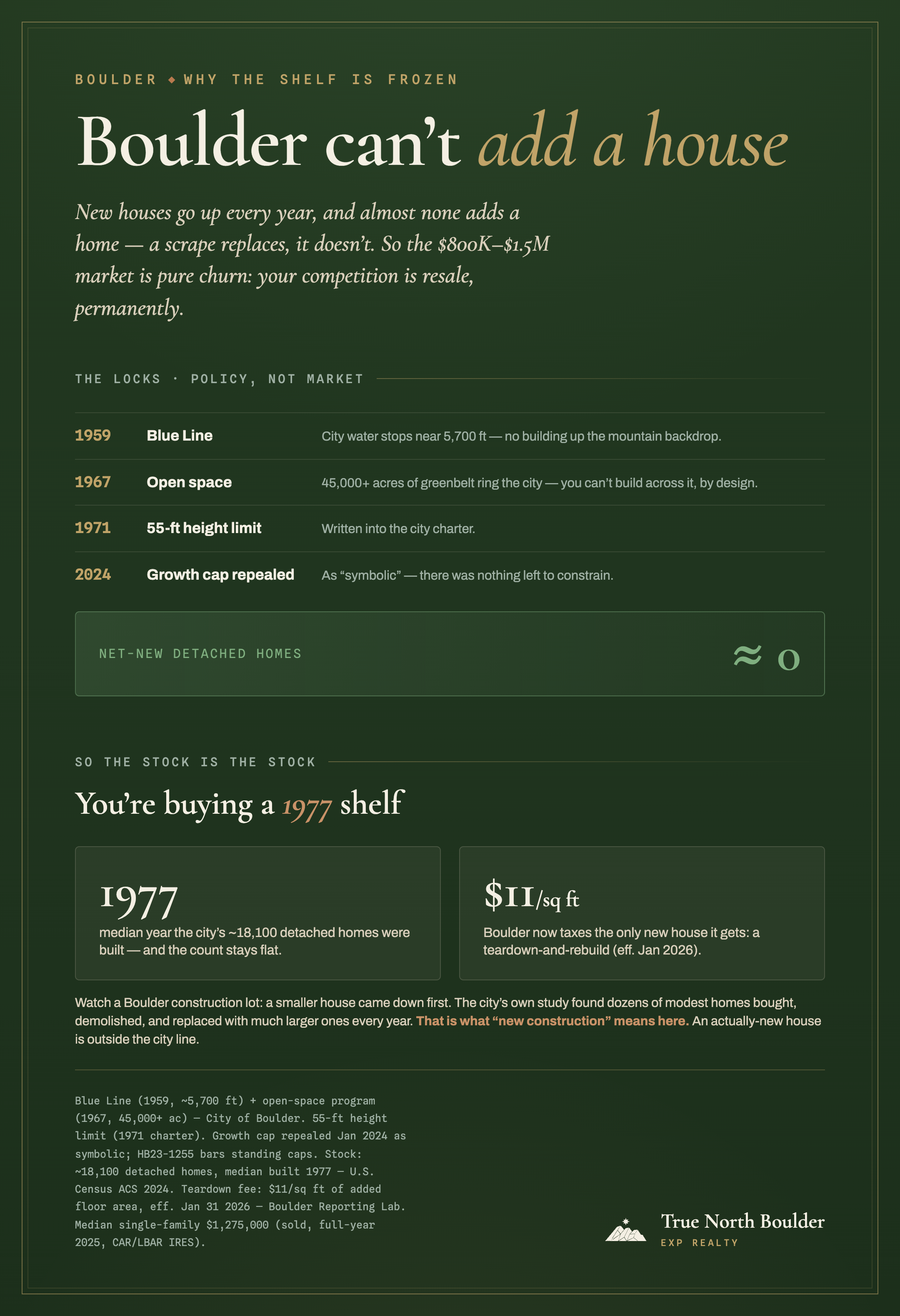
You will see construction fencing in Boulder. Concrete trucks, framing crews, the whole theater of a growing city. Watch what happens on those lots, though: in nearly every case a smaller house came down first. The city's own analysis, reported when the council priced this pattern in late 2025, found that dozens of modest homes are bought, demolished, and replaced with much larger ones every year. The study valued the replacements at millions more than what they came down for. That is what "new construction" means inside Boulder city limits. A scrape replaces. It does not add.
The reasons are old and deliberate, and they are not changing. In 1959, voters drew the Blue Line: city water service stops near 5,700 feet, which ended development up the mountain backdrop. In 1967, Boulder became the first city in the country to tax itself to buy open space, and today more than 45,000 acres of it ring the city, a greenbelt you cannot build across by design. A 55-foot height limit went into the charter in 1971. And the famous 1976 growth cap? The city repealed it in January 2024, and the reason is the tell: officials called it symbolic, because it had not actually constrained anything in two decades. There was nothing left to cap. State law (HB23-1255) now bars a standing cap like it anyway.
If you follow Colorado housing policy, you know the state pried some doors open in 2024: accessory dwelling units must now be allowed on single-family lots, transit areas must zone for density, occupancy limits based on family relationship are gone. All real. None of it produces a new detached house in Boulder. The stock the move-up market trades is the stock there will be: the census counts roughly 18,100 detached homes in the city, median year built 1977. The city itself just underlined the point: starting January 31, a new fee prices teardown-replacements at $11 per square foot of floor area added beyond the original home. Boulder is now literally taxing the only kind of single-family construction it gets.
What does that mean for you? Everything in this guide flows from it. Your competition when buying is resale only, forever. Your leverage when selling is structural, not cyclical. And the only way to buy an actually-new house at this budget is to cross the city line. That is a legitimate move, and a different trade.
The three Boulders: where living in Boulder, Colorado fits your budget
Boulder splits into three price regimes: the historic core (Mapleton Hill, Newlands, Chautauqua), where detached homes mostly start above $1.5M; the mid-city neighborhoods (Table Mesa, South Boulder, North Boulder, Martin Acres), where the $800K–$1.5M budget actually works; and the county satellites (Gunbarrel, Niwot), where the same money buys more house across a school-district line.
Locals argue about neighborhood boundaries, but the market itself is blunt. There are three Boulders, and your budget picks among them before you ever see a listing. If you are trading up within the city, name both of your tiers: the one you are selling from and the one you are buying into. They are usually not the same, and the difference is the whole negotiation. If both of your addresses land in the same tier, the fork at the end of this guide is your real map, and the caution there about band-level data applies to you twice.
Detached homes — priciest first
Mostly $1.5M and up
The historic core
Mapleton Hill, Newlands, the streets under Chautauqua. For this budget, a place to walk, not to bid.
$800K–$1.5M · your band
The mid-city neighborhoods
Table Mesa, South Boulder, Martin Acres, North Boulder. The market's middle, not its floor:
$1,275,000
2025 median sale — inside this band
Across the city line
The county satellites
Gunbarrel and Niwot. The same money buys more house — and the school district changes with the address.
Across 2025 the median single-family home in Boulder sold for $1,275,000, which falls inside the middle tier — CAR Local Market Update (IRES data). Tiers are this guide's framing, not a published market segmentation; no separate median is published for Gunbarrel or Niwot, which sit in unincorporated county.
The historic core (Mapleton Hill, Newlands, the streets under Chautauqua) is the Boulder on postcards, and for most readers of this guide it is a place to walk, not to bid. Detached homes there mostly start above $1.5M and run far past it. If that is your budget, the calculus is different and so is the competition, and our Mapleton Hill guide walks that historic-landmark district in full, while Newlands is the reno-trap case where a move-up budget buys the dirt, not the house.
The mid-city neighborhoods are where the $800K–$1.5M budget lives: Table Mesa and South Boulder, Martin Acres, and North Boulder, whose open-space edge around Wonderland Lake is its own guide. This is the most liquid slice of the market. Across 2025 the city's median single-family sale was $1,275,000, which means this band is the middle of the market, not the bottom. What the money buys is mostly 1955–1985 stock: ranches and tri-levels built in Boulder's one real growth spurt, solid and honest about their age. That age is a diligence list — this is an EPA Radon Zone 1 county, a finished basement may be unpermitted, sewer laterals and mid-century systems are often original, the clay soils move, and the 2013 flood redrew the maps on the eastern edges. None of it is a reason to walk away; all of it belongs in your offer math. Our Table Mesa guide works that checklist in detail, and shows which sub-area a given budget actually reaches.
The county satellites, Gunbarrel and Niwot, are where the same money buys more house, newer systems, and actual land. The trade is real, and it comes with a line on the map that matters more than any of the marketing: the school district changes (more on that next), and the resale market thins as you move out. Each has its own guide, because each is its own argument. And if a job is what brought you here, our employer relocation guide runs this same decision from the office's side of the map.
One structural note, because it changes how listings read: at the lower end of this band inside the city, the stock shifts substantially toward townhomes and condos. That is not a judgment, it is the shape of the stock. It is also why a blended "Boulder home value" from a portal sits so far below the single-family number.
Which side of the school line are you buying?
Gunbarrel feeds Boulder Valley (BVSD) schools; Niwot, one road north, is St. Vrain Valley (SVVSD). Crossing between districts by open enrollment is a capacity-limited lottery with no district transportation, and the application window for fall 2026 closed on January 7. The boundary you buy is the assignment you can count on.
Here is the detail that surprises almost everyone shopping across the north county: Gunbarrel and Niwot sit a few minutes apart, and they are in different school districts. Gunbarrel homes feed Boulder Valley schools; Niwot is St. Vrain Valley, full stop. The district line runs between two places most buyers mentally file together.
Boulder buyers have historically treated open enrollment as the escape hatch: buy the house you want, choice into the school you want. Understand what that hatch actually is before you price it into an offer. BVSD's choice enrollment is a lottery, not first-come-first-served. It is capacity-limited: the most requested schools fill and turn applicants away. The district does not provide transportation for choice students. And it runs on a school calendar, not a housing calendar: the window for fall 2026 closed on January 7. If you are reading this in late January, the window is shut: offers follow the lottery, and late applicants join a waitlist in the order they arrive, without sibling preference. The door reopens next winter; buying a specific house will not reopen it sooner.
This cuts both ways, and both errors cost real money. Some buyers pay a six-figure premium for an attendance boundary that open enrollment might have gotten them for free. Others buy the cheaper house counting on choicing in, and meet the lottery. The honest rule: the boundary you buy is the only assignment you can count on, so verify it for the exact address with the district's own tools (BVSD · SVVSD) before you write the offer, and treat anything beyond it as upside.
If you are selling this spring, read the same fact from the other side: with the window shut, the buyers touring your house in March are buying boundaries. If your address carries one they want, that is a property fact, and your listing should say it plainly.
A June close starts in January
Work the calendar backward: a June close in Boulder means under contract by late April, and at December 2025's average of about 86 days from list to accepted offer, on the market by late January or early February. So the preparation (sewer scope, radon test, insurance-to-rebuild review, lender file, the credit line you'll want later) is January work, not April work.
Boulder's spring market is real. In 2025, April closed two and a half times the homes January did. But closings lag decisions by months, so the sellers who look effortless in May did their work in the dark of winter. Run the arithmetic backward: a June closing means going under contract in late April. In the December 2025 report, the average Boulder single-family listing took about 86 days from list to accepted offer. That figure is an average, it runs to offer rather than to closing, and it is a winter read, so spring usually moves faster. Even discounted, it puts a late-January or early-February list date on the whiteboard. If you are reading this on the dateline and that math feels tight, run the prep list in parallel starting now, or point the same playbook at a July close. It works in any month; spring just pays best. Either way, this is the working month:
For sellers. On 1955–1985 stock, pre-inspect the things that blow up April contracts: scope the sewer lateral, test for radon (assume you will install mitigation if it is not there), pull your insurance policy and check the rebuild coverage against current construction costs. Fix what is cheap, disclose what is not, and let your February listing carry no surprises. One more, and it is the one nobody tells you: if a home-equity line is part of your bridge plan, open it now. Most lenders will not open a HELOC on a home that is already listed, or was listed recently. Policies vary. The sequence does not: line first, sign second.
For buyers. Two pieces of January work. First, the paperwork reality: since August 2024, an agent must have a written buyer agreement with you before touring homes, in person or virtual. Compensation is negotiable and not set by law. January, with no house on the line, is when you interview agents and negotiate that agreement; April, in a driveway, is when you regret not having done it. Second, for any address you get serious about, price the insurance before you offer: call for a replacement-cost quote on that specific house. After the Marshall Fire, a University of Colorado study of roughly 5,000 claims found 74% of total-loss households were underinsured, over a third of them severely. The state's new FAIR Plan exists as a last resort, and it is exactly that: it caps residential coverage at $750,000 and pays actual cash value, often less than what a house in this band costs to rebuild. Which is exactly the number the replacement-cost quote puts in your hand. A quote is one phone call, it works from any state, and it belongs in your offer math the way the inspection does.
Selling into the same scarcity you're buying from
Boulder's frozen market sits on both sides of a move-up trade: the scarcity that makes your sale strong makes your purchase hard. Whether the trade nets in your favor depends on the tier you're leaving and the tier you're entering. No one publishes data for that band, so treat anyone quoting it precisely with suspicion.
The freeze is the reason Boulder sellers feel invincible and Boulder buyers feel hunted. If you are trading up inside the city, you are both people in the same transaction. The scarcity that props up your sale price is the same scarcity thinning the shelf you are shopping from. Whether that nets out in your favor depends on which tier you are leaving and which you are entering, and those two markets can behave differently in the same month.
About this data, and the figure we won't fake
December 2025 closed with Boulder single-family supply at 2.7 months, and we'd caution you against reading much into that number, because December inventory is the seasonal trough; spring supply loosens as listings arrive, so don't price off a winter figure. What we won't quote at all is a months-of-supply or days-on-market figure for the $800K–$1.5M band itself. Nobody publishes one. The town-wide numbers blend the estate tier and the entry tier, and the band can behave differently than either. That count lives in IRES, the MLS covering this county, and until we can pull the band-level data ourselves we won't pretend a town average answers a band question. Any broker you interview can run that count in IRES; have them walk you through the search itself, not just read you the result.
So the decision comes down to a fork, and it is worth naming both branches honestly. Branch one: trade up within the frozen stock. You accept the hunt, because the neighborhood, the schools, or the walk to work is the point. You manage the two-sided risk with sequencing, and that is its own discipline: our buy-before-you-sell guide walks the mechanics. Branch two: take your Boulder equity across the city line, where the same money buys a newer, larger house in Longmont, Niwot, or further up the corridor, and where the resale market behind you is thinner. Our Boulder vs Longmont comparison weighs the biggest of those trades. Neither branch is the "smart" one. They are different problems, and the only mistake is not knowing which one you are choosing.
Which Boulder, with a broker who won't push
We are True North Boulder, a real-estate team brokered by eXp Realty, and this guide is the way we work: the number with its source and its window, the rule with its date, and a plain refusal where the data does not exist. If you are staring at the fork above, which Boulder or whether Boulder at all, that conversation is what we are for. Bring the address you are curious about and the house you would be leaving. We will bring the current numbers and the questions from this page. No scripts, and nobody gets talked into the city or out of it. Bring us both addresses, or keep reading: the full buying guide is the natural next page, the monthly Boulder market report keeps the numbers current, and everything we publish on this town gathers at the Boulder hub.
The bottom line
Boulder's housing market is a fixed pool with a current running through it. Pick your Boulder first: know whether your budget is a core budget, a mid-city budget, or a satellite budget, and which side of the school line each candidate address sits on. Then work the calendar like the locals who look lucky in May: the January before, not the April of. And when someone quotes you a precise number for exactly your slice of this market, ask to see the search.
Frequently asked
How much does it cost to buy a house in Boulder, Colorado?+
Across 2025, Boulder's median single-family home sold for $1,275,000. Condos and townhomes trade well below that, which is why blended portal figures look cheaper. The $800K–$1.5M budget works in a defined set of neighborhoods, not everywhere.
Why is there so little new construction in Boulder?+
City water stops near 5,700 feet under the 1959 Blue Line, more than 45,000 acres of city open space ring the edges, and the buildable land filled decades ago. New houses still appear, but almost every one replaces a smaller home that was torn down. A scrape replaces; it does not add.
What school districts serve Boulder homes?+
Two. Boulder Valley (BVSD) covers the city and Gunbarrel; St. Vrain Valley (SVVSD) starts at Niwot, one road north. The line between them is also a price line, and open enrollment across it is a capacity-limited lottery with no district transportation. Always verify assignment for the exact address.
When should I list a Boulder home for a spring sale?+
Work backward. A June close usually means going under contract in late April, and at December 2025's average of about 86 days from list to accepted offer, that puts you on the market by late January or early February. The preparation (sewer scope, radon test, insurance review, lender file) is January work.
Should I buy in Boulder or in one of the corridor towns?+
It depends on which problem you want to own. In Boulder you compete hard for an older house and resell easily later. In Longmont, Niwot, or Berthoud the same money buys newer and bigger, with a thinner resale market behind it. Our corridor comparison walks the trade town by town.
Sources & data notes
- Boulder single-family median $1,275,000. CAR Local Market Update (via LBAR), IRES data, single-family, sold, full-year 2025. December 2025 alone: median $1,175,000 on 62 sales, too few to lean on, which is why this page anchors to the year.
- December 2025 months of supply 2.7 and ~86 average days from list to accepted offer (same report). DOM is an average and runs list-to-offer, not to closing; December supply is the seasonal trough.
- 2025 monthly sold counts (January 39 → April 99): CAR/IRES monthly reports through December 2025.
- Blue Line (1959, ~5,700 ft) and the 1967 open-space program: City of Boulder. Growth cap repealed January 2024 as largely symbolic: Boulder Reporting Lab; standing caps barred by HB23-1255.
- Teardown-replacement fee: $11 per square foot of floor area added beyond the original home, effective January 31, 2026: Boulder Reporting Lab, on the city's nexus study.
- Housing stock: ~18,100 detached homes, median year built 1977: U.S. Census Bureau, ACS 2024 1-year estimates (B25024/B25035), Boulder city.
- BVSD choice enrollment mechanics and the January 7 window: BVSD. Verify school assignment per exact address with each district's school finder.
- Radon: EPA Zone 1 county; CDPHE. Aluminum branch wiring (1965–73): CPSC Publication 516.
- Marshall Fire underinsurance (74% of total losses; 36% severely): University of Colorado / NBER study, ~5,000 claims, via CU Boulder Today. Colorado FAIR Plan: coverage "not to exceed the total of $750,000 for property and contents combined for actual cash value, not replacement cost": Colorado Division of Real Estate advisory (hand-verified; the DOI's own FAIR landing page states the program but not the cap).
- Written buyer agreement before touring (effective August 17, 2024; compensation negotiable, not set by law): NAR.
- What we refused to publish: a net-new construction count (permit data counts scrape-rebuilds as new homes, so gross permits measure replacement, not addition) and any months-of-supply, days-on-market, or price figure for the $800K–$1.5M band specifically (no such data is published; it requires a direct MLS pull).