Best Boulder Neighborhoods for Remote Workers: Buy the Parcel, Not the Position
If you can work from anywhere, you're the one Boulder buyer with no commute to justify the premium, so you stop optimizing the map and start optimizing the parcel: two real offices, fiber at the exact address, and the five-minute radius you'll actually use.
Every other buyer in Boulder gets to skip one question. You don't: if your job doesn't care where you sit, why pay to sit in Boulder? You're a remote worker looking to buy in the $800,000–$1.5 million range, and you have something no one else in this market has. No commute. No office to be near. No employer telling you which side of town to live on. That sounds like pure freedom. In practice it's the hardest version of the decision, because when you can live literally anywhere, nothing justifies the choice for you. You have to justify it yourself, and the honest way to do that flips the usual house-hunt on its head.
Fast facts · buying in Boulder as a remote worker
Sources: CAR/LBAR Local Market Update (IRES) · FCC National Broadband Map · CO Department of Revenue · as of July 2026
The buyer whose job doesn't care where you sit
Every other buyer in this market is solving a location problem: minimize the drive to the campus, the commute downtown, the walk to transit. That's macro-location, where the house sits relative to the places you have to be. It's the invisible engine under almost every "where should we live" article ever written about Boulder.
Take away the commute and that engine has nothing to turn. You don't have to be near anything. So macro-location, the thing everyone else is optimizing and paying up for, is worth exactly nothing to you. Paying the Boulder premium for a proximity you'll never use is the single most expensive mistake this buyer makes.
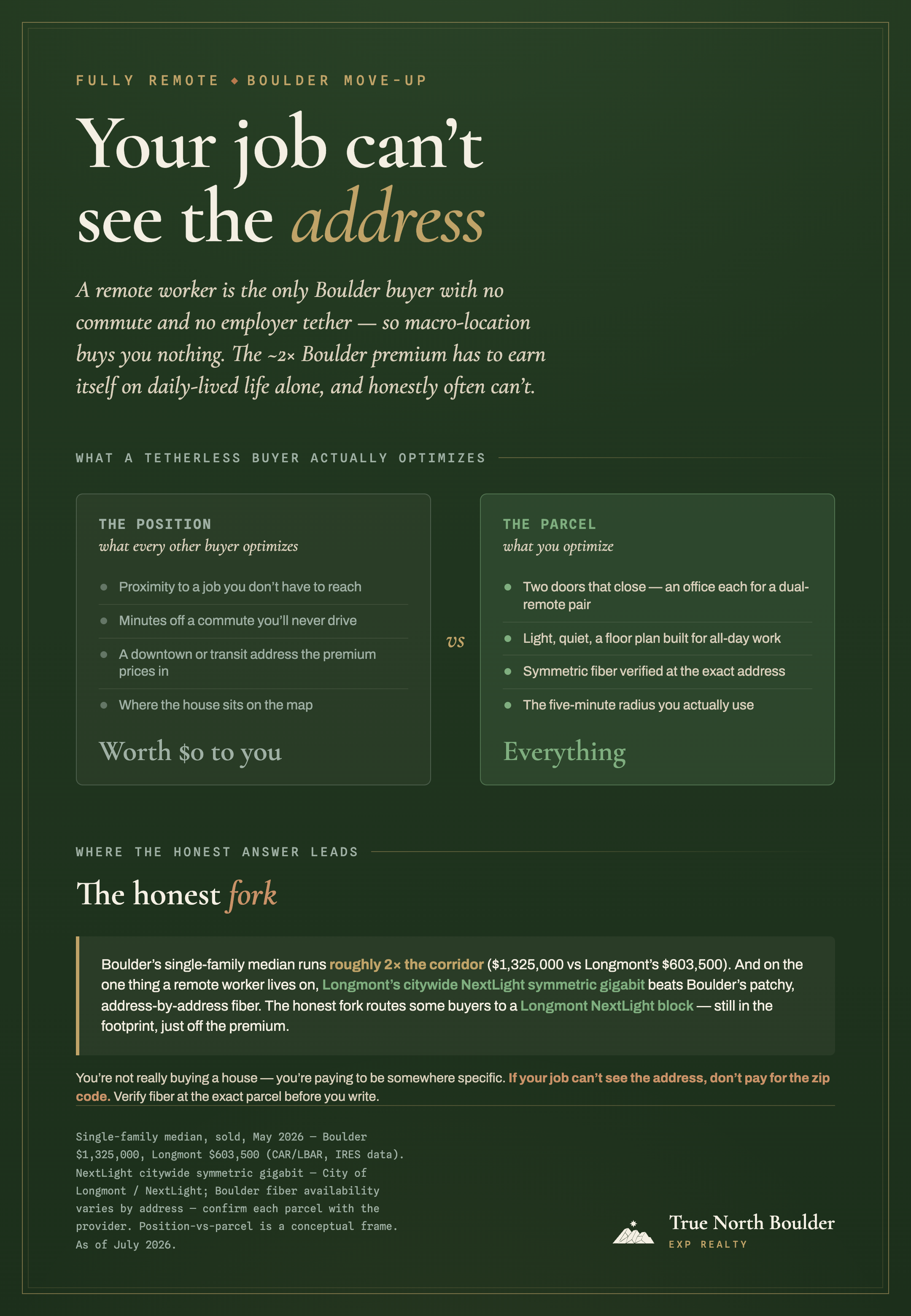
What you optimize instead is the parcel: the house you'll sit inside 40-plus hours a week, and the five-minute radius around it you'll actually use. You buy a place, not a position. Everything below follows from that one move. (And if you do have an occasional in-office day, that's a node-and-cadence question our Boulder–Denver commute guide answers; if your move is anchored to a specific employer after all, a guide like our relocating to Boulder for Google walkthrough maps that path instead. For the pure-remote buyer, both are footnotes, not the plan.)
What the Boulder premium actually buys you, and what it doesn't
Start with the price gap, because it reframes the whole decision. Boulder's single-family median runs around $1.3 million; down the corridor, Longmont sits near $600,000 and Loveland near $535,000 (single-family, sold, May 2026; the current figures are in the Boulder and Longmont market reports). That's a median roughly double the corridor's. Your own like-for-like gap will be smaller than that headline ratio, because an $800K–$1.5M budget buys the top of Longmont and the middle of Boulder, not median against median, but it's still real money, and a block-level comp set for your target address is the only honest number. For a buyer optimizing a commute, that premium buys minutes back every single day. For you, it buys a zip code.
That's not an argument against Boulder. It's an argument for being honest about what you're buying. The Boulder premium is real value if you'll use what it buys daily: an Open Space trailhead you can be standing on ninety seconds after you close the laptop, the specific density of coffee shops and colleagues-you-haven't-met-yet that a remote worker has to manufacture on purpose (because the office won't hand it to you anymore), the light and the Flatirons out the window that you'll see far more of than any commuter will. Those are the antidotes to the specific failure mode of remote work, the slow slide into never leaving the house, and for the buyer who will genuinely use them they can be worth every dollar of the premium. But they are dead money if what you really do all day is sit indoors on video and order groceries. So the whole decision comes down to two things a commuting buyer treats as afterthoughts: the house as a workplace, and the neighborhood as a daily-use amenity you'll step into. Get those right and Boulder earns its premium. Ignore them and you've bought the most expensive version of a life you could have had for a lot less down the corridor. You can start that test yourself from a thousand miles out: drop each shortlist address on a map and look at what's genuinely within a five-minute walk or drive: a trailhead, a coffee shop, a grocery you'd actually use. If the honest answer is a stroad and a garage, the premium isn't buying you anything you'll touch.
Which Boulder neighborhoods work for a remote worker: the two-office problem
A dual-remote household in Boulder is really a four-bedroom (or finished-basement) search: two rooms with doors that close, far enough apart that one 10 a.m. call doesn't bleed into the other, plus roughly 10 Mbps of upload to run both at once. In band, south Boulder's Table Mesa ranches with finished basements are the cleanest fit; charming small-roomed older stock often can't give you two quiet work zones without a renovation. Tour for the second office and the upload, not the bedroom count.
When your house is your office, the specs invert. A commuter can forgive a dark bedroom and a slow upload, because they're gone all day. You can't. The single sharpest test for a two-earner remote household: 1,800 square feet with two doors that close is worthless if the upload chokes the moment you're both on camera at 10 a.m. The office and the internet aren't two separate boxes to check. For a dual-remote couple they're the same problem, because two people on simultaneous calls contend for the exact same connection.
That reshapes which homes work. A dual-remote household is really running a four-bedroom (or finished-basement) search: two real offices, not a shared desk in a nook. And some of Boulder's most charming older stock fights it while other pockets solve it. Table Mesa, in south Boulder, is the sweet spot here: its 1950s–70s ranches are in band, and their finished basements are exactly the second office you need. Just price that basement as a cost, not a freebie; on this mid-century stock it usually comes with a permit question, a radon test, and a systems budget, which our Table Mesa guide walks through. Newlands, north-central and a walk from downtown, runs smaller-roomed and pricier (many pop-topped and renovated), and historic Mapleton Hill just west of downtown sits mostly above $1.5M, past this budget. The common trap is the small-roomed early-century floor plan that can't give you two quiet work zones without a renovation. Newer product in Gunbarrel or down the corridor tends to solve the two-office layout more cleanly still, one more reason this buyer sometimes lands outside old-Boulder charm. (The rest of what you can't see from a listing site out of state, from radon to wildfire insurance to floodplain to metro-district taxes, is the same checklist any relocating buyer runs; our relocation blind-spots guide lays it out.)
Fiber is a per-address question: check it before you fall in love
Fiber in Boulder is an address question, not a neighborhood one. It varies house to house even on the same block, and the near-universal cable is fast to download but asymmetric, so its upload can't always carry two all-day video callers. You can't tell from a listing, and a map hit means serviceable, not installed. Check the exact street address on the FCC Broadband Map and each provider's lookup, then call to confirm a real drop before your inspection deadline passes.
This is the piece of due diligence a general "moving to Boulder" article will never hand you, and it's the one a remote worker's income actually rests on. Boulder's fiber footprint is partial and address-specific. It reaches part of the city, house by house, and you genuinely cannot tell whether a beautiful $1.3 million home has a fiber drop or only asymmetric cable by looking at the listing. Buy the wrong one and you've purchased a problem you can't renovate away.
Look up the exact street address, not the ZIP
Check the specific address on the FCC National Broadband Map and on each provider's own address checker. Fiber serviceability is parcel-level, so the block next door tells you nothing: the identical house across the street can be fiber or cable-only. And read a map hit as serviceable, not installed: it's a provider's claim that it can reach the address, which is routinely optimistic.
Read the upload, not the headline download
A dual-remote household wants roughly 10 Mbps of upload headroom or more for two simultaneous HD calls (one 1080p call runs about 4 Mbps up). This is where asymmetric cable bites: a plan advertised at "500 down" can deliver only 10–20 up, and older tiers 5–10, right where the 10 a.m. double-call stutters. Symmetric fiber removes the contention entirely.
Call the provider with the address, then use the deadline you already have
A map hit isn't a working drop. Call the provider with the exact address, confirm whether a line or ONT already exists, and get the install timeline and any construction fee in writing before you close, so a "yes" doesn't turn into three weeks on a hotspot after move-in. You don't need a special clause to protect yourself: Colorado's standard contract gives you an Inspection Termination Deadline that lets you walk for any reason, no fiber included, without the seller's agreement. Verify inside that window. If you want it explicit, add it as an Additional Provision (in a balanced market you have the leverage), but the termination right already covers it.
Know your fallback: connection and power both
No fiber? Fixed-wireless, Starlink (usable for calls at roughly 25–50 ms latency, but less rock-solid than fiber), or 5G home internet can carry a household; the FCC's OTARD rule generally protects your right to mount a dish or antenna even under HOA covenants. In the foothills, check the actual cell signal at the address itself, because a mountain-shadow dead zone kills the very backup your income depends on. And check power, not just internet: west-Boulder and foothills addresses see downslope-wind outages, and Xcel has run public-safety power shutoffs in high-wind conditions, so an income that depends on staying online wants a UPS on the router at minimum and a battery or generator for a real dependency.
The kicker that makes this a corridor argument too: Longmont's NextLight is a citywide, symmetric, community-owned gigabit network, repeatedly rated among the fastest in the country, at a fraction of typical pricing. So the value town a remote worker is already eyeing for its lower prices also beats Boulder on the single piece of infrastructure they live on. When the thing you do all day is upload, that's not a small footnote.
When the honest answer is the corridor
We're a Boulder team, and this is the one buyer we'll sometimes point down the road: not out of our footprint, just off the Boulder premium. Here's why, plainly. As of 2025, more people left Colorado than moved in from other states for the first time since 2004 (the Colorado State Demography Office tracks it), and the inflow that remains is landing in the corridor and the newer communities north and east, not in Boulder-metro. Remote and hybrid work gets named as the driver, because a portable income keeps its out-of-state salary while buying a cheaper-lifestyle life.
The one buyer we might send to Longmont
If you'll spend your days on calls indoors, a corridor house buys you the two-office floor plan, the trailhead you'll actually use, and a citywide symmetric-gigabit network, for meaningfully less than Boulder. Boulder's premium is worth it only if you'll use what it buys. Routing you to a Longmont NextLight block instead of a Boulder zip code isn't sending you away; it's still our corridor, and it's the honest version of "buy the parcel, not the position." Putting you in the home where the parcel wins beats selling you a premium you won't use.
None of that means don't buy Boulder. It means buy Boulder for the right reason, the daily-use life you'll genuinely live, and let the corridor win when the premium is buying you nothing you'll touch. Longmont and Loveland put a bigger two-office home, better fiber, and a real downtown within the same budget, and we represent buyers across the whole corridor. If school boundaries drive your search, note that district lines don't follow town names: our Longmont and Boulder area guides map the BVSD and St. Vrain boundaries by address, so verify the assigned schools for any home before it wins you over. And for the full picture of what a given budget buys across the corridor, our what $1M–$1.5M buys guide runs the towns side by side.
The tax question nobody mentions until April
One more thing a remote buyer needs to hear before they close, not after. When you make Colorado your domicile, the state taxes your worldwide income at a flat rate, regardless of where your employer sits. And if that employer is in a "convenience of the employer" state (New York and Pennsylvania are the most common, among a handful that also includes Connecticut, Delaware, Nebraska, and Arkansas), you can end up owing tax in two places at once. This isn't tax advice, and every situation is genuinely different. But it is a question to put to a CPA before you establish residency, because it can quietly change the math on whether Boulder's premium is affordable after tax. The buyer who gets surprised is the one who never knew to ask.
Pressure-test each address from out of state
The whole job here is turning "we could live anywhere" into "we'll use this, every day." So the useful first step costs you nothing and needs no move date. Before you book a scouting trip, hand off the out-of-state shortlist you're weighing and we'll confirm what no listing photo reveals: the real symmetric upload at each exact address, whether the floor plan holds two real offices, and what's genuinely inside that five-minute radius. Some of those addresses will be in Boulder; some will make more sense a few exits north, and we'll lay the trade-off out either way. True North Boulder is a real-estate team under eXp Realty, and touring (even by video) starts with a short written buyer-agency agreement whose terms are negotiable, not set by law. For the buyer whose office is wherever the laptop opens, the right home is the one that works at your desk on a Tuesday, not the one that prices highest on the listing.
Frequently asked
Which Boulder-area neighborhoods actually have fiber?+
Fiber is an address question, not a neighborhood one, which is exactly the trap. Boulder fiber reaches only part of the city and it varies house to house even on the same street; the near-universal cable option is fast to download but asymmetric, so its upload can choke a household with two people on video all day. You cannot tell from a listing, and a map hit means serviceable, not installed. Check the exact street address (not the ZIP) on the FCC Broadband Map and each provider's own lookup, then call the provider to confirm a real drop and the install timeline before your inspection deadline passes -- Colorado's contract lets you walk inside that window for any reason. And note the corridor's edge: Longmont's NextLight is citywide, symmetric, community-owned gigabit.
What internet upload speed does a two-person remote household need?+
Plan for real upload headroom, because two simultaneous HD video calls contend for the same pipe. One 1080p call runs roughly 4 Mbps up, so two at once plus background traffic wants about 10 Mbps of upload as a floor, and more is comfortable. This is where asymmetric cable bites: a plan advertised at 500 Mbps download can deliver only 10-20 up, and older tiers as little as 5-10, which is where the 10 a.m. double-call stutters. Symmetric fiber removes the contention entirely, which is why fiber-at-the-address is the spec that matters most for a dual-remote home.
Should a remote worker buy in Boulder or Longmont?+
It depends on whether you'll use what Boulder's premium buys. Boulder single-family runs roughly double Longmont's, and if you spend your days indoors on calls, that premium is buying a zip code your job can't see. Longmont gives you more room for two offices, a citywide symmetric-gigabit network (NextLight) that beats Boulder's patchy fiber, and a real downtown -- for meaningfully less. Buy Boulder if the five-minute radius you'll actually use every day is worth the premium; if it isn't, the corridor is often the honest answer, and it's still our footprint.
Is Boulder a good place for a home office (or two)?+
For one office, easily. For two, watch the floor plan: a dual-remote couple needs two rooms with doors that close far enough apart that one call doesn't bleed into the other, plus the upload to run both at once. In band, Table Mesa's 1950s-70s ranches solve the second office with their finished basements -- just budget that basement as a cost (permit, radon, systems), not a freebie. The trap is the small-roomed early-century floor plan that can't fit two quiet work zones without a renovation, and Newlands runs pricier while Mapleton Hill is mostly above $1.5M. Newer product in Gunbarrel or down the corridor tends to solve the two-office layout more cleanly. Tour for the second office and the upload, not just the square footage.
Do remote workers pay Colorado income tax if their employer is out of state?+
Generally yes, once you make Colorado your domicile -- the state taxes a resident's worldwide income at a flat 4.4%, regardless of where the employer sits. And if that employer is in a 'convenience of the employer' state (New York and Pennsylvania are the most common, with Connecticut, Delaware, Nebraska, and Arkansas among the others), you can face tax exposure in both places. This isn't tax advice and every situation differs, so talk to a CPA before you establish residency -- a remote buyer who doesn't know to ask is the one who gets a surprise the following April.
About these numbers
Home prices are single-family, sold, from the CAR/LBAR Local Market Update (IRES data), May 2026, not portal estimates. (Our Boulder and Longmont area guides give town context and may show an earlier month's vintage; the May-2026 figures here are the current ones.) The Boulder-versus-corridor "roughly double" is the ratio of those two town medians, not a per-home promise, and your like-for-like gap is smaller, so get a block-level comp set for your target address.
Fiber coverage and upload speeds vary by exact address and by provider plan, and they change over time; the figures here are a planning floor, not a guarantee. Verify your specific address on the FCC Broadband Map and the providers' own lookups before you rely on it.
Migration, remote-work, and tax figures are as of July 2026. We refresh this guide when a major employer's return-to-office rules, the migration picture, or corridor fiber coverage shifts.
The bottom line
You're the only Boulder buyer with no commute to justify the premium, so buy the parcel, not the position: two real offices, verified fiber at the exact address, and the five-minute radius you'll actually use.
Sources & data notes
- This guide is independent and not affiliated with, or endorsed by, any internet provider. It is not tax advice; consult a CPA before you establish residency.
- Home prices: single-family, sold, from the CAR/LBAR Local Market Update (IRES data), May 2026: Boulder around $1.3M, Longmont near $600K, Loveland near $535K. See our Boulder and Longmont area guides for town context (they may show an earlier month's vintage).
- Fiber + upload: coverage is address-specific: FCC National Broadband Map plus each provider's own address lookup; Longmont's NextLight is a citywide, symmetric, community-owned gigabit network. Verify your exact address. As of July 2026.
- Video-call bandwidth: one 1080p HD call runs roughly 4 Mbps up, so a dual-remote household wants about 10 Mbps of upload as a floor, per general ISP guidance; asymmetric cable often delivers 5–20 up.
- Migration: Colorado saw more people leave than arrive from other states in 2025 for the first time since 2004, with remote/hybrid work named as a driver: Colorado State Demography Office (DOLA), 2025 net domestic migration.
- Tax: Colorado taxes a resident's worldwide income at a flat ~4.4%, regardless of employer location; "convenience of the employer" states include New York and Pennsylvania (plus Connecticut, Delaware, Nebraska, and Arkansas): Colorado Department of Revenue (residency/domicile); consult a CPA. As of July 2026.
- Refused: unsourced portal price estimates with no stated basis.