Living in Table Mesa, Boulder: The In-Band Ranch, and What It Really Costs
Table Mesa is where a move-up budget still buys a detached house inside Boulder city, but the vehicle is a 1950s–70s ranch with a finished basement, not a view lot, and it's a stacked cost you underwrite going in. Here's which rung your band reaches, and what the ranch really costs.
If you're a move-up buyer in Boulder, you've probably made a quiet peace with a hard idea: that Boulder-proper is gone for your budget, and the choice is a corridor town or an unincorporated pocket that borrows the "Boulder" address without the city behind it. Table Mesa is the neighborhood that reopens the question. It's genuinely inside the city, at the foot of the foothills, and there's still a way into it in the $800,000–$1.5 million band. But the way in isn't a cheaper pocket. It's a specific product: the 1950s–70s ranch with a finished basement. Get the product right and Table Mesa is the last in-band foothold inside Boulder-proper. Get it wrong and you've overpaid for a systems project someone priced like it was done.
Table Mesa is the one Boulder-city neighborhood where an $800,000–$1.5 million move-up buyer still gets a detached house inside the city: Boulder Valley schools, foothills and Open Space at the door, a fast bus to Denver. The vehicle is the mid-century ranch, and your band reaches it mostly on the lower and eastern rungs (Martin Acres, Keewaydin, lower Table Mesa), not the foothills view lots. The house, not the address, decides whether it's a good buy.
In Table Mesa the entry ticket is a product, not a pocket, on a ladder your band only partly reaches
Start with what the neighborhood is, because it's the opposite of the pockets people compare it to. Niwot and Gunbarrel are Boulder-address-but-not-Boulder-city; Table Mesa is unambiguously the city, laid out on the old Viele Ranch starting in 1962 and built out through the 1970s. That's why the stock is what it is: block after block of mid-century ranches, most with a finished (or finish-able) basement, on lots that step up toward the foothills. That ranch is the vehicle. It's how a move-up budget reaches a detached house inside Boulder-proper when the trophy stock in Newlands or Mapleton Hill sits well over $1.5 million. The other thing happening on these blocks is the pop-top (owners adding a second story to the original ranch), which is why a single street can run from an untouched rancher to a $1.6 million rebuild, and why a single "Table Mesa median" is a fiction.
But "Table Mesa is affordable" is only half-true, and the half that's false will burn you if you shop the name instead of the rung. Table Mesa is a ladder of sub-areas, and your band reaches only part of it.
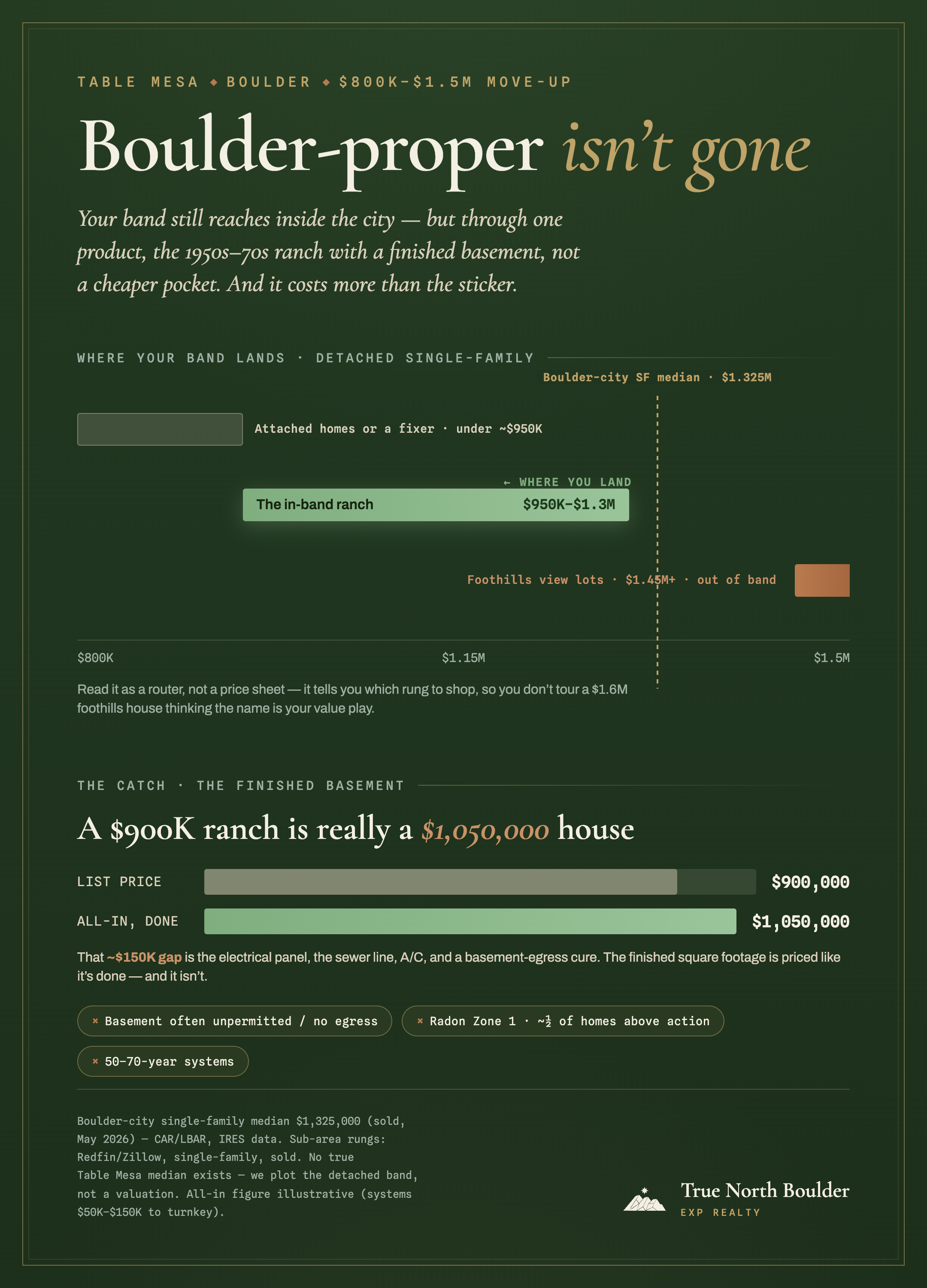
Read the ladder as a router, not a price sheet: under about $950,000 you're mostly in attached homes (townhomes, half-duplexes) or a real fixer in eastern Martin Acres and Keewaydin. Detached-in-band ranches mostly open around $950,000–$1,000,000; from there into the low $1.3 millions you reach the core detached stock in Martin Acres, Keewaydin, and lower and south Table Mesa; and if a listing is in Devil's Thumb, Upper Table Mesa, or the foothills-backing part of Shanahan Ridge, you're usually looking at the view lots that run past the band. The point of the ladder is to tell you where to look, so you don't tour a $1.6 million foothills house thinking the neighborhood is your value play. Two parcel-level things move price inside a rung. One is reno state: a gutted flip and an original-owner ranch on the same block diverge by hundreds of thousands, and here that renovation genuinely adds value; in Newlands, the mirror case, the same reno is the trap, because that land is priced for a scrape. The other is ownership mix: some Martin Acres blocks skew more investor- and rental-owned than owner-occupied, which shapes resale. Both are worth a parcel check.
Why we won't quote you a Table Mesa median
Table Mesa isn't a standalone reporting market (there's no CAR/LBAR sub-area report), and it's a ladder of sub-areas, so a portal "Table Mesa median" just averages a $700K teardown rung against a $1.8M pop-top rung and buries which rung your band actually reaches.
We anchor to the city-of-Boulder single-family median (~$1,325,000, sold, May 2026, CAR/LBAR IRES) and give sub-area ranges (Redfin/Zillow, single-family, sold), then price the specific house with a real comparable-sales pull. The portal "compare neighborhoods" figures are all-types blends and are not used.
The finished basement is the catch
Here's the part a glossy neighborhood guide sells as pure upside. The finished basement is what makes the ranch feel like a deal, the "4-bed, 2,400 finished square feet" at a price that looks impossible for Boulder. Three things converge on that exact basement, and a move-up buyer needs all three in the budget before the offer.
The basement bedroom is often not a real bedroom. A conforming bedroom needs legal egress, an escape window of a specified size and sill height. Plenty of Table Mesa basements were finished decades ago without a permit, so the "4th bedroom" won't appraise as one, may not insure or resell as one, and can run into Boulder's strict permitting and occupancy rules if you try to legalize or rent it. If you're pencilling that basement as rental income, know that Boulder requires a rental license and inspection and caps unrelated occupants, so the rent you underwrite may not be rent the city lets you collect. The finished basement is also the radon floor. Boulder County is a high-radon area, and roughly half of homes test above the action level; the finished basement is exactly where you and your household would spend time in that exposure. The test itself is cheap (a kit or a professional test runs from roughly $15 to $150); mitigation, if you're above the line, is a sub-slab system in the ballpark of $1,000–$2,500. It's a routine contingency item, but only if you test. And the systems are 50–70 years old. Original electrical panel, galvanized or cast-iron supply lines, an aging sewer line under the yard, often no central air, thin insulation. Bringing a mid-century ranch to genuinely turnkey commonly runs $50,000 to $150,000 depending on what's already been done, and the list price usually reflects only part of it.
Put it together and the real number changes. A lower-Table-Mesa ranch listed at $900,000 that needs the panel, the sewer line, air conditioning, and a basement egress cure isn't a $900,000 house; it's closer to a $1,000,000–$1,050,000 house once it's actually done. That's the figure you decide on, and it's the second half of the plate up top.
How to tell a value ranch from a money-pit
The two ranches sit on the same block at the same price: one is priced honestly for its condition, the other is a cosmetic flip hiding old systems behind new quartz. Before you fall for either, run this.
Pull the basement's permit history
Ask the listing agent for the finish permit, and check Boulder's permit records. No permit on a finished basement bedroom means it won't count as a bedroom for the appraisal, insurance, or resale. Price it as living space, not a bedroom, and confirm the egress window.
Read the systems' ages, not the finishes
New kitchen quartz is cheap to fake; a new electrical panel, sewer line, furnace, and roof are what cost money. Ask the age of each. A mid-century house with original systems needs a real updates budget on top of list.
Scope the sewer lateral
A $150–250 camera run tells you whether the 60-year-old clay line is root-bound or bellied, the single most expensive hidden surprise on a mid-century ranch, at roughly $10,000–25,000 to replace (more if it runs under the street), and one of the strongest inspection-objection levers you'll have.
Get a structural read, especially with a finished basement
Parts of south Boulder and the mesa sit on expansive clay that heaves slabs and cracks foundations, and a finished basement hides the evidence. Have the inspector (or a structural engineer on an older home) look for slab movement and foundation cracks before you rely on the finished space.
Test for radon and budget the contingency
Boulder County is high-radon and the finished basement is the exposure floor. A test is cheap (roughly $15–150), and mitigation (~$1,000–2,500) is a routine negotiation item if you're above the action level.
Get the hazard quote for your rung, before the objection deadline
The hazard depends on where you land. A foothills-backing lot carries wildfire exposure and a tightening carrier market, so confirm you can bind coverage. An eastern or lower lot near South Boulder Creek can sit in the FEMA flood zone, so check the flood map and get a flood-insurance quote. Either way, confirm coverage before you remove inspection and factor the premium into the number.
The foothills, and the trade on the same coordinates
The reason Table Mesa is worth this much work is out the back door: the neighborhood runs right up to NCAR, the Mesa Trail, Bear Canyon, and thousands of acres of Open Space, trailheads you can be walking in minutes after you park. That access is real, and it's the amenity the price is paying for.
It's also, on the same coordinates, the wildfire edge. The 2022 NCAR Fire triggered evacuations in Table Mesa, and Boulder's own wildfire planning treats the foothills interface as high-risk. The honest way to hold both is that it's a gradient, west to east: the homes backing directly to Open Space carry the interface exposure and the hardening insurance market, while the flatter eastern and lower blocks sit farther from it. Because the in-band rungs (Martin Acres, eastern and lower Table Mesa) are mostly on that eastern end, the insurability load is genuinely lighter for a move-up buyer here than for a foothills-view buyer, but you confirm bindable coverage before your objection deadline regardless. (If insurability is the whole question for you, our Loveland guide is where that constraint is the spine; here it's one factor among several.)
The catch is that the hazard doesn't disappear as you move east; it changes shape. The same eastern and lower blocks that shed the wildfire risk, near Keewaydin and Frasier Meadows, run up against the South Boulder Creek floodplain, where the 2013 flood put water waist-deep and a parcel can carry a federal flood-insurance requirement, a disclosure, and a resale factor of its own. So the read is symmetric: on a foothills-backing lot you're pricing wildfire and insurability, and on an eastern lot you're checking the FEMA flood zone and a flood-insurance quote. The hazard follows the coordinates either way; it just swaps which one you're underwriting.
The transit node
One thing Table Mesa has that almost no other in-band Boulder neighborhood does: a real transit node. The Table Mesa station on the US-36 Flatiron Flyer bus rapid transit is a fast, frequent ride to downtown Denver and Denver Union Station, which is why the neighborhood works for a household with an occasional Denver day without buying a Denver commute. One current caveat to see with your own eyes: the Table Mesa Park-n-Ride is in the middle of a roughly 18-month reconstruction (running from early 2026 into 2027), so the station is operating and the garage is open, but you'll drive past active construction and relocated gates until the work wraps.
Is Table Mesa your move?
Table Mesa fits if
- You want to be inside Boulder city (Boulder Valley schools, city services) and at the foothills in the $800K–$1.5M band.
- You're buying the mid-century ranch as a product and have the updates budget, not just the list price.
- A lower or eastern rung (Martin Acres, Keewaydin, lower Table Mesa) matches your number.
It probably isn't if
- You need turnkey with nothing to do.
- Your search is really the $1.5M-plus foothills view lot, a different budget and a heavier wildfire and insurance load.
- The corridor's newer stock and lower price for the same square footage matters more to you than a Boulder-city address.
Frequently asked
Is Table Mesa a good neighborhood to buy into in Boulder?+
For an $800,000-$1.5 million move-up buyer who wants to be inside Boulder city, it's often the one that still works: genuinely in the city (Boulder Valley schools, city services), at the foot of the foothills and Open Space, with a fast bus to Denver. The catch is that your budget reaches it through a specific product, the mid-century ranch, and mostly on the lower/eastern rungs (Martin Acres, Keewaydin, lower Table Mesa), not the foothills view lots that run over the band. Whether it's a good buy turns on the house, not the address.
How much does a house in Table Mesa cost?+
There's no honest single 'Table Mesa median,' because it isn't a standalone reporting market and it's a ladder of sub-areas, so any portal median blends a $700K teardown ranch with a $1.8M pop-top. For scale, the city-of-Boulder single-family median ran about $1,325,000 (sold, May 2026); within Table Mesa the entry rungs run from the high $800,000s for an attached home or a heavy-fixer ranch, with detached ranches mostly opening around $950,000–$1,000,000 and rising into the low $1 millions; the foothills view lots run past $1.45 million and out of the band. Price the specific house with a real comparable-sales pull, not an area average.
What's the catch with the mid-century ranches in Table Mesa?+
The ranch that gets you into the city in your band is a 1950s-70s house you'll put money into, and three things stack on it. The finished-basement 'extra bedroom' is often unpermitted and lacks legal egress, so it won't appraise, insure, or resell as a true 4th bed. That basement is also the radon exposure floor, and Boulder County is high-radon (roughly half of homes test above the action level). And mid-century systems (panel, sewer line, furnace, roof) commonly need real money to be turnkey. Budget the house as list price plus the updates, not list price.
Is Table Mesa a wildfire risk?+
Partly, and it runs by location. Table Mesa sits against the foothills, and the 2022 NCAR Fire triggered evacuations here, so wildfire is a real, parcel-level factor. But it's a west-to-east gradient: the homes backing to Open Space (Upper Table Mesa, the western edges of Shanahan and Devil's Thumb) carry the interface exposure and a tightening insurance market, while the flatter eastern and lower blocks (Martin Acres, eastern Table Mesa), where the in-band rungs mostly sit, are farther from it. The eastern trade-off is flood, not fire, so confirm the hazard coverage for your parcel before your objection deadline either way.
What schools are in Table Mesa?+
Table Mesa is Boulder Valley School District (BVSD), and the common feeders are Mesa Elementary, Southern Hills Middle, and Fairview High. Essentially all of Table Mesa feeds Fairview. Two things keep this a verify-by-address question rather than a neighborhood assumption: BVSD is actively redrawing attendance boundaries (changes phasing in for 2026–27), and the northern edge of south Boulder can fall in the Boulder High area. Because assigned schools are a well-documented driver of home values, confirm the current assignment for any specific home on the BVSD school-finder rather than assuming from the neighborhood name.
If it fits, skip the home-valuation tools, which are built for sellers. The move that protects you here is a rung-and-permit read on a specific house: start that with us and we'll place the listing on the ladder (which rung and sub-area it's really in), check whether the finished basement is permitted and has legal egress, flag the age of the panel, sewer line, and roof, and run comparable sales on that exact home. You'll know what the ranch costs to actually own before you write the offer.
A couple of guides worth a read alongside this one. Table Mesa is one neighborhood in our wider Boulder area guide. For a lab household at NIST, CU's south campus, or NCAR, the remote-worker's Table Mesa question (fiber at the address, two offices) is its own guide. And if you're still deciding whether you can trade up at all, start with how much equity you need to move up. True North Boulder is a real-estate team under eXp Realty.
The bottom line
Table Mesa is the last in-band foothold inside Boulder city, but the vehicle is a mid-century ranch you underwrite going in (unpermitted basement, radon, 50-year-old systems), and your band lands on the lower and eastern rungs, not the foothills view lots. Price the house as list plus the updates, and check the rung before you fall for the address.
Sources & data notes
- Price context: CAR/LBAR Local Market Update (IRES data), city-of-Boulder single-family, sold, ~$1,325,000 median, May 2026. Table Mesa is a no-report sub-area, so a precise sub-area median is refused (per market-data-sourcing §5); rung figures are sub-area ranges (Redfin/Zillow, single-family, sold). Portal "compare neighborhoods" medians are all-types blends and are not used.
- Radon: Boulder County Public Health (EPA Zone 1; roughly half of homes test above the 4.0 pCi/L action level).
- Wildfire: City of Boulder Community Wildfire Protection Plan; 2022 NCAR Fire evacuations.
- Transit: RTD Flatiron Flyer; Table Mesa Park-n-Ride reconstruction (2026–2027).
- Schools: Boulder Valley School District (BVSD) school-finder (Mesa Elementary / Southern Hills Middle / Fairview or Boulder High by parcel).
- History: Table Mesa developed on the Viele Ranch from 1962.
- As of July 2026. Verify school district, permit status, radon, and insurability for any specific address.