Living in Lyons, Colorado, Where No Median Holds Up
Try to look up what a home in Lyons costs and you'll get four different answers hundreds of thousands of dollars apart. There's a reason: Lyons is too small and too varied to have a usable median. Here's how you actually price a house here.
You decide you want to live in Lyons, and the first thing you do is the first thing anyone does: you look up what a house there costs. You get a number. Then, on the next site, you get a different number. Then a third, and a fourth, and by now they're hundreds of thousands of dollars apart and you have no idea which one to believe. What's worth knowing before you go any further: none of them is the answer, because Lyons doesn't have one. It's too small and too varied a place to have a reliable median, and once you understand why, you stop looking for the number and start doing the thing that actually works here, which is pricing the specific house in front of you.
What Lyons actually is
Lyons is a town of about 2,200 people in Boulder County, tucked at the mouth of the canyon where the North and South St. Vrain meet, at the junction of US-36 and CO-7, both of which climb to Rocky Mountain National Park. It's the old sandstone-quarry town that hosts the Planet Bluegrass festivals, it feeds St. Vrain Valley schools (not Boulder Valley), and it's about a 25-minute drive down US-36 to Boulder. Hemmed in by canyon and open space, it can't sprawl, which is the root of nearly everything below.
Start with what Lyons is, because it isn't a suburb of anywhere. It sits in Boulder County at the confluence of the North and South St. Vrain creeks, right where the plains hand off to the foothills, at the junction of US-36 and CO-7. Both roads lead up to Rocky Mountain National Park, which is why the town's old nickname is the Double Gateway to the Rockies. It's a historic sandstone town, its red rock quarried and shipped out to build much of the region a century ago, and today it's as well known for Planet Bluegrass, whose RockyGrass and Rocky Mountain Folks festivals fill the St. Vrain riverbanks every summer. About 2,200 people live here.
Fast facts · Lyons
Sources: US Census, SVVSD, Town of Lyons.
Two orientation facts save relocating buyers real trouble. First, the schools are St. Vrain Valley School District, with Lyons Elementary and the combined Lyons Middle/Senior High in town. That surprises people who assume Boulder County means Boulder Valley schools; it doesn't here, so check the district by address if it matters to you. Second, the commute: Lyons is about sixteen miles and a little under half an hour down US-36 to Boulder, with the Lyons Flyer bus running that corridor, but it's a genuine haul to Denver, and the canyon roads carry real winter-weather and closure risk. This is a lifestyle-trade town, gateway living for people who want it, not a convenience-first location, and it's honest to be clear about that. The corridor towns down on the plains each have their own guide, from Boulder and Longmont to Loveland and Berthoud; Lyons is the one that sits up at the canyon mouth, and it behaves differently from all of them.
Why Lyons doesn't have a price
No association publishes a Lyons market report. The monthly town-by-town numbers you see for Longmont or Loveland are kept at the Boulder County level for Lyons, because it sells only a handful of homes a month, far too few to average. So the "medians" floating around, roughly $632,000 to $938,000 depending on the source, are each doing something different with a tiny amount of data, and they disagree by more than $300,000. On a small, varied market like this, the disagreement is the real information.
Here's the part that reframes the whole search. There is no Lyons market report. The associations that publish those tidy monthly town numbers, the ones you can pull for Longmont or Berthoud or Loveland, keep Lyons folded into Boulder County, because the town simply doesn't transact enough to break out. In a typical month only a small handful of homes close here. You can't compute a stable median from that; one or two sales move it by a fortune.
The honest take
In a market this thin and this varied, the disagreement between the sources isn't a glitch to reconcile. It is the information. There's no town number to trust, so you don't price the town. You price the parcel.
Which is exactly why the numbers you find don't agree. Go looking for "the Lyons median" and here is the range you actually get, all of it recent, all of it describing the same little town:
- A sold median around $894,000, from early 2025.
- A different sold median near $850,000, from the middle of 2025.
- A modeled "home value" of about $938,000, from late 2025.
- Another modeled figure closer to $632,000, also from 2025.
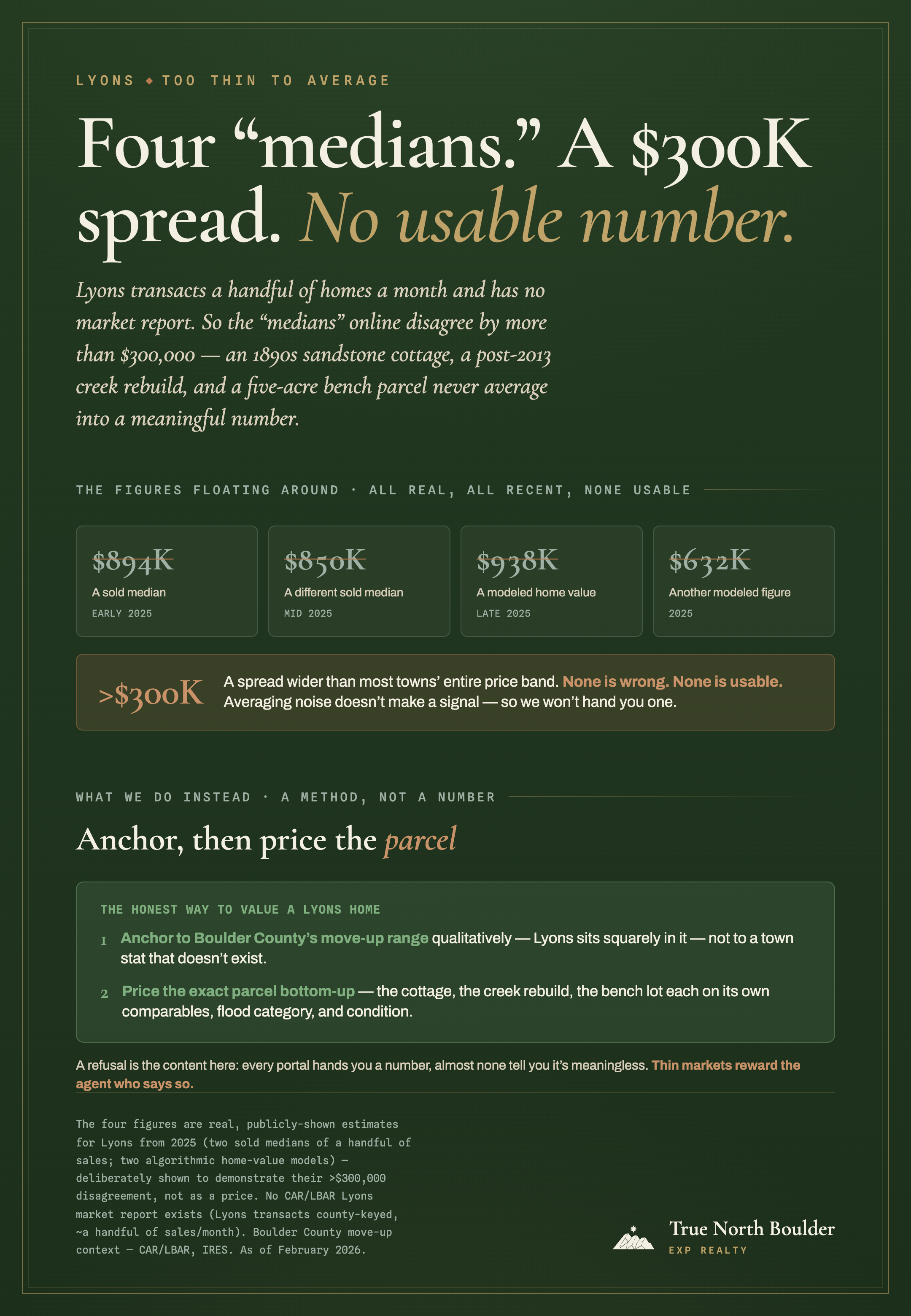
That's a spread of more than $300,000, and none of those is wrong, exactly. Each is doing something different: one is the median of the few homes that sold, another is an algorithm's estimate, a third is the median asking price of unsold listings (which drift high, because overpriced homes are the ones that sit). And the 80540 ZIP code runs for miles up into the mountains, taking in cabins in Pinewood Springs and Apple Valley that share nothing with a house in town, so some of these numbers aren't even measuring Lyons. Stack a few thin sales on top of that and you don't get a signal, you get four confident answers and a coin flip. The honest conclusion isn't to pick the one you like. It's to stop trusting any town-wide number and price the specific house instead.
Too few sales, too many kinds of house
You'll notice we didn't just average those four figures and call it "the price." Averaging noise doesn't make a signal. For orientation, know that Lyons sits squarely in Boulder County's move-up range, where single-family homes run well into seven figures, and use that as a starting altitude, not a comp. If you're weighing Lyons against the plains towns that do have real medians, [what a move-up budget buys across the corridor](/guides/what-1m-to-1-5m-buys-across-the-corridor/) lays them side by side. But the real number for any given house comes from the parcel and a handful of genuine, adjusted comparable sales, which is the next section. Anyone who quotes you a confident, precise "Lyons median" is selling you certainty this market can't actually give, and that's worth being wary of.
So how do you actually value a house here
You build the value instead of looking it up. Pull every comparable single-family sale in Lyons over the last twelve to eighteen months (a month's worth won't be enough), throw out the ones that aren't truly comparable (in-town versus bench lot versus mountain acreage, rebuilt versus original, creek-adjacent versus dry), and adjust the three to five that remain for parcel, condition, and flood category. Automated "instant estimate" tools are least reliable here, because they can't see the two things that most move a Lyons value: flood status and whether the home is on town water or a private well.
If there's no number to look up, value becomes something you construct. A real valuation here is a hand-built comparison: you pull every single-family sale in Lyons over the last twelve to eighteen months, not the last month, because you need enough transactions to work with. Then you throw most of them out, because a Lyons "comp set" is full of homes that aren't comparable at all. An 1890s stone cottage on a town lot, a modern rebuild elevated over a creek, and a five-acre parcel on a well and septic up on the bench are three different products; pretending they're one market is how you get a meaningless median. What's left is maybe three to five genuinely similar sales, and even those you adjust, up or down, for the specific parcel, its condition, and its flood situation.
This is also why the automated valuation tools, the "instant estimate" widgets, are at their worst in Lyons. They lean on volume and homogeneity, and Lyons offers neither. Worse, they're blind to the two factors that most swing value here, whether a parcel sits in the floodplain and whether it's on town water or a private well, so they routinely price a rebuilt-to-code home and a still-exposed original one as if they were the same house. They are not. Which brings you to the parcel itself, and the one piece of diligence no listing will do for you.
The parcel is the unit, and it starts with flood
Because homes here vary so much, you diligence the parcel, not the town, and flood is the marquee item. Lyons was hit hard in the September 2013 flood, and FEMA adopted updated floodplain maps for the area in October 2024. Sort any home into one of three buckets: a never-flooded lot outside the mapped floodplain, a post-2013 rebuild elevated to current code, or an original home still inside the remapped floodplain. They carry very different risk, insurance cost, and renovation rules, and the current FEMA map for the exact address tells you which.
Lyons and water have a long history, and September 2013 is the chapter that still shapes the market. The North and South St. Vrain overran the town in what hydrologists put at a 500-to-1,000-year flood; of roughly 960 homes, dozens were substantially damaged and about a fifth of the housing stock was lost, including two mobile-home parks that were the town's most affordable housing. Lyons rebuilt, the state re-mapped the floodplain, and FEMA adopted the updated maps as effective in October 2024. So flood isn't the story of Lyons, but it is the first thing you check on any specific parcel, and it sorts homes into three very different buckets.
A never-flooded bench or mesa lot outside the mapped floodplain carries little of this and no federal flood-insurance requirement. A home rebuilt after 2013 to current code, elevated with proper venting, is often lower-risk than its history suggests, but you verify the permits and get an elevation certificate. An original, pre-2013 home still sitting inside the remapped floodplain carries the most, and two specific traps come with it. First, if you buy one and later renovate, FEMA's "substantial improvement" rule means any project that runs to half the structure's value forces the whole house up to current floodplain code, elevation and all, which can quietly double a remodel budget. Second, flood insurance is now priced property by property under the federal Risk Rating 2.0 system, so the seller's old premium tells you nothing; pull a fresh quote in your own name inside your contingency window, but also ask whether the seller's existing federal flood policy can be assumed, because an in-force policy's capped, phased-in rate is sometimes cheaper than a brand-new one. A substantial share of the valley-floor and creek-corridor parcels sit in the mapped area, so this is a per-address question, not a "Lyons is or isn't a flood town" one.
One more parcel split that catches people: water and sewer. Homes in town are on municipal service, and it's worth knowing Lyons buys its drinking water from the City of Longmont, drawn from the North St. Vrain, while running its own municipal sewer. Parcels outside town, up on the mesa or on acreage, typically run a private well and a septic system, which changes your financing and adds real diligence: a potability and flow test on the well, a septic inspection, and the one that blindsides people, the well permit's type. Many Colorado domestic wells are permitted for indoor household use only, meaning no outdoor irrigation, no livestock, sometimes no second dwelling, so confirm the permitted use with the state Division of Water Resources before you assume you can water a garden or keep a horse. In Boulder County, selling a home on septic also triggers a transfer-of-title inspection of the system. None of this is on the listing. All of it moves the value.
Winning the rare good listing
Because Lyons can't sprawl, the genuinely good house, clean title, out of the floodplain or rebuilt to code, in-town charm, is scarce, and it draws competing offers even in a calm market. So you win it by being ready before it lists: buyer-agency agreement signed, fully underwritten, and able to write a strong, clean offer in days. Plan for an appraisal gap, too, because the same missing comps that make pricing hard make appraisals lag a contested sale. If you have to sell your current home first, solve that timing before the right house appears, not after.
The scarcity that makes Lyons hard to price is the same scarcity that makes the right house hard to get. The town is boxed in by canyon and open space and can't add much new inventory, so when a genuinely good listing appears, out of the floodplain or properly rebuilt, clean on water and title, with the in-town character people move here for, it doesn't sit. It draws multiple offers, and the buyer who wins is the one who was ready before it hit the market. That means the buyer-agency agreement signed (which you'll do before touring anyway, under the rules in place since 2024), a full underwrite done rather than a quick pre-qualification, and the ability to write a clean, strong offer in a matter of days, not weeks.
Here's the operational order that gets you there, the diligence from the sections above sequenced into the way you'd actually run it at a specific house:
Before you tour
Sign buyer-agency and get fully underwritten
Under the rules in place since 2024 you'll sign a written, negotiable buyer-agency agreement before touring anyway; do a full underwrite, not a quick pre-qualification, so you can move in days rather than weeks.
Place the parcel in a flood category
Pull the current FEMA map for the exact address and sort the home: a never-flooded bench lot outside the mapped floodplain, a post-2013 rebuild elevated to current code, or an original pre-2013 home still inside the remapped floodplain.
Pull the flood and permit history
Ask the town about the parcel's flood history and any substantial-damage record; on a rebuild, verify the permits and get an elevation certificate.
Get a flood-insurance quote in your name
Coverage is priced property by property now, so the seller's old premium tells you nothing. Quote it fresh inside your contingency window, and ask whether the seller's existing federal policy can be assumed.
Confirm water and sewer
Town water and sewer, or a private well and septic? On a well, verify the permitted use type with the state before you assume you can irrigate a garden or keep an animal.
Build the value by hand
There's no number to look up, so pull every comparable Lyons sale over the last twelve to eighteen months and adjust the three to five that genuinely compare for parcel, condition, and flood category.
When the right one lists
Be ready to write fast and clean
The good listing draws competing offers, so solve your bridge or sale timing first (a contingent offer loses to a clean one) and be ready to write in days, with a plan for the appraisal gap.
Two hard realities to plan around. One is the appraisal gap, which is the direct consequence of everything above: the appraiser faces the same comp desert you do, so on a competitive home the appraised value often lags the winning price, and you need a plan, extra cash or gap coverage, so a low appraisal doesn't sink the deal. The other is timing. If you're a move-up buyer who has to sell your current home before you can buy, you're at a structural disadvantage on the rare good Lyons listing, because a contingent offer loses to a clean one. Solve that before the house appears, whether that means a bridge approach or lining up your sale first; our buy-before-you-sell guide walks through the options. Don't discover the problem the week your dream house lists.
If you're on the selling side of this, the same facts point the other way. Price your home bottom-up from its parcel and a hand-built, widened comp set, never off an inflated portal "estimate," because listing to a number no real sale supports means you sit, and a sitting listing is exactly what drags that list-median up and misleads the next seller. Disclose your flood category and history honestly, since it's material under Colorado's seller disclosure and a buyer's agent will price on it regardless, so you're better off controlling the story. Know too that if your home sits in the floodplain, a buyer on a federally backed loan is legally required to carry flood insurance, which narrows your buyer pool and eats into what they can borrow, a real listing-strategy fact, not just a disclosure one. Your scarcity is real leverage on a clean home; the appraisal gap is the counterweight, so vet your buyer's financing and hand your comp package to the appraiser to defend the price.
This guide is for you if
- You want to live in Lyons and the wildly different price estimates online have you confused about what anything actually costs.
- You're a move-up buyer eyeing a specific Lyons home and need to know how to value it when there's no market report to lean on.
- You're weighing a creek-adjacent or rebuilt home and want the flood, water, and insurance questions laid out before you write an offer.
- You own in Lyons and are trying to price a sale honestly in a market with almost no comparable sales.
Value it from the parcel up, not off a town number
The most useful thing we can do in Lyons isn't quote you a number, it's build you the real one for a specific house: pull the genuine comparable sales, adjust them for the parcel, place the home in its flood category, and check the water and title questions that move the value. Name a specific Lyons house and we'll do that work, whether or not you ever hire us, because in a market this thin the only honest price is the one built from the parcel up.
So here's the offer, and it's deliberately not "tell us your budget." Point us at a specific Lyons house you've found and can't make sense of, and we'll build the number the internet can't: the real comparable sales, adjusted for the parcel; the flood category off the current map; the water, septic, and title questions that decide what the home is genuinely worth and what it will cost to own. That's a concrete, useful answer on a single house, and it's the right first step whether or not we ever work together.
None of that requires hiring us. But it's the work a market with no comps actually demands, and it's what we do, as a team under eXp Realty. You'd sign a buyer-agency agreement before we toured anything, its terms and its fee open to negotiate. In a market with no usable comps, what that agreement buys you is a valuation built from the specific parcel up, on the specific house, rather than a town number that was never real. Point us at the house, and that is exactly where we start.
The bottom line
Lyons is a place worth wanting, a small, singular canyon-gateway town that doesn't make more of itself. But it's too thin and too varied a market to have a number you can look up, which is why the estimates online swing by hundreds of thousands of dollars and why none of them should decide your offer. There's no median to check here, so you check the parcel: its comps, its flood category, its water, its title. Anchor to Boulder County for altitude, value the specific house from the ground up, and get yourself pre-positioned to move when the rare right one appears. In Lyons, you don't buy the market. There isn't one. You buy the parcel.
Sources & data notes
- No Lyons town market report: Colorado Association of Realtors market data is selected by county (Boulder County), not town. There is no Lyons Local Market Update; Lyons rolls up into Boulder County reporting, while Longmont and the Loveland-Berthoud (LBAR) association publish their own areas. Colorado Association of Realtors. Transaction thinness: roughly a handful of closings a month (e.g., ~11 sold or pending, June 2025; ~1 town sale in a recent month) per Rocket / Redfin; the 80540 ZIP extends into mountain areas (Pinewood Springs, Apple Valley), inflating "for sale" counts.
- The disagreeing figures (all dated on or before Feb 2026): Redfin sold median ~$894,000 (Feb 2025) and ~$850,000 (June 2025, ~$385/sqft), per Redfin / Rocket; NeighborhoodScout modeled ~$937,641 (Q4 2025), per NeighborhoodScout; a modeled figure near $632,000, per BestNeighborhood; ~$849,000 for the 80540 ZIP, per RealtyTrac. We publish no single Lyons median and no Boulder County scalar; the county anchor is qualitative by design.
- 2013 flood + floodplain: the September 2013 St. Vrain flood damaged much of the town (of ~960 homes, dozens substantially damaged, ~20% of stock lost, including two mobile-home parks), per FEMA case study; the floodplain was re-mapped and FEMA adopted updated Effective FIRMs in October 2024, per Town of Lyons (see also the Lyons Recorder). FEMA's 50% substantial-improvement rule (a repair/improvement ≥ 50% of the structure's value triggers full floodplain-code compliance), per FEMA/NFIP; Risk Rating 2.0, property-specific NFIP pricing fully in effect since April 2023, per FEMA. The share of the town inside the mapped floodplain is described qualitatively; verify any parcel on the current FEMA map.
- Water/sewer: the Town of Lyons receives its drinking water from the City of Longmont (North St. Vrain / Ralph Price Reservoir) and runs its own municipal sewer, per Town of Lyons Water Utility. Outlying parcels commonly use private well and septic (verify per parcel).
- Identity: Boulder County; St. Vrain Valley School District (Lyons Elementary; Lyons Middle/Senior High), not Boulder Valley; population 2,209 (2020 U.S. Census); junction of US-36 and CO-7 at the North/South St. Vrain confluence; ~16–17 miles / ~25 minutes to Boulder (Boulder County Lyons Flyer); historic sandstone town; Planet Bluegrass (RockyGrass, Rocky Mountain Folks Festival). ZIP 80540.
- Colorado's Seller's Property Disclosure (Residential) requires disclosure of known flooding/material facts, including a designated flood-hazard area (Colorado Real Estate Commission form); a written, negotiable buyer-agency agreement is required before touring (in effect since August 2024). Not legal advice: confirm specifics with your broker and counsel.
Frequently asked
What is the median home price in Lyons, Colorado?+
There isn't a reliable one, and that's the honest answer. No association publishes a Lyons market report; the data is kept at the Boulder County level because Lyons sells only a handful of homes a month. Look it up and you'll get figures ranging from roughly $632,000 to about $938,000 depending on the source, all recent, all describing the same small town. In a market this thin and this varied, a single 'median' isn't a price, it's noise. You price a Lyons home from the specific parcel and a handful of real comparable sales, not from a town-wide number.
Why do different websites show such different Lyons home prices?+
Because each is doing something different with a tiny amount of data. One reports the median of the few homes that actually sold, another models an estimated 'home value,' a third shows the median list price of what's sitting unsold, and the 80540 ZIP code sprawls miles up into the mountains, so some figures include cabins in Pinewood Springs and Apple Valley that have nothing to do with a house in town. With only a handful of sales a month, one or two closings swing any of these numbers by six figures. The disagreement is the real information: it tells you not to trust any single number.
Is Lyons a flood risk after the 2013 flood?+
It depends entirely on the parcel, which is why you check the specific address, not the town. Lyons was hit hard in September 2013, and FEMA adopted updated floodplain maps for the area in October 2024. A never-flooded bench or mesa lot outside the mapped floodplain carries little flood exposure; a home rebuilt to code and elevated after 2013 is often lower-risk than it looks; an original pre-2013 home still inside the remapped floodplain carries the most. Pull the current FEMA map for the exact parcel, ask the town about its flood history, and get a flood-insurance quote in your name before you're committed, because that coverage is now priced property by property.
What school district is Lyons in?+
St. Vrain Valley School District, not Boulder Valley. Lyons has its own Lyons Elementary and Lyons Middle/Senior High. It's a common surprise for buyers who assume Boulder County means Boulder Valley schools; if the district matters to you, verify it by the specific address.
Do I need my own agent to buy in a market with no comps?+
More than usual. In a town with no market report and only a few sales a month, value isn't something you look up, it's something you build, by pulling every comparable Lyons sale over the last year or more and adjusting for the parcel. Your own agent does that work, reads the flood category, and gets you pre-positioned to move fast when the rare good listing appears, since those draw competing offers. Under the rules in place since 2024 you'll sign a written, negotiable buyer-agency agreement before touring anyway.