Relocating to Boulder for a Google Job: 2026 Home Map
Moving to Boulder for a Google job flips the usual advice. One central campus by Boulder Junction, a three-day badge, and priced against a $1.45M Bay Area median, Boulder's $1,325,000 single-family median reads as a discount, if you're buying the walk-to-work life, not chasing corridor space.
If you're relocating to Boulder for a Google job, the usual "moving to Boulder" advice gets it backward. Google here is one central campus by Boulder Junction, you'll badge in three days a week, and coming from the Bay Area, Boulder is a discount rather than a wall. Boulder's single-family median was $1,325,000 in May 2026 (CAR Local Market Update, IRES data), against a record $1.45 million single-family median across the Bay Area and $2.1 million in Santa Clara County (California Association of Realtors; NBC Bay Area). A local move-up buyer feels priced out of Boulder and flees north to the corridor to save. You're not that buyer. This guide maps why, where the walk-to-work life actually is, and the one place the discount-framing quietly costs transplants money.
Most people reading this are staring at a Google offer with a signing deadline, trying to price a whole life two time zones away. The goal here is to hand you the real trade-offs now, so your one house-hunting trip confirms a plan instead of starting one.
Where is Google in Boulder, and why does that flip the advice?
Google's Boulder footprint sits in one central-east area: the Pearl Place campus and a newer campus at 30th and Pearl by the Boulder Junction transit district, planned for around 1,500 workers. There's effectively one commute target, so the search starts with what kind of life you want near it, not with picking a campus.
Because the campus is a single central location, the question that drives most relocation advice, "which office are you near?", is already answered for you. Google's Boulder work is clustered around Pearl Place and the newer 30th-and-Pearl campus in the Rēve development, adjacent to Boulder Junction, with nearby offices on Walnut and Pearl (Built In Colorado; Mile High CRE). That's a very different starting point than an aerospace or defense employer spread across several campuses, where the whole search hinges on pinning your campus first. Here, one spot near the heart of the city anchors everything, which means your real decision is about lifestyle and budget, not geography.
Coming from the Bay Area, is Boulder actually expensive?
Not the way it is to a local. Boulder's $1,325,000 single-family median (May 2026, CAR/IRES) sits below the Bay Area's record $1.45 million and well below Santa Clara County's $2.1 million. Overall living costs run roughly a third under San Francisco. The catch: that relief is exactly what makes transplants overpay.
This is the piece of the map that flips everything. A Boulder home that a local experiences as a stretch is, to someone selling a Sunnyvale or Palo Alto house, a step down in price. San Francisco's cost of living runs more than a third above Boulder's (Salary.com, 2026), and the housing gap is wider still.
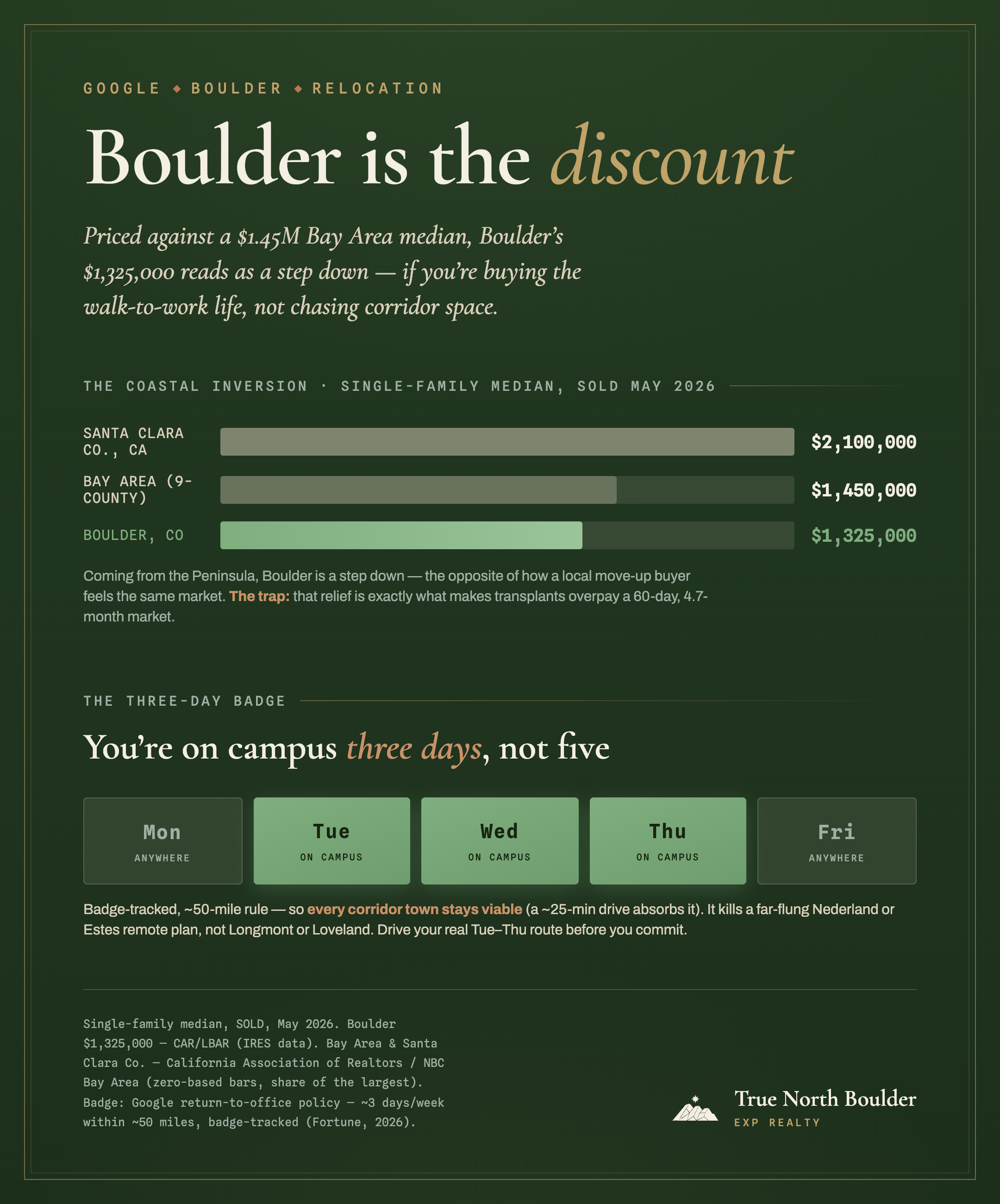
Here's the counterweight, and it's the most valuable sentence in this guide: that same sticker-relief is precisely what makes Bay Area buyers overpay in Boulder. Boulder single-family homes sat near 60 days on market with about 4.7 months of supply in May 2026 (CAR/IRES): a balanced-to-slightly-loose market, not the waive-everything, 20-percent-over reflex of the Peninsula. Walking in with those habits, waiving the inspection and the appraisal gap out of muscle memory, is how you leave real money on a table that would have waited for you. The discount is real. So is the temptation it creates.
What the three-day badge rule does and doesn’t decide
Google expects most staff within about 50 miles of an office three days a week, typically Tuesday through Thursday, badge-tracked, and part of performance review (Fortune, 2026). Every corridor town is inside 50 miles, so the rule keeps Longmont and Loveland viable. It kills a far-flung remote plan, not the corridor.
Don't let the badge talk you into the city. Three fixed days on campus is real, and it does rule out the "we'll basically be remote in the mountains" fantasy. Nederland, Estes Park, or a far Fort Collins address turns a badge requirement into a daily grind. But three days is not five. A short e-bike from Gunbarrel, or a 25-to-35-minute Diagonal drive from Longmont on a Tuesday-through-Thursday peak (test it yourself), absorbs a three-day week without much pain. So the badge keeps the corridor genuinely viable; what it doesn't do is mandate that you buy in Boulder proper. If you buy the walk-to-campus life, buy it because you want that life and the origin-market math makes it affordable, not because a badge forced your hand.
Can you afford to live near the campus, and what does that buy?
Usually yes, but in an attached home. Detached single-family in the walkable central neighborhoods runs above Boulder's $1,325,000 median; the in-band way to buy walk-or-bike-to-work is typically a townhome or condo, with Boulder Junction the newest transit-oriented option. Less space and HOA dues are the trade.
The neighborhoods that put you on foot or a bike to the campus are the central ones, and they price accordingly. Goss-Grove and Whittier are among the most walkable and bikeable in the city, steps from Pearl Street; Newlands and North Boulder give a more residential version of the same short commute. Boulder runs more than 300 miles of bikeway with dozens of underpasses (City of Boulder), and Boulder Junction is a purpose-built transit-oriented district anchored by the RTD Depot Square station and the Flatiron Flyer bus to Denver. For a car-light Google household, that infrastructure is a genuine lifestyle upgrade over a Bay Area freeway commute.
Google Boulder is one central spot by Boulder Junction — so your choice is a lifestyle, not an office
On foot or a bike to Pearl Street. Detached homes run above the $1,325,000 median, so in-band here usually means a townhome or condo.
The newest condos and townhomes, steps from the campus and the RTD Depot Square hub. The car-light option.
Detached space in the band, 15–35 minutes at a Tuesday-to-Thursday peak. The corridor still wins for many households.
Boulder single-family median $1,325,000 — CAR Local Market Update (IRES data), sold, May 2026. Campus at Pearl Place / 30th & Pearl by Boulder Junction (Built In Colorado; Mile High CRE).
The honest limit: detached houses in those central neighborhoods generally sit above the $1,325,000 median, at or past the top of the $800K–$1.5M band. So the realistic in-band way to buy walk-to-work is attached: a townhome or condo, with Boulder Junction offering the newest product. That's a real trade a Bay Area seller of a detached home will feel: less square footage, HOA dues, and an appreciation profile that behaves differently than detached single-family. On newer attached product especially, have your lender run a project warrantability review and check the HOA for pending litigation, reserve health, and special assessments before you commit, because a non-warrantable project can sink your financing. It's a fair trade for the right buyer, but make it on purpose.
About this data
We don't publish a "Boulder Junction median" or a lone walkable-neighborhood price here. Those areas trade too few single-family homes each month for an honest monthly median, and the attached-home figures blend condos and townhomes of very different sizes. The one figure we stand behind is the citywide single-family median, $1,325,000 (CAR Local Market Update, IRES data, sold, May 2026). For an exact address, we'll pull the specific comparable sales rather than quote a neighborhood average that hides the product mix.
For schools, one line matters even for a Boulder-proper buyer: Boulder and Gunbarrel are Boulder Valley (BVSD), while the corridor towns split across St. Vrain and Thompson districts, and boundaries are an address question, not a town one, so confirm the assigned schools before you write an offer. And one risk that isn't only a corridor problem: homes against the foothills and open space on Boulder's west and north sides, including parts of Newlands and North Boulder, carry real wildfire-insurance cost and availability risk after the county's recent fire history, so get an insurance quote before you're under contract.
When does the corridor still win for a Google buyer?
When you want detached space and a yard in the band, when a partner works fully remote so only one income is badge-tethered, or when the numbers matter more than the walk. Then Longmont, Loveland, or [Gunbarrel](/boulder/gunbarrel/) buy more house, and the same out-of-state blind spots apply.
The inversion isn't a blanket rule, and the corridor still wins for a big share of Google households. If you're at the $800K–$1.0M end of the band and want a detached house with a yard, you can't touch that walk-to-campus, and the corridor is the right call, not a compromise. If your partner works fully remote for an out-of-state employer, only one of you is tied to Pearl Street, and corridor space gets easy to justify. And a Google job, like any tech job, can move. Layoffs and campus reshuffles are real, so don't overpay for proximity to one office you might not report to in three years. Buy a home you'd still want if you changed employers.
Lean toward the city if
- You're in the upper band ($1.1M–$1.5M) and both incomes value a walk or bike to Pearl Street.
- You're arriving with equity from a pricier metro and want the car-light life you moved here for.
- You'll accept an attached home to be central.
Lean toward the corridor if
- You want detached space and a yard in the $800K–$1.0M range.
- One partner works fully remote, so only one income is badge-tethered.
- The monthly numbers matter more to you than the commute length.
If the corridor is your answer, the same things you can’t see from out of state (wildfire insurance, radon, floodplain status, and the metro-district mill levy on newer subdivisions) apply exactly as they do for any relocating buyer. Rather than re-map them here, the Ball Aerospace relocation guide walks each one, and the corridor value breakdown covers where the metro-district tax bites.
Buying from out of state without overpaying a slower market
Set up representation and financing before you tour, and reset your Bay Area reflexes. Boulder is a balanced market, so you have inspection, appraisal, and price leverage you didn’t have at home. Consider renting three to six months first; at 4.7 months of supply, the market gives you the time.
The single biggest mistake a Google transplant makes here is buying like it's still the Bay Area. In a market near 60 days on market, you have leverage the coastal seller’s market trained out of you: on inspection, on the appraisal gap, on price. Waiving those protections out of habit is how transplants overpay. Renting for a season to learn the micro-geography is not a failure of nerve; it's the rational move in a market that will wait for you.
On the mechanics: under the 2024 NAR settlement you'll sign a written buyer-agency agreement before touring in person or on a live video call, with compensation negotiable (not set by law) and disclosed up front, and Colorado bans dual agency — so decide early whether you'd be represented as a client or working with a transaction-broker. On financing, the 30-year fixed averaged 6.49% the week of July 9, 2026 (Freddie Mac). If you own a home elsewhere, the sequence question, buy here before selling there, is the same one local move-up buyers weigh, and the buy-before-you-sell guide walks the bridge-versus-contingency math whether your current home is in Mountain View or Seattle.
The one call this move turns on, made with you
We're upfront that our Boulder deal history is still thin, so instead of a closing count, we'll bring a tech transplant our reasoning on the single call this guide is built around. For a Google relocation that means a straight side-by-side: whether the walk-to-campus life pencils against your budget and the market you're leaving, which neighborhoods put you on a bike instead of a freeway, what an attached home actually costs to own once the HOA and warrantability are in, and where the corridor quietly wins for your household. Choose it on your budget, your badge days, and how you want to live, not on a relocation-brochure line about the Boulder dream.
Frequently asked
Is Boulder cheaper than the Bay Area for a Google relocation?+
On a single-family basis, yes. Boulder's single-family median was $1,325,000 in May 2026 (CAR Local Market Update, IRES data), against a record $1.45 million Bay Area single-family median and a $2.1 million median in Santa Clara County the same month (California Association of Realtors; NBC Bay Area). Coming from the Peninsula or South Bay, Boulder reads as a step down in price, the opposite of how a local Boulder move-up buyer experiences the same market. Be wary of any blended, all-property-types 'Boulder median' near $1 million: it folds condos and townhomes into the single-family number and understates a detached house.
Does Google's return-to-office policy change where I should live?+
It sets the floor, not the answer. As of early 2026 Google expects most employees within about 50 miles of an office three days a week, typically Tuesday through Thursday, with attendance badge-tracked and part of performance review (Fortune, 2026). Every corridor town is inside 50 miles, so the rule keeps Longmont or Loveland viable; it's three days, not five. What it does kill is a far-flung 'we'll be mostly remote' plan in Nederland or Estes Park. Drive or bike your real Tuesday route before you commit.
Where is Google's Boulder campus?+
Google's Boulder presence is concentrated in one central-east part of the city: the Pearl Place campus and a newer campus at 30th and Pearl in the Rēve development, next to the Boulder Junction transit district, plus nearby offices on Walnut and Pearl (Built In Colorado; Mile High CRE). At capacity the footprint is planned for roughly 1,500 employees. Unlike a multi-campus employer, there's effectively one commute target here, which is why the search starts with lifestyle, not with picking a campus.
Can I afford to live within biking distance of the Google campus?+
Often yes, but usually in an attached home. Detached single-family in the central walkable neighborhoods (Whittier, Goss-Grove, Newlands, North Boulder) generally runs above Boulder's $1,325,000 single-family median, which puts it at the top of or beyond the $800K–$1.5M band. The way to buy walk-or-bike-to-work inside the band is typically a townhome or condo, with Boulder Junction offering the newest transit-oriented product. That's a real trade: less space, HOA dues, a different appreciation profile than a detached house. Price it with eyes open.
Should I rent first or buy right away when relocating to Boulder?+
You have more time than a Bay Area market taught you to expect. Boulder single-family homes sat around 60 days on market with roughly 4.7 months of supply in May 2026 (CAR/IRES): a balanced-to-slow market, not the waive-everything velocity of the Peninsula. A short rental of three to six months to learn the micro-geography is a defensible move, and it's far cheaper than a six-figure mistake on a neighborhood you didn't understand from a thousand miles away.
What if my partner works fully remote? Does that change the math?+
It can flip it. If only one of you is badge-tethered to the Boulder campus three days a week and the other works fully remote for an out-of-state employer, the household's need to be close to Pearl Street drops sharply. That's often the case where corridor space, a larger home in Longmont, Loveland, or Berthoud for the same money, wins even for a Google household. The walk-to-campus premium is easiest to justify when both incomes value the location.
Keep reading
- Boulder vs Longmont for move-up buyersCity or corridor? The head-to-head, priced by position not town name.
- The Longmont housing marketIf corridor space wins, where that market actually sits for the upper band.
- NiwotA close-in Boulder-County option with more room and SVVSD schools.
- Relocating to Boulder for CUThe other big-employer move, on a fall-start clock and a salary that finances the gap.
- Relocating for NOAA or NISTA federal move, where the clock you don't control changes the whole rent-first calculus.
- Best Boulder neighborhoods for remote workersIf there's no campus at all, the map changes: optimize the parcel, not the position.
Map your Google relocation before you fly out.
Tell us your budget and how you want to live, and we'll send a straight side-by-side: walk-to-campus attached homes versus corridor space, the real ownership math, neighborhood by neighborhood.
External references: Google Boulder careers & location · Freddie Mac Primary Mortgage Market Survey · RTD Flatiron Flyer.
Daniel Hsieh is a licensed Colorado real estate broker with True North Boulder, brokered by eXp Realty. This is independent relocation guidance and is not affiliated with or endorsed by Google. Prices, tax districts, school assignments, and market conditions change; verify specifics for any address before you act.