Relocating to Boulder for a NOAA or NIST Job: Rent, Verify, Then Buy
A NOAA or NIST move is the one Boulder relocation you can neither schedule nor stretch into: the start date slips, the move may be unfunded, and a new hire's income is least protected exactly when they're tempted to buy. So you rent, verify, then buy from strength.
An offer from NOAA or NIST comes with something no private-sector offer does: a start date nobody can quite promise you, landing in a stretch of furlough headlines and return-to-office memos. You took the stable job on purpose, and now wanting a house of all things somehow feels reckless. Here's the reassuring part, and it's real: you may hold the single most stable income a mortgage lender ever underwrites. And here's the honest part: that stability arrives on a delay, and the gap between "the lender loves your income" and "you can actually count on it" is exactly what this guide is about. A federal-science move is unlike every other Boulder relocation in one way that changes the whole plan: you can neither schedule the purchase nor stretch into it, so you rent, verify, and then buy from strength.
Fast facts · relocating for a NOAA/NIST job
Sources: NIST / boulder.doc.gov · FederalPay 2026 (Denver locality) · OPM · as of July 2026
The one Boulder relocation you can't put on a calendar
Not on the schedule you'd pick. The federal hiring pipeline runs two months to over a year, and onboarding plus a background investigation add months more; roles that need a security clearance add six to twelve beyond that. So your start date, and your first real Boulder paycheck, land on a timeline you don't control. You can't responsibly time a home purchase to a date that can slip by a season, so the first move is to rent, not buy.
Most relocations have a clock you can plan around. An academic hire relocating for CU, for instance, knows the job starts in August and can shop the spring market and close ahead of it. A federal-science hire has the opposite: a start date set by a hiring pipeline that routinely takes months, a background investigation and onboarding that add months more, and, for the roles that need one, a security clearance that can add six months to a year on top of that. You can get a tentative offer and still be a season away from your first day, or even from knowing your first day.
That single fact reorders everything. You cannot write an offer, schedule a closing, and line it up against a start date that might move by three months. Try to, and you're either carrying a mortgage on a house in a town you're not yet working in, or scrambling to unwind a contract when the date slips. So the first decision isn't which neighborhood. It's to give yourself a rental runway and refuse to buy against a clock you don't own.
The trap nobody warns a new federal hire about: your first two years
Here's the part a relocation checklist won't tell you, and it's the one that matters most. A new federal employee spends their first one to two years on probation, and a probationary employee has very little protection in a reduction in force, with generally no route to challenge one until they've completed a year of continuous service. You are, in employment terms, the least-protected person in the building until you clear that window.
This isn't abstract in Boulder. In early 2025, roughly 80 staff at Boulder's NOAA office were let go, about ten percent of the office, and probationary employees were among the first out. NIST and other federal offices here saw cuts too. Whatever you make of the politics, the mechanism is what a buyer has to plan around: the income a lender treats as bulletproof is, for a brand-new hire, genuinely exposed.
So hold two true things at once. Federal income, once established, is about as stable as a mortgage underwriter ever sees: decades of tenure, a public pay schedule, near-impossible to fire without cause. And a first-year hire has none of that protection yet. The gap between those two facts is the whole reason you rent first.
Rent and verify: the same word an academic hires on, for the opposite reason
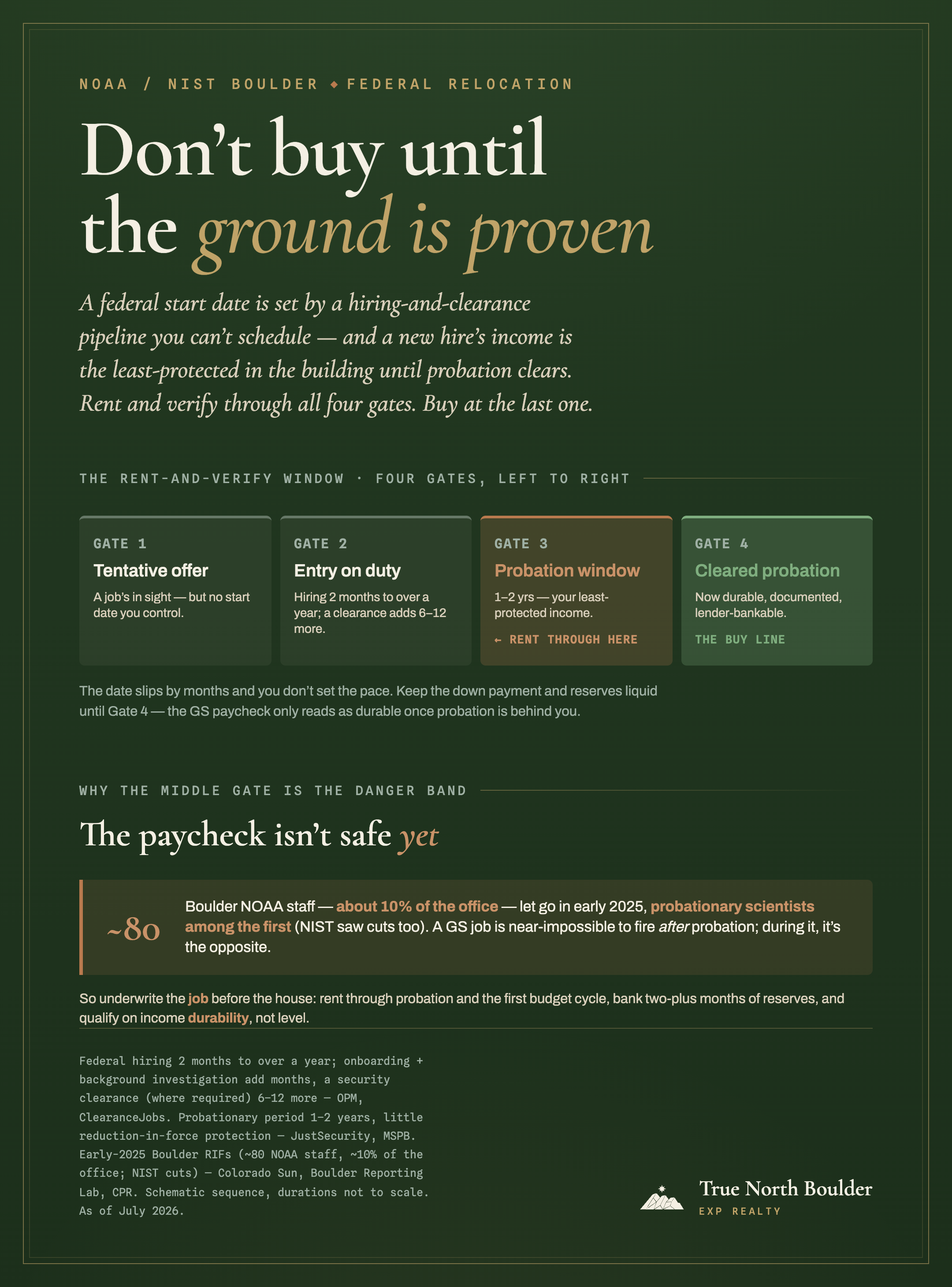
Plenty of relocation advice says "rent first." So does the guide for an academic move. But read why, because the reason is the opposite and it changes what you do. An academic rents to dodge one brutal fortnight, arriving in August into the worst rental crunch and the school-enrollment scramble at once. You rent because the ground itself is unproven: the date is unknowable and your job security is still provisional. One is dodging a bad week. The other is verifying the two biggest variables in the decision before you commit half a million dollars to it.
Renting to verify isn't waiting around. It's an active sequence, and doing it well is most of the game.
While you settle
Rent near the Labs, and keep an exit
South Boulder apartment rents run roughly $1,700 to $2,200; an in-band household renting a single-family home will pay several times that, so pull a live quote for your target block before you size anything. A year or two of that rent stacks on top of the reserves you're keeping liquid. Boulder leases are 12-month standard, so don't chase a custom length you won't get: take the year, but negotiate a month-to-month rollover or an early-termination clause so you can move the moment your file is ready. Plan on renewing at least once, since probation runs one to two years, longer than a single lease.
Keep the down payment and reserves liquid
Hold your down payment and reserves in cash. Two months is the shutdown-era floor, but an $800K–$1.5M Boulder home is a jumbo loan in this county, and jumbo lenders often want six to twelve months of payments in reserve, so bank generously and don't sink it into furniture or a car while you're renting.
Verify the two unknowns
Work through your first government shutdown, and clear, or nearly clear, your probationary window. These are the two variables that decide whether your income is really bankable, and you can only prove them by living them.
Re-engage your lender from strength
Now your income reads as the durable, documented, near-impossible-to-fire paycheck underwriters love, and you buy on that, not on day-one anxiety.
The reward for the patience is concrete: you go from being the most nervous borrower in the room to one of the most bankable, and you do it in about the time it takes to learn which Boulder neighborhoods you'd actually want to live in.
What a government shutdown does to your Boulder mortgage
It can stall one in progress, so build the cushion before you write. In the 43-day shutdown that ended November 2025, Fannie Mae and Freddie Mac issued temporary rules for affected federal borrowers, waiving the 30-day paystub rule and requiring about two months of verified reserves. That guidance expired at reopening, but shutdowns recur, so keep two-plus months of reserves liquid on top of your Boulder down payment.
A shutdown is the federal wrinkle a Boulder listing agent won't think to warn you about. When the government lapsed for 43 days in the fall of 2025, the longest shutdown on record, mortgage underwriting for federal borrowers got harder overnight. Fannie Mae and Freddie Mac issued temporary guidance: they waived the usual rule that a paystub be dated within 30 days of application, and they required lenders to verify roughly two months of reserves for affected borrowers. That specific guidance expired when the government reopened, and there's no live shutdown rule to plan around today.
But the pattern is the point, not any one rule. Shutdowns recur, income verification is exactly what freezes when they hit, and the fix is the same one the rent-and-verify sequence already asks for: keep two or more months of reserves liquid, on top of your down payment, before you go under contract. If the timing is unlucky, that cushion is the difference between a delayed closing and a dead one.
Nobody may pay for your move: budgeting a PCS you might not get
Maybe not, so check your USAJOBS announcement. Federal civilian relocation (PCS) is discretionary, not automatic, and many science and technical postings state plainly that "payment of relocation expenses is not authorized." Unlike a military PCS, there's no default moving allowance or housing. If yours isn't authorized, budget the full move and closing costs yourself. It often comes straight out of the down payment a Boulder purchase needs.
If you're picturing the military version of a government move, with movers booked, housing arranged, and a per-diem while you settle, set it aside. Civilian federal relocation is a different animal. A PCS (permanent change of station) for a civilian hire is discretionary, has to be justified as "in the government's interest," and for a great many science and technical postings simply isn't offered. The USAJOBS announcement will say so in a line most people skim: payment of relocation expenses is not authorized.
Read that line before you build your budget. If your move is unfunded, the cost of getting yourself and your household to Colorado comes out of your own pocket, and in practice it comes out of the same savings that were going to be your down payment. A buyer who assumed a relo package and didn't get one can arrive in Boulder several thousand dollars short of the closing they'd planned. Know which situation you're in before you fall for a house.
Once you clear probation, your income is the strongest thing a lender sees
This is the turn the whole guide has been building toward, so don't lose it in the caution: a settled federal scientist is a tremendous mortgage candidate. The pay schedule is public and predictable, the tenure runs for decades, and the job is famously hard to lose without cause. Underwriters know this. Once you've cleared probation and can show a clean, documented income history, your file is about as strong as they come, and you're buying from a position most Boulder move-up buyers would envy.
That's why the discipline here is timing and reserves, not stretching the number.
This guide fits you if
- You're arriving in the $800K–$1.5M band as a GS-15 or SES scientist.
- You're a dual-federal or dual-income household whose combined pay carries a Boulder mortgage.
- You're bringing equity from a pricier market to close the gap to a Boulder price.
It's a different guide if
- You're a single GS-13 or GS-14. Then the corridor is where your salary buys a home, and this guide points you there.
On the number itself, be honest with yourself about which household you are. A GS-15, a dual-federal-scientist couple, or a transplant arriving with equity from a pricier market can reach Boulder's $800,000–$1.5 million band. If you're bringing equity from a home you're selling elsewhere, we can help you time and finance around that sale even though the sale itself is in another market. A single GS-13 or GS-14, earning real money, roughly $119,000 to $140,000 with locality, generally can't in the city. That's not a knock; it's arithmetic against a median north of $1.3 million.
| Your situation | What it reaches | Commute to 325 Broadway |
|---|---|---|
| Single GS-13–14 (~$119K–$140K) | Corridor: Longmont / Loveland single-family | Longmont ~30 min off-peak, 40–50 in the a.m. rush (the Diagonal lands you in north Boulder; the Labs are far south) / Loveland ~50 min–1 hr |
| GS-15 / SES (~$165K) | In-band Boulder possible, south / central | Bike-to-15 min |
| Dual-federal or dual-income | In-band Boulder | South / central Boulder |
| Equity-rich transplant | In-band Boulder, most of the map | Your pick |
If you're the single-income scientist, the corridor isn't a consolation prize; it's a genuinely good answer. Longmont puts a move-up single-family home well within a GS-13/14 budget and sits about 30 minutes from the Labs off-peak, closer to 40 or 50 in the morning rush (the Diagonal lands you in north Boulder and you cross town to the south-side Labs from there); Loveland stretches your dollar further at 50 minutes to an hour. Our Longmont and Loveland guides show what that money buys. Many Labs scientists choose exactly that trade and are glad they did.
Where the NOAA and NIST Boulder Labs are, and what a listing won't show you
The Labs sit at 325 Broadway, in south Boulder at the foot of the foothills near Table Mesa; NOAA's David Skaggs Research Center and NIST's Boulder campus share the Department of Commerce site. (A note to keep your search clean: NCAR up on the mesa is a university-run lab, not a federal GS employer, and NREL is a Department of Energy site down in Golden. Different jobs, different math, not this guide.) Close-to-work means south and central Boulder, which is also some of the county's priciest ground, the collision that sends most in-band-but-not-flush buyers to weigh the corridor. For the block-by-block on where to live and bike from, our Boulder area guide is the deep version, and the Google relocation guide works through the same bike-to-work trade-offs for a nearby campus.
And a few Boulder costs never appear on a listing and can't be seen from out of state: radon (the county is a high-radon zone), foothills wildfire insurance that's gotten pricey and hard to place, floodplain-by-address, and metro-district mill levies on some newer corridor homes. We lay the whole checklist out in the Ball Aerospace relocation guide; it applies to any northern-Front-Range move, so read it there and bring the questions to your agent.
Underwrite the job before the house
The federal scientists who do this well almost all do the same unglamorous thing: they rent, let the start date and the background check and the probationary year resolve, keep their powder dry through the noise, and buy once their footing is real. That's not caution for its own sake; it's buying from the strongest version of your file instead of the most anxious.
So underwrite the job before you underwrite the house, and let us help you do it. Send us where you stand, whether offer in hand, mid-investigation, or just scoping the move, and we'll map the whole runway with you: what to rent and for how long, how much to hold back for a jumbo file, and the month to re-open the mortgage conversation once probation is behind you. It's a working session on a screen, not a sales call and not a flight you have to book. And if the read this year is "rent, keep your powder dry, and call us when you've cleared," we'll say exactly that and mean it. A renter earns us nothing, which is the whole reason you can trust the advice. True North Boulder is a real-estate team under eXp Realty, independent of those agencies and not affiliated with or endorsed by NOAA, NIST, or the federal government. When your file is bulletproof, we'll be here to put it to work.
Frequently asked
Does NOAA or NIST pay to relocate to Boulder?+
It varies by the specific USAJOBS announcement, and for many science and technical postings the answer is no -- the listing will say 'Payment of relocation expenses (PCS) is not authorized.' Federal civilian relocation isn't automatic the way a military PCS is; it's discretionary, has to be 'in the government's interest,' and new hires frequently receive little or nothing. Read your announcement's relocation line before you budget, and if it's not authorized, plan your move and closing costs assuming zero reimbursement -- that unfunded move often eats the down payment a Boulder purchase needs.
Can I get a mortgage in Boulder during a government shutdown?+
You can, but a shutdown mid-transaction can stall it, so build the cushion in first. During the 43-day shutdown that ended in November 2025, Fannie Mae and Freddie Mac issued temporary guidance for affected federal borrowers -- waiving the usual 30-day paystub-dating rule and requiring lenders to verify roughly two months of reserves. That guidance expires when the government reopens, but shutdowns recur, so the durable lesson stands: before you write an offer, have two-plus months of reserves liquid on top of your down payment, and expect income verification to get harder, not easier, if the timing is unlucky.
Can a GS-13 or GS-14 afford a house in Boulder?+
On one salary, usually not in Boulder itself. With the Denver-area locality adjustment, a GS-13 earns roughly $119,000 and a GS-14 roughly $140,000 -- real money, but Boulder's single-family median runs north of $1.3 million, so a single mid-career scientist is priced into the corridor, not the city. A GS-15 (about $165,000), a dual-federal-scientist household, or a transplant bringing equity from a pricier market can reach the $800,000-$1.5 million band in Boulder. If you're a single GS-13/14, Longmont and Loveland put you in a home your salary actually carries, about 30 to 50 minutes from the Labs.
Where are the NOAA and NIST Boulder Labs, and where should I live?+
NOAA (the David Skaggs Research Center) and NIST share the Department of Commerce Boulder Labs at 325 Broadway, in south Boulder at the base of the foothills near Table Mesa. So the close-to-work neighborhoods are south and central Boulder -- which is also some of the priciest stock in the county. Most in-band buyers weigh that against the corridor: Longmont is about 30 minutes off-peak via the Diagonal (CO-119) but 40 to 50 in the morning rush, since the Diagonal drops you in north Boulder and the Labs sit at the far south end; Loveland runs 50 minutes to an hour. Our Boulder area guide maps the neighborhoods; the trade is proximity now versus a home your salary carries.
Is my federal job stable enough to buy a house in Boulder?+
Federal income is one of the most stable things a lender underwrites -- but that stability is real once you've cleared probation, and a brand-new hire is the least-protected person in the building. In early 2025, roughly 80 staff at Boulder's NOAA office were let go, many of them probationary, and NIST saw cuts too. That's not a reason never to buy; it's a reason not to buy at the top of your pre-approval during your probationary window. Rent, clear probation, keep your reserves liquid, and buy from strength once your income durability is proven.
About these numbers — and why this guide is dated
This guide is written to a fast-moving federal picture, and it's dated on purpose. The GS locality figures, the mortgage-rate environment, and the hiring and clearance timelines are as of July 2026. The 2025 shutdown's mortgage-relief rules are expired precedent, cited to show what a future shutdown can trigger, not a live rule you can plan around today.
The early-2025 Boulder RIF figures, roughly 80 NOAA staff, about ten percent of the office, are reported conditions from local news, not our own account. We refresh this piece when a new shutdown, RIF, or return-to-office change lands, because on a decision this size a stale federal fact is worse than none.
The bottom line
You can't schedule a federal start date or stretch a probationary paycheck. Rent near the Labs, verify the ground, keep your reserves liquid, and buy once your income is the strongest thing in the room.
Sources & data notes
- This guide is independent and not affiliated with, or endorsed by, NOAA, NIST, or the federal government. Confirm your specific terms against your USAJOBS announcement and offer.
- The Labs: NOAA (David Skaggs Research Center) and NIST share the Department of Commerce Boulder Labs at 325 Broadway, south Boulder. boulder.doc.gov; NIST "Getting to Boulder."
- Hiring + clearance timelines: federal hiring runs two months to over a year; onboarding and a background investigation add months, and a security clearance (where required) six to twelve more. OPM; ClearanceJobs. As of July 2026.
- Probation: new federal employees serve a one-to-two-year probationary period with little protection in a reduction in force. JustSecurity; U.S. Merit Systems Protection Board (MSPB).
- 2025 Boulder RIFs: roughly 80 NOAA-Boulder staff (about ten percent of the office) let go in early 2025, with NIST cuts reported. Colorado Sun; Boulder Reporting Lab; CPR.
- Shutdown mortgage guidance: during the 43-day shutdown that ended November 2025, Fannie Mae and Freddie Mac issued temporary guidance waiving the 30-day paystub rule and requiring roughly two months of reserves (now expired). Fannie Mae LL-2025-03.
- GS pay: Denver-locality GS-13 ~$119K, GS-14 ~$140K, GS-15 ~$165K (2026). FederalPay 2026 (Denver-Aurora-Lakewood locality).
- Boulder prices: single-family median north of $1.3M (single-family, sold). CAR/LBAR Local Market Update (IRES data) via our Boulder market report.
- Rents: south Boulder apartments run roughly $1,700–$2,200 (1–2 BR); a single-family rental runs materially higher. Zumper / RentCafe south-Boulder neighborhood reads, July 2026 (small sample, so a range rather than a point).