Relocating to Boulder for a CU Job: A Timing Guide
A CU job is the one Boulder relocation where the offer letter sets both your move-in date and your budget, and both work against you. So the first smart housing move isn't where to buy. It's when.
You took a job at CU, and somewhere between the congratulations and the moving quotes you opened a Boulder real-estate tab and felt the floor tilt. The town you spent a career aiming for, the one that finally said yes, doesn't clear on the salary that brought you here. That feeling is real, and it's nearly universal among people who move here for the university. So before it turns into a 1 a.m. argument with your spouse about whether the job was worth it, let's turn it into a plan. Relocating for CU differs from relocating for Google or Ball or Medtronic in one specific way, and that difference decides everything: your offer letter sets both your move-in date and your budget, and it sets them against you.
Fast facts · relocating for a CU job
Sources: CU Faculty Affairs (appointments) · CU Treasurer (FHAP) · BVSD 2026-27 calendar · univstats (CU salary) · CAR/LBAR (IRES) via our Boulder market report · as of March 2026
The four other big-employer relocations we write about all answer the same question: where do you buy for the best value? For a CU hire, where is the second question. The first is when, and the reason is the gap.
Your CU offer decides two things before you do: your date and your budget
Here's the honest starting point, and it's structural, not personal. Boulder is the one place your CU offer letter will not, on its own, buy you a single-family home. That's true of nearly every full professor, and it's not a comment on your worth or your work. A full professor at CU earns, on average, somewhere in the mid-$100,000s. On salary alone, that qualifies for roughly a $650,000 to $750,000 mortgage. Boulder's single-family median has been running north of $1.3 million. The math simply does not reach the $800,000 to $1.5 million move-up band on an academic paycheck, and no amount of budgeting closes a gap that size.
So who actually buys in-band after a CU move? Two kinds of household, and it's worth being precise, because the whole plan depends on which one you are. The first is equity-rich: you're selling a home in a pricier market, a coastal metro or another expensive college town, and you're bringing real equity to close the gap. The second is dual-income: a trailing professional spouse or partner whose earnings, added to the CU salary, carry the mortgage that $160,000 alone can't. If you're neither, if one academic income is all there is and no big equity sits behind it, this guide will be honest with you in a minute about the corridor towns your salary genuinely reaches. But if you're one of the two, the rest of this is your playbook.
This guide fits you if
- You're arriving in the $800K–$1.5M band as senior or endowed faculty, or as a dean or senior administrator.
- You're selling a home in a pricier market and bringing that equity to close the gap.
- A second household income joins the CU salary to carry a Boulder mortgage.
It's a different guide if
- One academic income has to reach Boulder city on its own. Then the corridor towns your salary does reach are the honest answer, and this guide points you to them.
Whichever household you are, the same two facts frame the move, because your offer letter fixed both of them before you had any say. Here's what it decided for you.
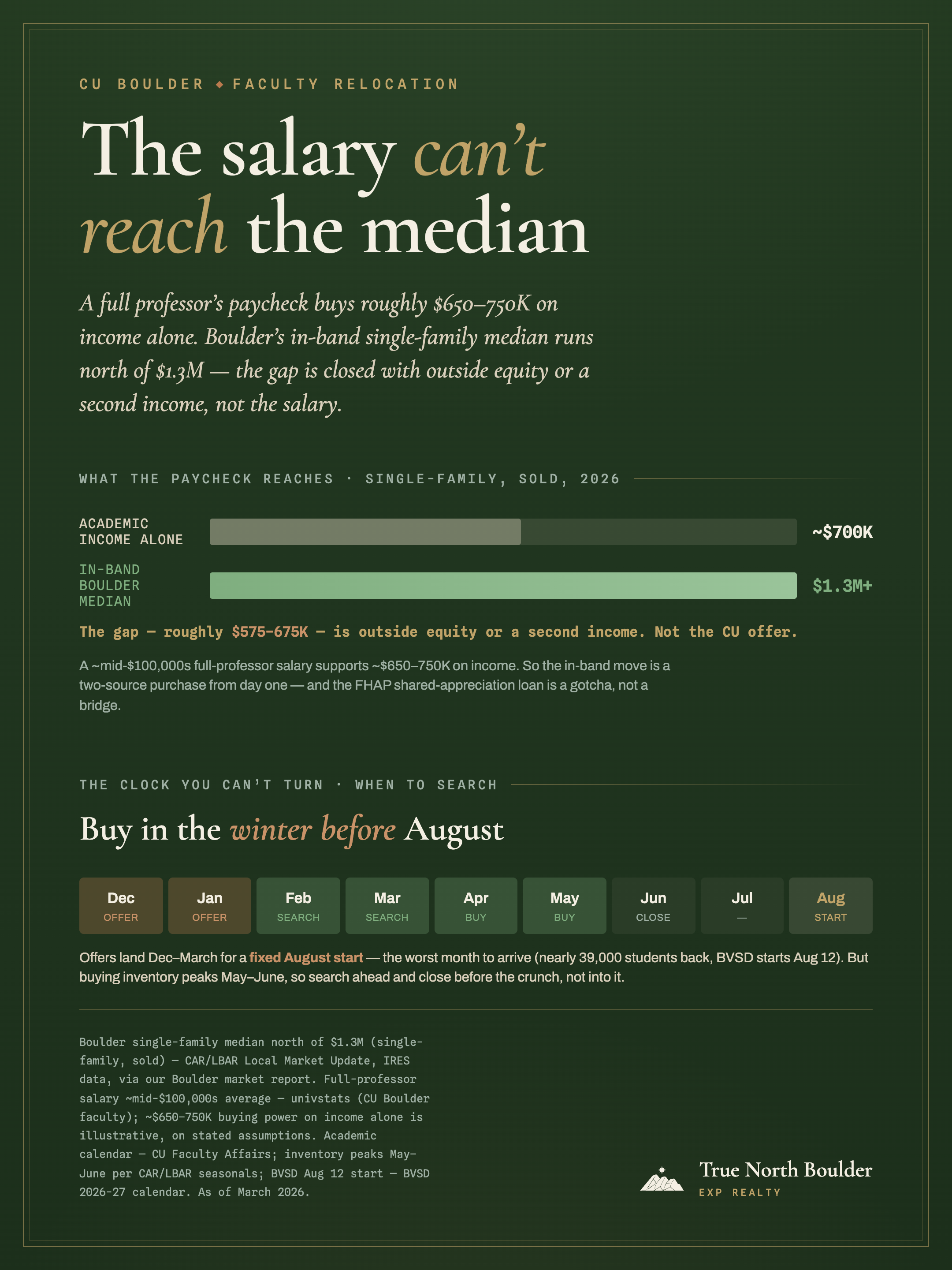
Neither dial is yours to turn. The academic calendar is fixed and the median is the median. What you can decide is when you meet the clock and how you meet the budget, and those two decisions are the whole rest of this guide.
Why an August start is a housing problem, and which half actually hurts
Not for buying, actually. Boulder's for-sale inventory peaks in late spring and thins through fall, so an August buyer often has leverage, not scarcity. What August punishes is renting: nearly 39,000 CU students return in August and September, making it the tightest, priciest month to land a short-term or bridge rental. The pain is the rental side, and it's real.
A lot of relocation advice will tell you August is the worst month to buy in a college town. It isn't, and getting this right matters, because the fix depends on it. Boulder's for-sale inventory actually peaks in late spring and declines through the fall, bottoming out in November and December. An August buyer is shopping a post-peak, thinning market, which, if anything, hands a prepared buyer a little leverage.
The part of August that genuinely hurts is the rental market. Nearly 39,000 students come back to CU in August and September, and they take the short-term inventory with them. If your plan is "we'll land in August and rent while we look," you've picked the single hardest month of the year to find a bridge rental at a sane price. And you're hunting for it during the same two weeks you're prepping a syllabus and enrolling kids in school. That's the collision. Not August the buying month. August the everything-at-once month.
The move: start the search the prior winter or spring, buy ahead of the report
Back the housing timeline up to the offer, not the start date. Faculty offers typically land December through March, early enough to shop Boulder's spring inventory peak and close before the August report date, arriving to a house that's already yours. If your offer comes too late to do that without rushing, rent one academic year and buy the following winter, on your clock. That's the calmest version of this move.
The answer to a fixed August report date is to stop treating August as your search window. Junior tenure-track offers usually land between December and March, which is early enough to do this calmly. Senior, endowed, and administrative searches often close later into the spring, and if yours does, the one-year rental below isn't the fallback, it's the plan. Either way, your offer, not your start date, is the real starting gun.
Dec–March · offer in hand
Start the search now, not in summer
Your offer is the real starting gun, not your start date. Get pre-approved on the full picture (academic income, outside equity, and any second income) so you know your true number before you shop.
Spring
Shop Boulder's inventory peak
For-sale inventory peaks in May and June. Work with a local agent doing video tours you can act on from out of state, so distance isn't what costs you the house. (Touring, even by video, starts with a short written buyer-agency agreement; the terms and commission are negotiable, not set by law.)
Late spring / early summer
Go under contract and close ahead of the report date
Close before August, so the report date is a moving day, not the day you start a house hunt.
August
Arrive to a home that's already yours
Teach, enroll the kids, and unpack, without a seven-figure decision stacked on top of your first weeks on the job.
If your offer lands too late
Fall back to a one-year rental
Rent one academic year and buy the following winter, in Boulder's November–December inventory trough, on your own clock instead of the university's.
If your offer arrives too late in the spring to pull that off without white-knuckling it, take the fallback and don't feel bad about it: rent for one academic year, and buy the following winter. Yes, that's us telling you to rent, knowing a broker earns nothing on a renter. We'd still rather you make the biggest purchase of your life in a November you chose than an August the university chose for you. The report-date buy, made in the most overloaded fortnight of the year, is the version of this move we'd most caution a client against.
Financing a Boulder price on an academic salary: the equity bridge
Because the gap is closed with equity or a second income rather than a big W-2, a CU move-up purchase is really an equity-timing exercise, and it has a few tripwires an out-of-state buyer can't see coming.
The first is the contingency, and how much it costs you depends on the market you land in. In a hot seller's market, an offer contingent on a home you haven't sold loses to buyers sitting on cash. But Boulder's single-family market has been more balanced than that reputation, and the $800K–$1.5M band is the more liquid slice of it, so on a well-priced in-band home that's already sat a while, a clean, well-structured contingency can be accepted. It's also worth knowing the difference between a home-sale contingency (you still have to sell) and a home-settlement one (your sale is already under contract, just not closed). The settlement version is far stronger and often dissolves the whole problem without a loan. Still, from 1,000 miles away the safest play is usually to arrive liquid or get bridge-approved so a financing wrinkle can't cost you the house. We walk through all of it, current conditions included, in our bridge-loan versus sale-contingency guide, the mechanical companion to this section.
The second is how the income reads to an underwriter. A nine-month academic appointment, startup funds, summer salary, and a partner's income don't always fit a lender's standard boxes cleanly. None of it is disqualifying. But confirm your liquid down payment and get fully underwritten before you write, so a financing wrinkle doesn't surface the week you're trying to win a house from 1,000 miles away. And note that a bridge loan isn't automatic either: the lender underwrites you carrying both homes, and a nine-month academic income can make that math tight, which is one more reason to get the full picture priced before a house wins you over.
Does CU help you buy? The FHAP, and when to decline it
Here's a piece of local knowledge no relocation blog will hand you: CU runs a Faculty Housing Assistance Program. It's a shared-appreciation down-payment loan of up to $80,000, essentially interest-free, offered to tenure and tenure-track faculty through Elevations Credit Union, with a loan-guarantee option alongside it. For the right household it's a genuine leg up.
But the broker read is the caution, not the cheer.
The broker read on FHAP
If you already have the down payment, model FHAP both ways before you take it. It's tenure-track only, and it's shared-appreciation, so on an $80,000 sliver of a $1.2 million purchase, in a market that compounds like Boulder's, the appreciation you hand back can dwarf the interest you saved. If it's the difference between buying and not, it's a real gift. If it isn't, the "free" money can cost more than it saves.
Model it both ways with your lender before you sign. If FHAP is what makes the purchase possible, it's a real gift. If you have the down payment anyway and you're taking it because it's offered, you may be handing CU a share of Boulder appreciation you never needed to give up.
Schools are a winter decision, not an August one
Sooner than you'd expect, often before you even have keys. BVSD's on-time choice-enrollment window for 2026-27 ran November 1, 2025 to January 7, 2026, and placement is a lottery, not first-come. Miss it and you're on waitlists, with your neighborhood-boundary school as the fallback. So for a mid-year CU offer, the boundary school attached to the house you buy often is the school decision.
If you have kids, this is the input that quietly reorders your whole search, and it's the one you can't see from out of state. Boulder Valley School District runs on choice enrollment, a lottery rather than first-come, and its on-time window for the 2026-27 year ran from November 1, 2025 to January 7, 2026. If your CU offer landed in February or March for an August start, you've already missed the on-time lottery. You can still apply on a rolling basis, but you're on waitlists, and the realistic fallback is your neighborhood-boundary school.
Which means, for most mid-year academic arrivals, the boundary school attached to the house you buy is your school decision. The link between boundary and price isn't a footnote here, it's a driver. Confirm the assigned schools for the exact address before a house wins you over, and know that district lines don't follow the map you'd guess: Niwot, for all its Boulder-area feel, is St. Vrain, not Boulder Valley, while neighboring Gunbarrel is Boulder Valley. Verify by address, every time.
Which campus are you actually reporting to?
"Close to campus" is a single answer for a Google hire, because there's one office. CU is two work sites on opposite sides of town, so pin your building before you pin a neighborhood.
| Your CU work site | Where it is | Bike/commute-friendly areas |
|---|---|---|
| Main Campus (Norlin Quad, most departments, JILA / Duane Physics) | Central Boulder, off Broadway/Baseline | Table Mesa and south Boulder, Martin Acres, central Boulder; University Hill nearest (dense short-term rentals, high noise and tenant turnover to weigh) |
| East Campus / CU Research Park (SEEC, LASP / Space Science, aerospace and research institutes) | East Boulder, off Foothills Pkwy & Arapahoe | East Boulder, Gunbarrel; a shorter reverse-commute from the corridor |
A humanities professor teaching on Main Campus and an aerospace engineer at a Research Park lab do not have the same commute, and they shouldn't shop the same neighborhoods. For the block-by-block on Boulder's neighborhoods, our Boulder area guide is the deep version; if you'll be bike-commuting, our Google relocation guide works through the same walk-and-bike-to-work trade-offs (for a different campus, but the logic transfers). Start there once you know which side of town is yours.
And if the honest answer is that one academic income doesn't reach Boulder city at all, that's not a dead end. It's a different map. On a single academic salary, the corridor is where your budget actually stretches to a house: a $650,000-to-$750,000 range reaches the entry-to-mid single-family stock in Longmont and Loveland, not their move-up tier, and plenty of CU staff commute in happily from there. Start with our Longmont and Loveland guides to see what that budget buys. (If you're the equity-rich or dual-income buyer weighing corridor value against Boulder, our what $1M–$1.5M buys across the corridor guide is the in-band comparison.) And if a federal lab rather than a faculty post is what's bringing you, our NOAA and NIST guide runs a very different, and far less predictable, clock.
The blind spots your offer letter won't mention
A few Boulder-specific costs never show up on a listing, and from out of state you can't see any of them coming, though they can move a budget by real money. Boulder County sits in EPA Radon Zone 1, so budget a test and likely mitigation. Foothills wildfire insurance has gotten materially pricier and harder to place at all. Flood risk is assigned parcel by parcel, and a newer corridor home can sit inside a metro district that quietly adds mills to the tax bill. We break these down in the Ball Aerospace relocation guide, since the same checklist applies to any northern-Front-Range move. Rather than repeat it, read it there and bring the questions to your agent.
Starting the file a year before you start the job
The people who move here for CU and love it a year later almost all have one thing in common: they started early and refused to let the offer letter pick their house. That's the whole play. You don't need to be ready to buy to start. You need a read on the market, the school clock, and your own financing months before the truck is booked.
That's the kind of file we like to open early. If your CU offer is signed or close, tell us your target start date and which campus you'll report to, and we'll build you a realistic relocation timeline over the phone or a video call, since you probably can't keep flying out to look. If the honest advice that day is to rent for a year, that's the advice you'll get, because on a fall-start clock the rushed August purchase is the expensive mistake this whole guide is written to prevent. True North Boulder is a real-estate team under eXp Realty. We're independent and not affiliated with or endorsed by the University of Colorado, and helping you not rush is exactly where the relationship starts.
Frequently asked
When should I start house-hunting if my CU job starts in August?+
Earlier than the offer feels like it allows -- ideally the winter or spring before your August start, not the summer of the move. Two clocks are against an August arrival, and neither is the buying market: the student-return rental crunch (nearly 39,000 students come back in August and September, the worst window to land a short-term rental) and BVSD's mid-August school start, which in 2026 is August 12. Boulder's for-sale inventory actually peaks in late spring and thins through fall, so the winning move is to shop into that spring peak and close ahead of the report date, rather than arrive in August to fight for a rental and pick over what's left. If your offer lands too late to do that calmly, rent one academic year and buy on your own clock.
Does CU Boulder help faculty buy a home?+
Yes, through the Faculty Housing Assistance Program (FHAP): a shared-appreciation down-payment loan of up to $80,000, essentially interest-free, offered to tenure and tenure-track faculty via Elevations Credit Union, plus a loan-guarantee option. It is real and, for the right household, genuinely useful. But read the fine print before you take it: it's open to tenure and tenure-track faculty only (so it excludes many of the deans, administrators, and dual-income staff households who make up the in-band buyers), and it is shared-appreciation -- meaning CU takes a slice of your home's gains. In a market that compounds the way Boulder's has, handing over a share of appreciation on an $80,000 sliver of a $1.2 million purchase is often a poor trade for a buyer who already has the down payment. Model it both ways before you sign.
Rent or buy when you relocate for a CU faculty job?+
For many in-band CU hires, the right first move is to rent for one academic year -- and we say that knowing we earn nothing on a renter. The report-date purchase, the one made in the two most overloaded weeks of an August arrival, is the classic regret of an academic relocation. Renting one cycle converts a forced August buy into a chosen winter or spring one, when you know the neighborhoods, the school assignment, and your own commute. If you can start the search the prior spring and close ahead of the report, buying first is fine. If you can't, rent, then buy on your clock.
How much does a house near CU Boulder cost, and can a professor afford it?+
Boulder's single-family median has run north of $1.3 million (single-family, sold; basis and current figure in our Boulder market report). A full professor's salary at CU averages around the mid-$100,000s, which on income alone supports roughly a $650,000-$750,000 mortgage -- so a CU paycheck, by itself, does not reach Boulder's move-up band. That's true of nearly every full professor and is not a comment on any one buyer. The faculty who do buy in-band close the gap two ways: outside equity from a home sold in a pricier market, or a second household income. If neither applies, the corridor towns your salary does reach are the honest answer.
Which Boulder neighborhoods let me bike or walk to CU campus?+
It depends which CU you report to -- there are really two work clusters on opposite sides of town. Main Campus sits in central Boulder, so Table Mesa, south Boulder, Martin Acres, and the central neighborhoods put you within a bike commute; the University Hill blocks nearest campus are dense short-term rentals, with high noise and tenant turnover to weigh. East Campus and the CU Research Park are east, off Foothills Parkway and Arapahoe, which shifts the answer toward east Boulder and Gunbarrel. For the block-by-block, our Boulder area guide covers the neighborhoods in detail; if you'll bike to work, our Google relocation guide works through the same walk-and-bike trade-offs for a different campus.
About these numbers (and the ones we won't print)
This guide is deliberately light on live price figures. It's written to be read year-round, and a median printed in one month is stale by the next, so where a number matters we give the basis and window and point to our Boulder market report for the current single-family figure.
We also won't pretend a CU salary buys Boulder. The salary-versus-median gap is the honest center of this piece, not a number to dress up. Boulder single-family median: north of $1.3M (single-family, sold; see the Boulder report). CU full-professor salary: mid-$100,000s on average (published figures). Both are used for the relationship, not to the decimal.
The bottom line
You can't change your start date or the median. Start the file early, buy ahead of the report, and don't let the university's calendar choose your house.
Sources & data notes
- This guide is independent and not affiliated with, or endorsed by, the University of Colorado. Confirm your specific appointment terms with your offer letter.
- Appointment calendar: fall appointments start in August, spring in January, with no mid-year flexibility for tenure-track roles. CU Faculty Affairs, as of March 2026.
- Faculty Housing Assistance Program (FHAP): a shared-appreciation down-payment loan of up to $80,000, essentially interest-free, for tenure and tenure-track faculty via Elevations Credit Union. CU Treasurer, as of March 2026.
- Schools: BVSD 2026-27 on-time choice-enrollment window ran November 1, 2025 – January 7, 2026 (a lottery, not first-come); school starts August 12, 2026. Boulder Valley School District, as of March 2026.
- Salary: CU full-professor salary averages around the mid-$100,000s. univstats (CU Boulder faculty salary).
- Enrollment: CU Boulder total enrollment is nearly 39,000 students. CU Boulder Fast Facts, 2025-26.
- Boulder prices: single-family median north of $1.3M (single-family, sold). CAR/LBAR Local Market Update (IRES data) via our Boulder market report.
- Radon: Boulder County is an EPA Radon Zone 1 area. EPA Map of Radon Zones. Budget a test and likely mitigation.